Department of Infectious Disease, Beijing Tiantan Hospital, Capital Medical University, Beijing, China.
Department of Geriatric Medicine, Shandong Provincial Third Hospital, Cheeloo College of Medicine, Shandong University, Jinan, Shandong Province, China.
Biomed Res Int. 2021 Mar 18;2021:5539304. doi: 10.1155/2021/5539304. eCollection 2021.
Inflammation is one of the key mechanisms involved in functional impairment after stroke. Intercellular adhesion molecule-1 (ICAM-1) is an important inflammatory molecule in the body. The purpose of our study was to determine the correlation between ICAM-1 and the prognosis of acute ischemic stroke (AIS).
286 AIS patients treated at Beijing Tiantan Hospital were continuously included in the study. The demographic data of the patients were collected, and the fasting blood within 24 hours of admission was collected to detect the clinical indicators. The functional prognosis was measured using the modified Rankin Scale (mRS) 3 months after stroke. The poor prognosis is defined as mRS ≥ 3. The enzyme-linked immunosorbent assay (ELISA) was used to determine the serum ICAM-1 levels.
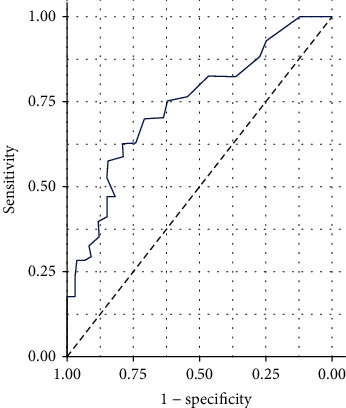
The serum ICAM-1 levels of patients with poor prognosis were significantly higher than that of patients with good prognosis (144.2 ± 14.8 vs 117.5 ± 12.1 pg/ml). Receiver operating characteristic curve (ROC) analysis showed that the sensitivity and specificity of serum ICAM-1 for predicting the prognosis of AIS were 74% and 76%, respectively. In logistic regression analysis, the serum ICAM-1 level is still an independent predictor of poor prognosis (odds ratio [OR]: 0.52; 95% confidence interval [CI]: 0.318-0.839).
Higher serum ICAM-1 levels on admission in AIS patients might increase the risk of poor prognosis.
炎症是中风后功能障碍的关键机制之一。细胞间黏附分子-1(ICAM-1)是体内重要的炎症分子。本研究旨在探讨 ICAM-1 与急性缺血性脑卒中(AIS)预后的相关性。
连续纳入北京天坛医院收治的 286 例 AIS 患者。收集患者的人口统计学数据,并采集入院 24 小时内的空腹血,检测临床指标。采用改良 Rankin 量表(mRS)评估卒中 3 个月后的功能预后。预后不良定义为 mRS≥3。采用酶联免疫吸附试验(ELISA)测定血清 ICAM-1 水平。
预后不良患者的血清 ICAM-1 水平明显高于预后良好患者(144.2±14.8 比 117.5±12.1 pg/ml)。受试者工作特征曲线(ROC)分析显示,血清 ICAM-1 预测 AIS 预后的敏感性和特异性分别为 74%和 76%。Logistic 回归分析显示,血清 ICAM-1 水平仍是预后不良的独立预测因子(比值比 [OR]:0.52;95%置信区间 [CI]:0.318-0.839)。
AIS 患者入院时较高的血清 ICAM-1 水平可能增加预后不良的风险。