Sicinski Kathleen M, Montanari Vittorio, Raman Venkata S, Doyle Jamie R, Harwood Benjamin N, Song Yi Chi, Fagan Micaella P, Rios Maribel, Haines David R, Kopin Alan S, Beinborn Martin, Kumar Krishna
Department of Chemistry, Tufts University, Medford, Massachusetts 02155, United States.
Molecular Cardiology Research Institute, Tufts Medical Center, Boston, Massachusetts 02111, United States.
ACS Cent Sci. 2021 Mar 24;7(3):454-466. doi: 10.1021/acscentsci.0c01237. Epub 2021 Feb 15.
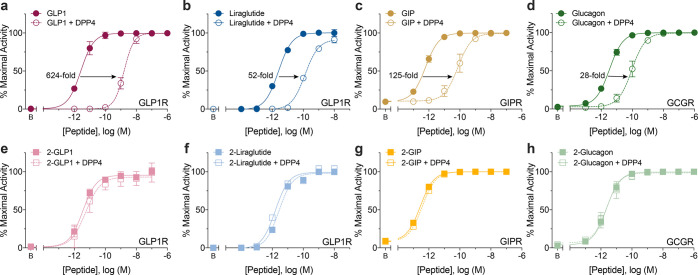
The gut-derived incretin hormone, glucagon-like peptide-1 (GLP1), plays an important physiological role in attenuating post-prandial blood glucose excursions in part by amplifying pancreatic insulin secretion. Native GLP1 is rapidly degraded by the serine protease, dipeptidyl peptidase-4 (DPP4); however, enzyme-resistant analogues of this 30-amino-acid peptide provide an effective therapy for type 2 diabetes (T2D) and can curb obesity via complementary functions in the brain. In addition to its medical relevance, the incretin system provides a fertile arena for exploring how to better separate agonist function at cognate receptors versus susceptibility of peptides to DPP4-induced degradation. We have discovered that novel chemical decorations can make GLP1 and its analogues completely DPP4 resistant while fully preserving GLP1 receptor activity. This strategy is also applicable to other therapeutic ligands, namely, glucose-dependent insulinotropic polypeptide (GIP), glucagon, and glucagon-like peptide-2 (GLP2), targeting the secretin family of receptors. The versatility of the approach offers hundreds of active compounds based on any template that target these receptors. These observations should allow for rapid optimization of pharmacological properties and because the appendages are in a position crucial to receptor stimulation, they proffer the possibility of conferring "biased" signaling and in turn minimizing side effects.
肠道来源的肠促胰岛素激素胰高血糖素样肽-1(GLP1)在减轻餐后血糖波动方面发挥着重要的生理作用,部分原因是它能增强胰腺胰岛素分泌。天然的GLP1会被丝氨酸蛋白酶二肽基肽酶-4(DPP4)迅速降解;然而,这种30个氨基酸的肽的酶抗性类似物为2型糖尿病(T2D)提供了一种有效的治疗方法,并且可以通过在大脑中的互补功能抑制肥胖。除了其医学相关性外,肠促胰岛素系统还为探索如何更好地分离同源受体上的激动剂功能与肽对DPP4诱导降解的敏感性提供了一个丰富的领域。我们发现,新型化学修饰可以使GLP1及其类似物完全抵抗DPP4,同时完全保留GLP1受体活性。该策略也适用于其他治疗性配体,即靶向促胰液素受体家族的葡萄糖依赖性促胰岛素多肽(GIP)、胰高血糖素和胰高血糖素样肽-2(GLP2)。这种方法的通用性基于任何靶向这些受体的模板提供了数百种活性化合物。这些观察结果应该能够快速优化药理特性,并且由于这些附加基团处于对受体刺激至关重要的位置,它们提供了赋予“偏向性”信号传导并进而最小化副作用的可能性。