Department of Health and Nursing, Katholische Stiftungshochschule München, Munich, Germany.
PLoS One. 2021 Apr 1;16(4):e0249457. doi: 10.1371/journal.pone.0249457. eCollection 2021.
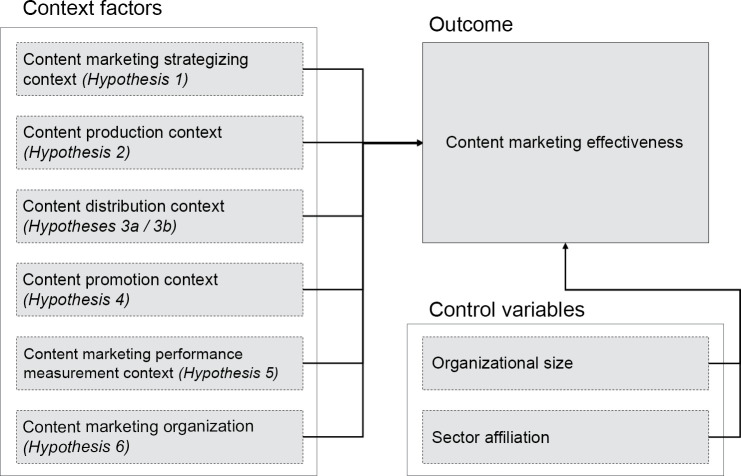
Content marketing has gained momentum around the world and is steadily gaining importance in the marketing mix of organizations. Nevertheless, it has received comparatively little attention from the scientific community. In particular, there is very little knowledge about the effectiveness, optimal design and implementation of content marketing. In this study, the authors conceptualize content marketing as a set of activities that are embedded in and contingent on the specific organizational context. Based on this framework, the authors empirically investigate the context features determining content marketing effectiveness from a managerial perspective, using primary data collected from senior marketers in 263 organizations from various sectors and across different size categories, conducting multiple regression analysis. The empirical results indicate that clarity and commitment regarding content marketing strategy and a content production in line with the organization's target groups' content needs as well as normative journalistic quality criteria are context factors associated with higher content marketing effectiveness. The outcomes also reveal that regularly measuring content marketing performance and using the data obtained as guidance for improving content offerings positively influence content marketing effectiveness, as do structural specialization and specialization-enabling processes and systems. The insights provided in this study could offer important theoretical contributions for research on content marketing and its effectiveness and may help practitioners to optimize the design and implementation of content marketing initiatives.
内容营销在全球范围内迅速兴起,在组织的营销组合中逐渐占据重要地位。然而,它在科学界却受到的关注相对较少。特别是,关于内容营销的有效性、最佳设计和实施,我们知之甚少。在本研究中,作者将内容营销概念化为一组活动,这些活动嵌入并取决于特定的组织背景。基于这一框架,作者从管理的角度,使用从 263 家来自不同部门和不同规模类别的组织的高级营销人员收集的主要数据,进行了多元回归分析,实证研究了决定内容营销有效性的情境特征。实证结果表明,内容营销策略的明确性和承诺、与组织目标群体的内容需求以及规范性新闻质量标准一致的内容制作,以及定期衡量内容营销绩效并将获得的数据用于指导改进内容产品,这些都是与更高的内容营销效果相关的情境因素。研究结果还表明,结构专业化以及支持专业化的流程和系统,对内容营销效果也有积极影响。本研究提供的见解可以为内容营销及其有效性的研究提供重要的理论贡献,并帮助实践者优化内容营销活动的设计和实施。