Department of Epidemiology and Biostatistics, and Centre for Clinical Big Data Statistics, Second Affiliated Hospital, Zhejiang University College of Medicine, 866 Yuhangtang Road, Hangzhou, 310058, China.
Department of Infection Control, Wenzhou people's Hospital, Wenzhou, China.
BMC Infect Dis. 2021 Apr 1;21(1):313. doi: 10.1186/s12879-021-06014-w.
Currently, the association of nutritional risk screening score with the development of nonventilator hospital-acquired pneumonia (NV-HAP) is unknown. This study investigated whether nutritional risk screening score is an independent predictor of NV-HAP.
This retrospective cohort study was conducted between September 2017 and June 2020 in a tertiary hospital in China. The tool of Nutritional Risk Screening 2002 (NRS-2002) was used for nutritional risk screening. A total score of ≥3 indicated a patient was "at nutritional risk." Logistic regression was applied to explore the association between the NRS score and NV-HAP.
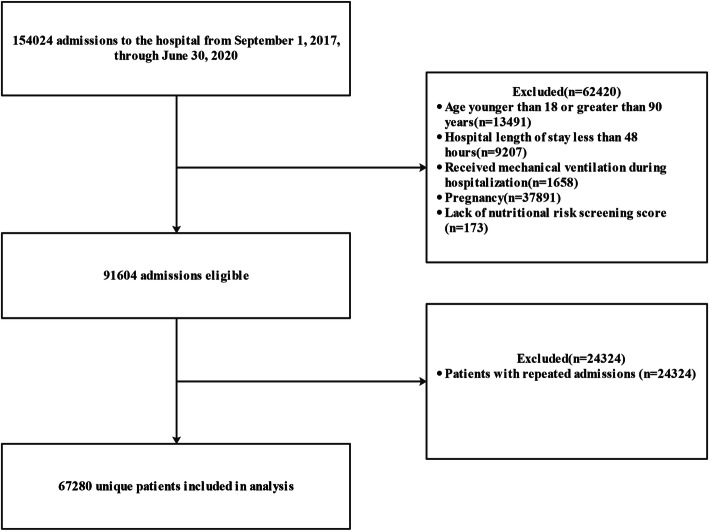
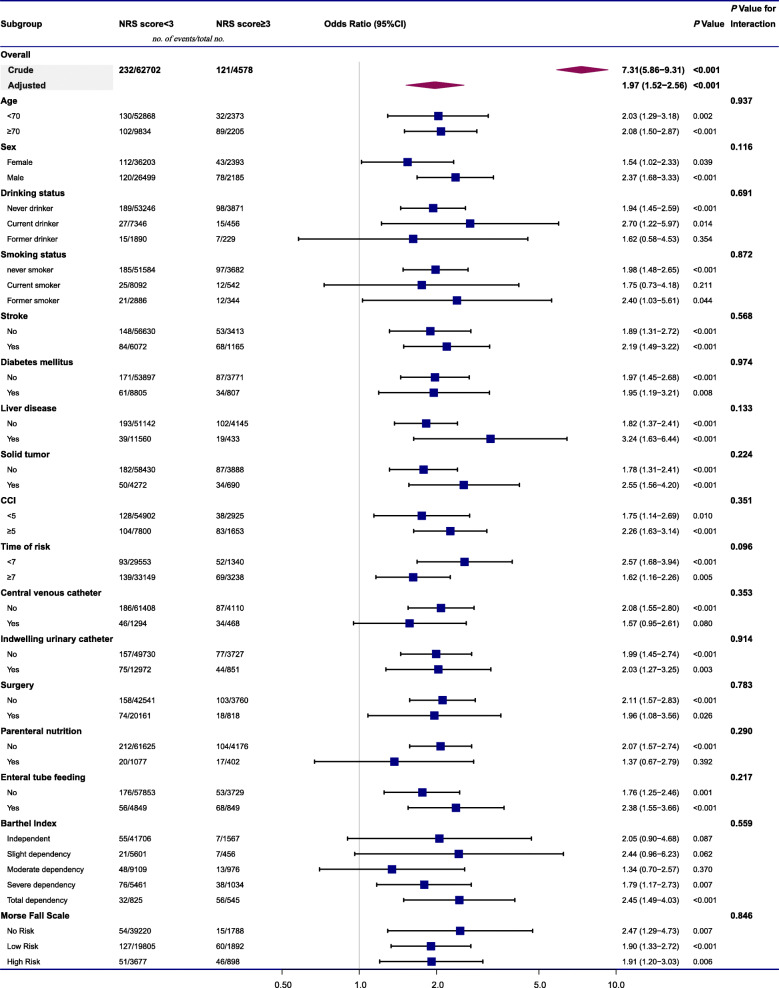
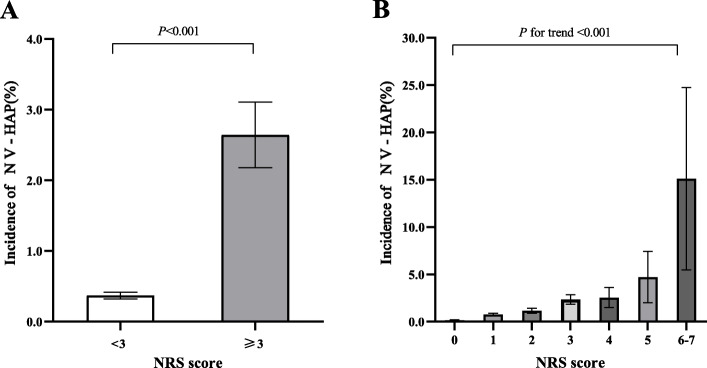
A total of 67,280 unique patients were included in the study. The incidence of NV-HAP in the cohort for the NRS < 3 and ≥ 3 NRS group was 0.4% (232/62702) and 2.6% (121/4578), respectively. In a multivariable logistic regression model adjusted for all of the covariates, per 1-point increase in the NRS score was associated with a 30% higher risk of NV-HAP (OR = 1.30; 95%CI:1.19-1.43). Similarly, patients with NRS score ≥ 3 had a higher risk of NV-HAP with an odds ratio (OR) of 2.06 (confidence interval (CI): 1.58-2.70) than those with NRS score < 3. Subgroup analyses indicated that the association between the NRS score and the risk of NV-HAP was similar for most strata. Furthermore, the interaction analyses revealed no interactive role in the association between NRS score and NV-HAP.
NRS score is an independent predictor of NV-HAP, irrespective of the patient's characteristics. NRS-2002 has the potential as a convenient tool for risk stratification of adult hospitalized patients with different NV-HAP risks.
目前,营养风险筛查评分与非呼吸机获得性肺炎(NV-HAP)的发展之间的关联尚不清楚。本研究旨在探讨营养风险筛查评分是否为 NV-HAP 的独立预测因子。
这是一项在中国一家三级医院进行的回顾性队列研究。采用营养风险筛查 2002 版(NRS-2002)进行营养风险筛查。总分≥3 分表示患者存在“营养风险”。应用 logistic 回归探讨 NRS 评分与 NV-HAP 之间的关系。
共纳入 67280 名患者。NRS<3 和 NRS≥3 组的队列中 NV-HAP 的发生率分别为 0.4%(232/62702)和 2.6%(121/4578)。在调整了所有协变量的多变量 logistic 回归模型中,NRS 评分每增加 1 分,NV-HAP 的风险增加 30%(OR=1.30;95%CI:1.19-1.43)。同样,NRS 评分≥3 的患者发生 NV-HAP 的风险高于 NRS 评分<3 的患者,比值比(OR)为 2.06(95%CI:1.58-2.70)。亚组分析表明,NRS 评分与 NV-HAP 风险之间的关联在大多数分层中相似。此外,交互分析显示 NRS 评分与 NV-HAP 之间没有交互作用。
NRS 评分是 NV-HAP 的独立预测因子,与患者特征无关。NRS-2002 有望成为一种方便的工具,用于对具有不同 NV-HAP 风险的成年住院患者进行风险分层。