Department of Internal Medicine, School of Medicine, Shiraz University of Medical Sciences, Shiraz, 7193634154, Iran.
Student Research Committee, Shiraz University of Medical Sciences, Shiraz, Iran.
BMC Pulm Med. 2021 Apr 1;21(1):112. doi: 10.1186/s12890-021-01481-y.
This study was performed to evaluate the anti-inflammatory effect of atorvastatin in patients with chronic bronchitis, exposed to sulfur mustard gas.
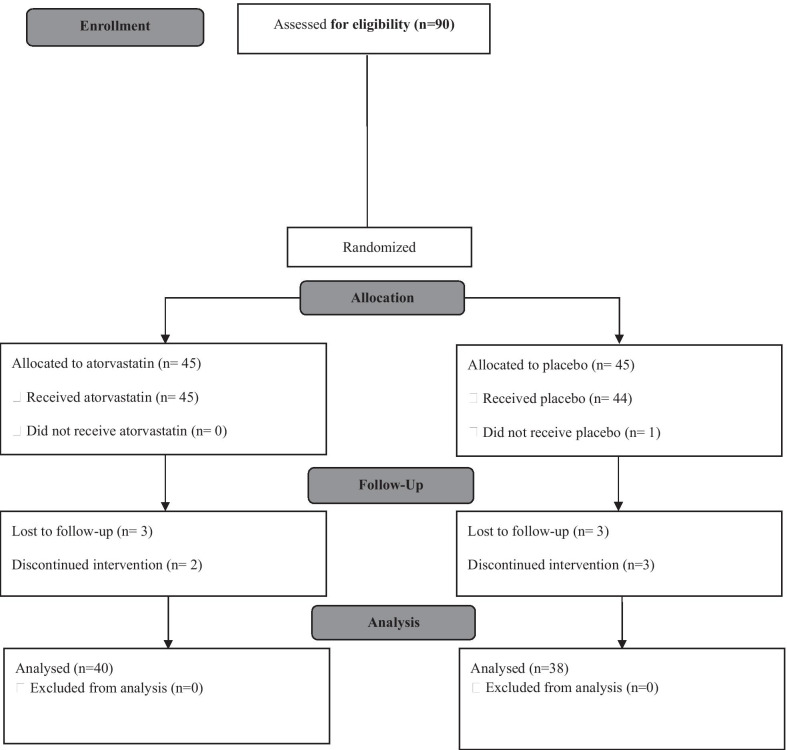
In this randomized double-blinded clinical trial we recruited patients with chronic bronchitis after exposure to sulfur mustard gas. Ninety men 45-75 years old diagnosed with chronic bronchitis after exposure to mustard gas during the Iran-Iraq war, were randomly assigned to receive either atorvastatin (40 mg) or placebo once a day for 3 months. The interleukin 6 (IL-6), tumor necrosis factor α (TNF-α), procalcitonin, highly sensitive CRP and COPD assessment test (CAT) score was compared at baseline and after 12 weeks.
After consuming atorvastatin for 12 weeks, IL-6 level (mean difference [95%CI]; 0.2 [- 0.05, 0.5]), TNF-α (mean difference [95%CI]; - 0.07 [- 0.2, 0.07]), high sensitive CRP (mean difference [95%CI] - 0.1 [- 1.2, 0.9]), and procalcitonin (mean difference [95%CI]; 0.003 [- 0.02, 0.03]) did not change significantly. However, in the placebo group, only IL-6 (mean difference [95%CI]; 0.6 [0.2, 1.05]) decreased significantly after 12 weeks, but levels of high sensitive CRP (mean difference [95%CI]; - 0.3 [- 1.4, 0.8]) TNF-α (mean difference [95%CI]; - 0.2 [- 0.34, - 0.06]) and procalcitonin (mean difference [95%CI]; 0.02 [- 0.001, 0.04]) did not change significantly. After 12 weeks, the mean differences in TNF- α, IL-6 level, high sensitive CRP, procalcitonin, and CAT score did not significantly differ between the two groups.
The administration of 40 mg atorvastatin for 3 months did not significantly change the inflammatory markers or the quality of life of patients exposed to mustard gas with chronic bronchitis.
IRCT, IRCT138904144312N1. Registered 16 August 2014, https://en.irct.ir/trial/4577 .
本研究旨在评估阿托伐他汀对暴露于芥子气的慢性支气管炎患者的抗炎作用。
在这项随机双盲临床试验中,我们招募了在伊朗-伊拉克战争中暴露于芥子气后患有慢性支气管炎的患者。90 名年龄在 45-75 岁之间的男性,在战争中暴露于芥子气后被诊断患有慢性支气管炎,随机分为每天服用阿托伐他汀(40mg)或安慰剂组,疗程为 3 个月。在基线和 12 周后比较白细胞介素 6(IL-6)、肿瘤坏死因子-α(TNF-α)、降钙素原、高敏 C 反应蛋白(hs-CRP)和 COPD 评估测试(CAT)评分。
服用阿托伐他汀 12 周后,IL-6 水平(平均差值[95%CI];0.2[-0.05, 0.5])、TNF-α(平均差值[95%CI];-0.07[-0.2, 0.07])、hs-CRP(平均差值[95%CI];-0.1[-1.2, 0.9])和降钙素原(平均差值[95%CI];0.003[-0.02, 0.03])均无明显变化。然而,在安慰剂组中,仅 IL-6(平均差值[95%CI];0.6[0.2, 1.05])在 12 周后显著下降,但 hs-CRP(平均差值[95%CI];-0.3[-1.4, 0.8])、TNF-α(平均差值[95%CI];-0.2[-0.34, -0.06])和降钙素原(平均差值[95%CI];0.02[-0.001, 0.04])水平无明显变化。12 周后,两组间 TNF-α、IL-6 水平、hs-CRP、降钙素原和 CAT 评分的平均差值无显著差异。
阿托伐他汀 40mg 治疗 3 个月并未显著改变暴露于芥子气的慢性支气管炎患者的炎症标志物或生活质量。
IRCT,IRCT138904144312N1。2014 年 8 月 16 日注册,https://en.irct.ir/trial/4577。