Bestwick Jonathan P, Auger Stephen D, Simonet Cristina, Rees Richard N, Rack Daniel, Jitlal Mark, Giovannoni Gavin, Lees Andrew J, Cuzick Jack, Schrag Anette E, Noyce Alastair J
Preventive Neurology Unit, Wolfson Institute of Preventive Medicine, Barts and the London School of Medicine and Dentistry, Queen Mary University of London, London, UK.
Department of Clinical and Movement Neuroscience, UCL Institute of Neurology, University College London, London, UK.
NPJ Parkinsons Dis. 2021 Apr 1;7(1):33. doi: 10.1038/s41531-021-00176-9.
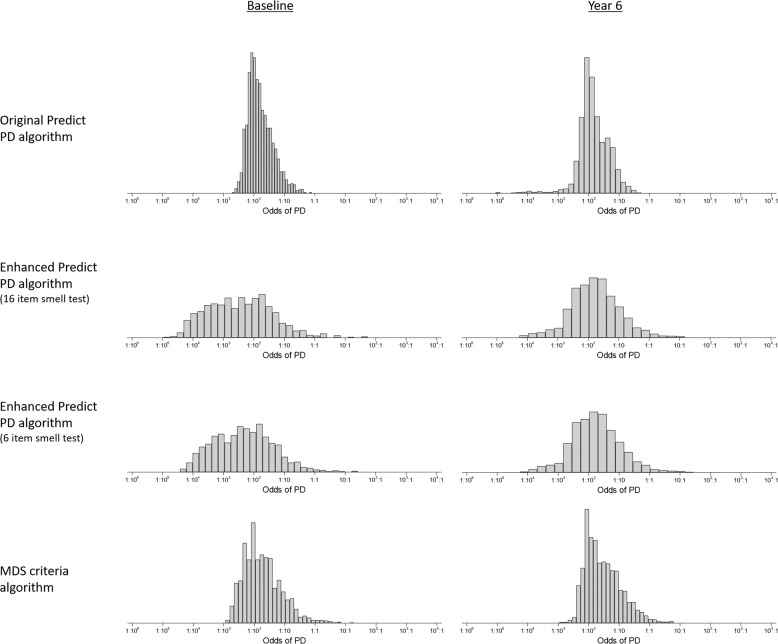
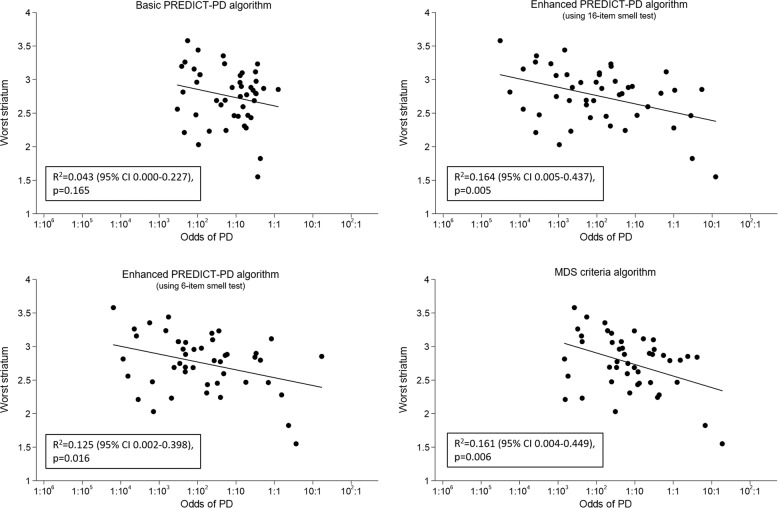
We previously reported a basic algorithm to identify the risk of Parkinson's disease (PD) using published data on risk factors and prodromal features. Using this algorithm, the PREDICT-PD study identified individuals at increased risk of PD and used tapping speed, hyposmia and REM sleep behaviour disorder (RBD) as "intermediate" markers of prodromal PD in the absence of sufficient incident cases. We have now developed and tested an enhanced algorithm which incorporates the intermediate markers into the risk model. Risk estimates were compared using the enhanced and the basic algorithm in members of the PREDICT-PD pilot cohort. The enhanced PREDICT-PD algorithm yielded a much greater range of risk estimates than the basic algorithm (93-609-fold difference between the 10th and 90th centiles vs 10-13-fold respectively). There was a greater increase in the risk of PD with increasing risk scores for the enhanced algorithm than for the basic algorithm (hazard ratios per one standard deviation increase in log risk of 2.75 [95% CI 1.68-4.50; p < 0.001] versus 1.47 [95% CI 0.86-2.51; p = 0.16] respectively). Estimates from the enhanced algorithm also correlated more closely with subclinical striatal DaT-SPECT dopamine depletion (R = 0.164, p = 0.005 vs R = 0.043, p = 0.17). Incorporating the previous intermediate markers of prodromal PD and using likelihood ratios improved the accuracy of the PREDICT-PD prediction algorithm.
我们之前报告了一种利用已发表的风险因素和前驱特征数据来识别帕金森病(PD)风险的基本算法。使用该算法,PREDICT-PD研究识别出了患PD风险增加的个体,并在缺乏足够的新发病例时,将敲击速度、嗅觉减退和快速眼动睡眠行为障碍(RBD)用作前驱PD的“中间”标志物。我们现在开发并测试了一种增强算法,该算法将这些中间标志物纳入了风险模型。在PREDICT-PD试点队列的成员中,使用增强算法和基本算法对风险估计值进行了比较。与基本算法相比,增强后的PREDICT-PD算法产生的风险估计值范围要大得多(第10百分位数和第90百分位数之间的差异分别为93 - 609倍和10 - 13倍)。与基本算法相比,增强算法中随着风险评分增加,PD风险的增加幅度更大(对数风险每增加一个标准差的风险比分别为2.75 [95%置信区间1.68 - 4.50;p < 0.001] 和1.47 [95%置信区间0.86 - 2.51;p = 0.16])。增强算法的估计值也与亚临床纹状体DaT-SPECT多巴胺耗竭的相关性更强(R = 0.164,p = 0.005,而R = 0.043,p = 0.17)。纳入先前前驱PD的中间标志物并使用似然比提高了PREDICT-PD预测算法的准确性。