NHC Key Laboratory of Immunodermatology, Ministry of Education Key Laboratory of Immunodermatology, National Joint Engineering Research Center for Diagnosis and Treatment of Immunologic Skin Diseases, Department of Dermatology, The First Hospital of China Medical University, Shenyang, China.
Department of Dermatology, The First Hospital of China Medical University, Shenyang, China.
Front Immunol. 2021 Mar 16;12:653356. doi: 10.3389/fimmu.2021.653356. eCollection 2021.
Pemphigus is a rare but life-threatening autoimmune skin disease characterized by blistering on skin and/or mucous membranes. The physiological process of blister formation involves IgG antibodies against the desmogleins (Dsgs) and desmocollins (Dscs). Additional autoAbs have also been suggested to mediate the disease heterogeneity, such as anti-thyroid peroxidase (anti-TPO) and antithyroglobulin (anti-Tg) antibodies, the essential culprits of the immune system in autoimmune thyroid diseases.
To investigate the levels and antibody positivity of anti-TPO and anti-Tg antibodies in pemphigus patients.
Antibody positivity and levels of anti-TPO and anti-Tg antibodies in pemphigus patients as compared to healthy controls were examined. A meta-analysis was conducted by reviewing six similar studies.
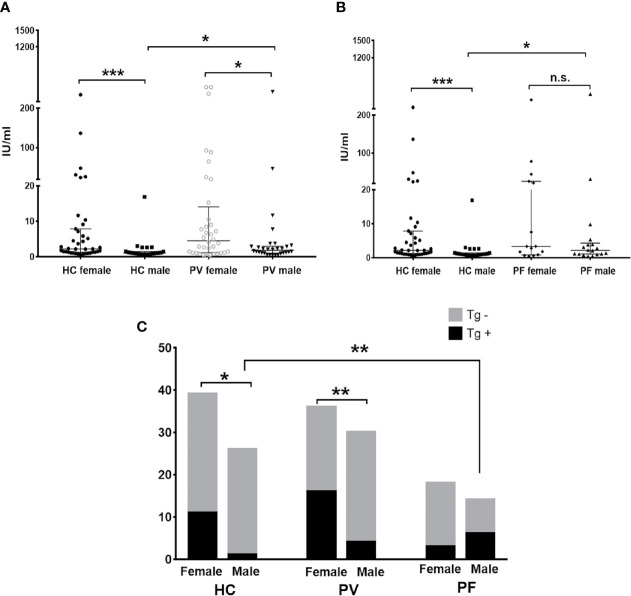
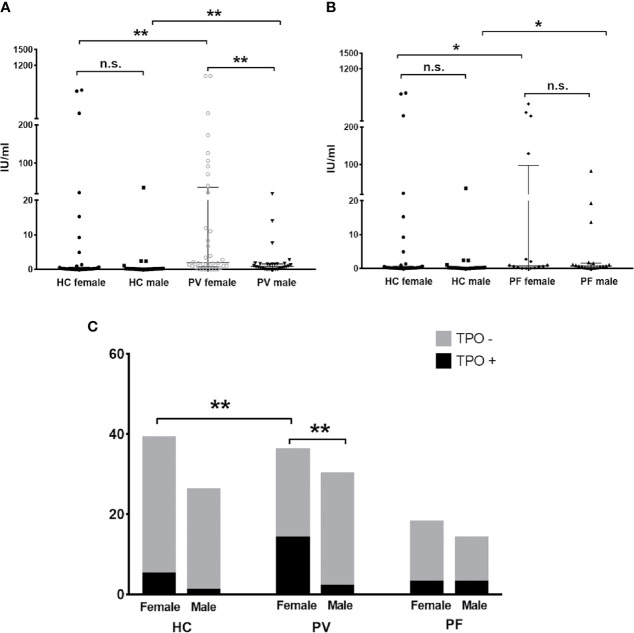
98 Chinese pemphigus patients and 65 healthy controls were enrolled in the study. Our meta-analysis revealed a significant correlation between increased presence of positive anti-TPO and anti-Tg antibodies and pemphigus, particularly for pemphigus vulgaris (PV). Such correlation was also observed in our own hospitalized PV patients, but not in pemphigus foliaceus (PF) patients. In addition, the status of anti-TPO and anti-Tg antibodies were also compared between females and males within PV patients, PF patients or controls, as well as compared for females or males between pemphigus patients and controls. In the analysis of T cell counts, we found abnormal low CD3 + T cell counts (< 690 n/µl) were only detected in patients whose thyroid antibody levels were less than 20 IU/ml.
Pemphigus patients showed higher levels and antibody positivity of anti-TPO and anti-Tg antibodies than healthy controls. Further investigations are needed to identify the pathogenic functions of these antibodies in pemphigus, as well as to identify the potential shared susceptibility genes.
天疱疮是一种罕见但危及生命的自身免疫性皮肤病,其特征是皮肤和/或粘膜上出现水疱。水疱形成的生理过程涉及针对桥粒芯糖蛋白(Dsgs)和桥粒胶蛋白(Dscs)的 IgG 抗体。此外,还提出了其他自身抗体来介导疾病异质性,如抗甲状腺过氧化物酶(anti-TPO)和抗甲状腺球蛋白(anti-Tg)抗体,它们是自身免疫性甲状腺疾病中免疫系统的主要罪魁祸首。
研究天疱疮患者抗 TPO 和抗 Tg 抗体的水平和抗体阳性率。
与健康对照组相比,检查了天疱疮患者抗 TPO 和抗 Tg 抗体的抗体阳性率和水平。通过回顾六项类似研究进行了荟萃分析。
本研究纳入了 98 名中国天疱疮患者和 65 名健康对照者。我们的荟萃分析显示,抗 TPO 和抗 Tg 抗体的阳性率和水平与天疱疮,特别是寻常型天疱疮(PV)之间存在显著相关性。这种相关性在我们自己收治的 PV 患者中也观察到,但在落叶型天疱疮(PF)患者中没有观察到。此外,还比较了 PV 患者、PF 患者或对照组中女性和男性之间的抗 TPO 和抗 Tg 抗体状态,以及天疱疮患者和对照组中女性或男性之间的抗 TPO 和抗 Tg 抗体状态。在 T 细胞计数分析中,我们发现只有甲状腺抗体水平低于 20 IU/ml 的患者才会出现异常低的 CD3+T 细胞计数(<690 n/µl)。
与健康对照组相比,天疱疮患者的抗 TPO 和抗 Tg 抗体水平和抗体阳性率更高。需要进一步研究以确定这些抗体在天疱疮中的致病作用,并确定潜在的共同易感基因。