Pappo Emily, Wilson Chris, Flory S Luke
School of Natural Resources and Environment, University of Florida, 103 Back Hall, Gainesville, FL 32603, USA.
Agronomy Department, University of Florida, 1676 McCarty Hall B, PO Box 110500, Gainesville, FL 32611, USA.
AoB Plants. 2021 Feb 25;13(2):plab010. doi: 10.1093/aobpla/plab010. eCollection 2021 Apr.
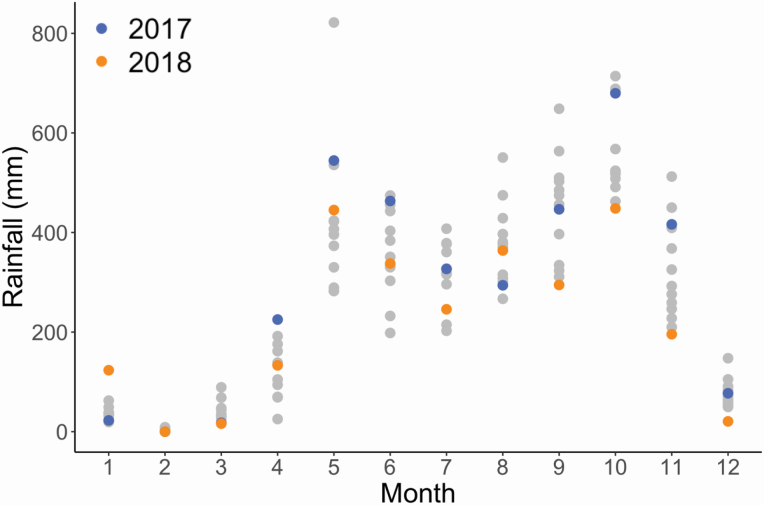
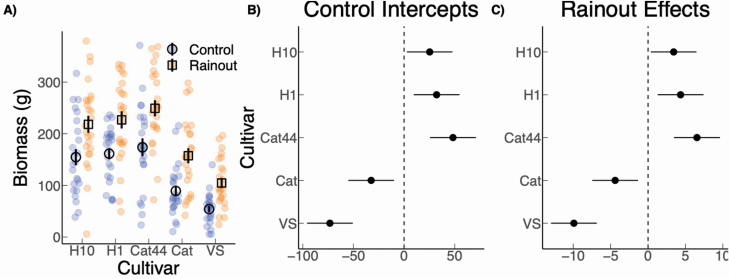
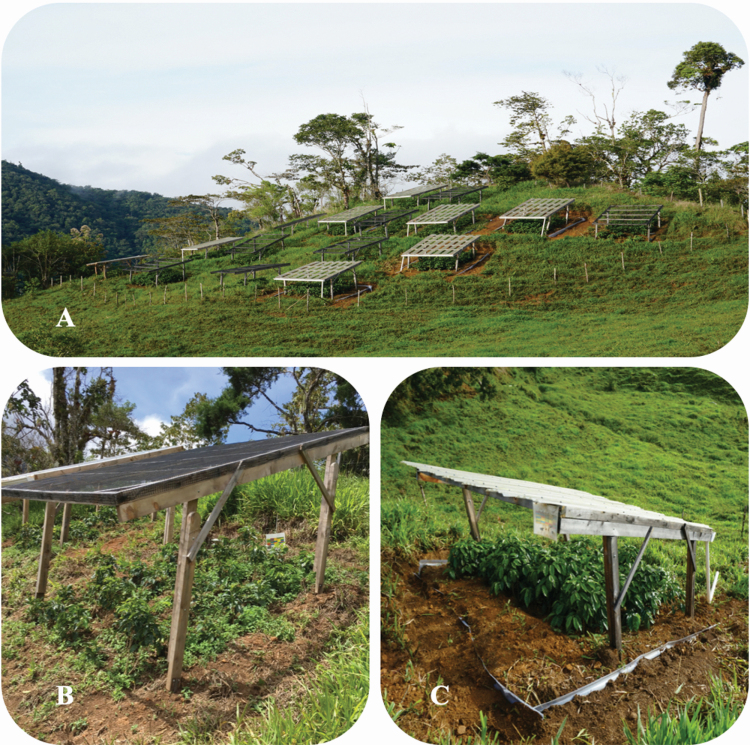
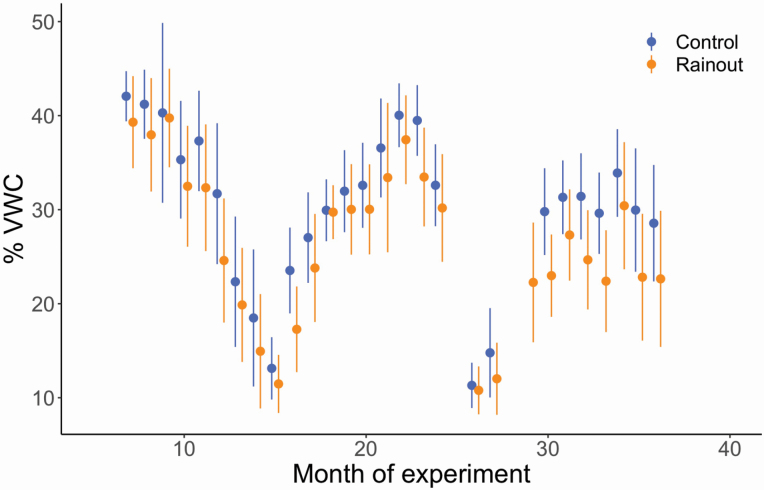
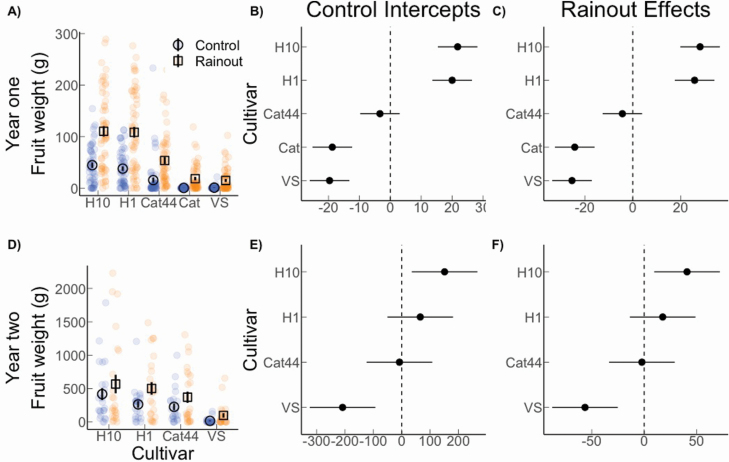
Anthropogenic climate change is predicted to cause shifts in temperature and precipitation patterns that will be detrimental for global agriculture. Developing comprehensive strategies for building climate resilient agroecosystems is critical for maintaining future crop production. Arabica coffee () is highly sensitive to the quantity and timing of precipitation, so alterations in precipitation patterns that are predicted under climate change are likely to be a major challenge for maintaining coffee agroecosystems. We assessed cultivar selection as a potential component of more resilient coffee agroecosystems by evaluating water stress responses among five Arabica coffee cultivars (clonal hybrids H10 and H1 and seedling lines Catuai 44, Catuai, and Villa Sarchi) using a precipitation reduction experiment in the highlands of Tarrazú, Costa Rica. During the first harvest (eighteen months after planting), plants under the rainout treatment had 211 % greater total fruit weight and over 50 % greater biomass than under the control treatment, potentially due to protection from unusually high rainfall during this period of our experiment. At the second harvest (30 months after planting), after a year of more typical rainfall, plants under rainout still produced 66 % more fruit by weight than under control. The magnitude of the responses varied among cultivars where, at the first harvest, H10 and H1 had approximately 92 % and 81 % greater fruit production and 18 % and 22 % greater biomass, respectively, and at the second harvest H10 had 60 % more fruit production than the overall average. Thus, our findings suggest that the hybrid lines H10 and H1 are more resilient than the other cultivars to the stress of high soil moisture. Overall, our results indicate that stress due to higher than average rainfall could impair coffee plant growth and production, and that cultivar selection is likely to be an important tool for maintaining the viability of coffee production, and the resilience of global agroecosystems more generally, under climate change.
预计人为气候变化将导致温度和降水模式发生变化,这将对全球农业产生不利影响。制定全面的战略以构建适应气候变化的农业生态系统对于维持未来作物产量至关重要。阿拉比卡咖啡()对降水量和降水时间高度敏感,因此气候变化预测下的降水模式改变可能是维持咖啡农业生态系统的一大挑战。我们通过在哥斯达黎加塔拉珠高地进行降水减少实验,评估了五个阿拉比卡咖啡品种(克隆杂交种H10和H1以及实生苗品系卡图艾44、卡图艾和比利亚萨尔奇)对水分胁迫的反应,以此作为更具韧性的咖啡农业生态系统的一个潜在组成部分。在第一次收获时(种植后18个月),防雨处理下的植株总果实重量比对照处理下的植株高211%,生物量高出50%以上,这可能是由于在我们实验的这段时间里免受了异常高降雨的影响。在第二次收获时(种植后30个月),经过一年较为典型的降雨后,防雨处理下的植株果实重量仍比对照处理下的植株高出66%。不同品种的反应程度各不相同,在第一次收获时,H10和H1的果实产量分别比对照高出约92%和81%,生物量分别高出18%和22%,在第二次收获时,H10的果实产量比总体平均水平高出60%。因此,我们的研究结果表明,杂交品系H10和H1比其他品种更能抵御高土壤湿度胁迫。总体而言,我们的结果表明,高于平均水平的降雨造成的胁迫可能会损害咖啡植株的生长和产量,并且品种选择可能是在气候变化情况下维持咖啡生产的可行性以及更广泛地维持全球农业生态系统韧性的重要工具。