Borrero-de Acuña José Manuel, Rohde Manfred, Saldias Cesar, Poblete-Castro Ignacio
Institute for Microbiology, Technische Universität Braunschweig, Braunschweig, Germany.
Braunschweig Integrated Centre of Systems Biology (BRICS), Technische Universität Braunschweig, Braunschweig, Germany.
Front Bioeng Biotechnol. 2021 Mar 16;9:642023. doi: 10.3389/fbioe.2021.642023. eCollection 2021.
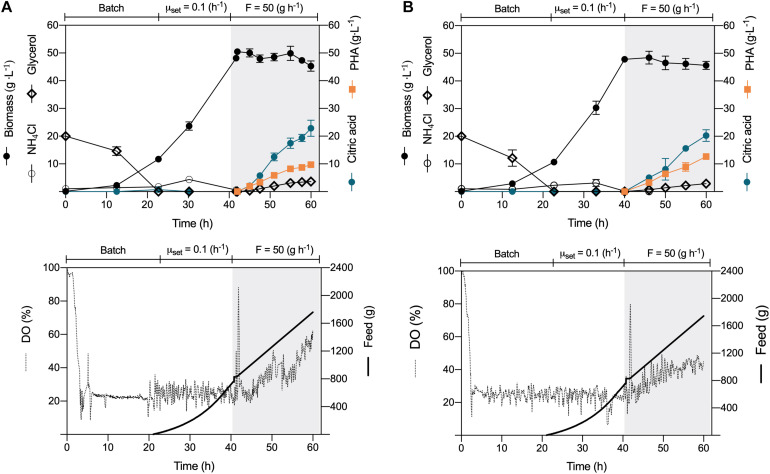
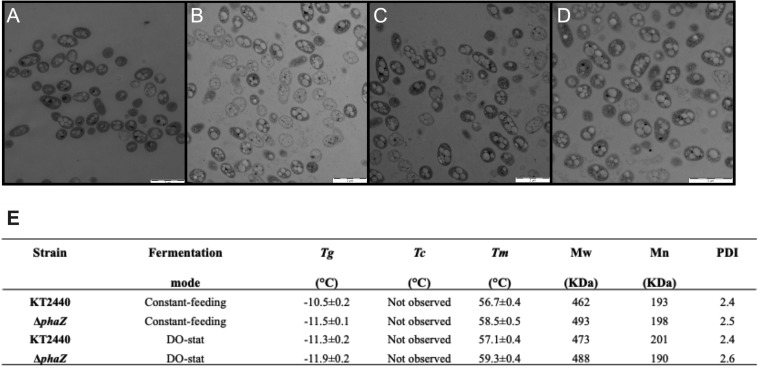
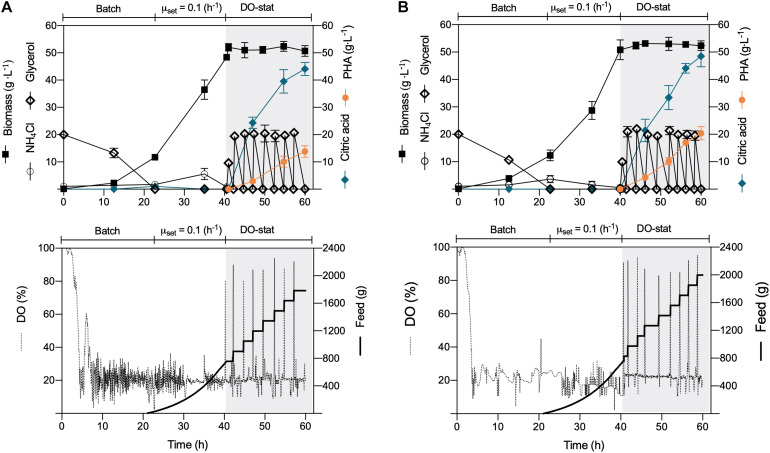
Crude glycerol has emerged as a suitable feedstock for the biotechnological production of various industrial chemicals given its high surplus catalyzed by the biodiesel industry. bacteria metabolize the polyol into several biopolymers, including alginate and medium-chain-length poly(3-hydroxyalkanoates) (PHAs). Although is a suited platform to derive these polyoxoesters from crude glycerol, the attained concentrations in batch and fed-batch cultures are still low. In this study, we employed KT2440 and the hyper-PHA producer Δ mutant in two different fed-batch modes to synthesize -PHAs from raw glycerol. Initially, the cells grew in a batch phase (μ 0.21 h) for 22 h followed by a carbon-limiting exponential feeding, where the specific growth rate was set at 0.1 (h), resulting in a cell dry weight (CDW) of nearly 50 (g L) at 40 h cultivation. During the PHA production stage, we supplied the substrate at a constant rate of 50 (g h), where the KT2440 and the Δ produced 9.7 and 12.7 gPHA L, respectively, after 60 h cultivation. We next evaluated the PHA production ability of the strains using a DO-stat approach under nitrogen depletion. Citric acid was the main by-product secreted by the cells, accumulating in the culture broth up to 48 (g L) under nitrogen limitation. The mutant Δ amassed 38.9% of the CDW as -PHA and exhibited a specific PHA volumetric productivity of 0.34 (g L h), 48% higher than the parental KT2440 under the same growth conditions. The biosynthesized PHAs had average molecular weights ranging from 460 to 505 KDa and a polydispersity index (PDI) of 2.4-2.6. Here, we demonstrated that the DO-stat feeding approach in high cell density cultures enables the high yield production of -PHA in strains using the industrial crude glycerol, where the fed-batch process selection is essential to exploit the superior biopolymer production hallmarks of engineered bacterial strains.
鉴于生物柴油行业催化产生的大量过剩,粗甘油已成为生物技术生产各种工业化学品的合适原料。细菌将多元醇代谢成几种生物聚合物,包括藻酸盐和中链长度聚(3-羟基脂肪酸酯)(PHA)。尽管是从粗甘油中获得这些聚氧酯的合适平台,但在分批培养和补料分批培养中获得的浓度仍然很低。在本研究中,我们使用KT2440和高产PHA的Δ突变体以两种不同的补料分批模式从粗甘油合成-PHA。最初,细胞在分批阶段(μ0.21 h)生长22 h,然后进行碳限制指数补料,其中比生长速率设定为0.1(h),在培养40 h时细胞干重(CDW)接近50(g/L)。在PHA生产阶段,我们以50(g/h)的恒定速率供应底物,在培养60 h后,KT2440和Δ分别产生9.7和12.7 gPHA/L。接下来,我们在氮耗尽的情况下使用溶解氧(DO)控制方法评估了菌株的PHA生产能力。柠檬酸是细胞分泌的主要副产物,在氮限制下在培养液中积累高达48(g/L)。突变体Δ积累了38.9%的CDW作为-PHA,并且在相同生长条件下表现出0.34(g/L·h)的比PHA体积生产率,比亲本KT2440高48%。生物合成的PHA的平均分子量范围为460至505 kDa,多分散指数(PDI)为2.4-2.6。在这里,我们证明了在高细胞密度培养中使用DO控制补料方法能够在菌株中使用工业粗甘油高产-PHA,其中补料分批工艺的选择对于利用工程细菌菌株的卓越生物聚合物生产特性至关重要。