Departments of Neurosurgery, University of California, Los Angeles, 300 Stein Plaza, Suite 562, Los Angeles, CA, USA.
David Geffen School of Medicine, Los Angeles (UCLA), Los Angeles, CA, USA.
Acta Neurochir (Wien). 2021 Jul;163(7):1921-1934. doi: 10.1007/s00701-021-04794-3. Epub 2021 Apr 2.
High-grade gliomas (HGG) comprise the most common primary adult brain cancers and universally recur. Combination of re-irradiation therapy (reRT) and bevacizumab (BVZ) therapy for recurrent HGG is common, but its reported efficacy is mixed.
To assess clinical outcomes after reRT ± BVZ in recurrent HGG patients receiving stereotactic radiosurgery (SRS), hypofractionated radiosurgery (HFSRT), or fully fractionated radiotherapy (FFRT).
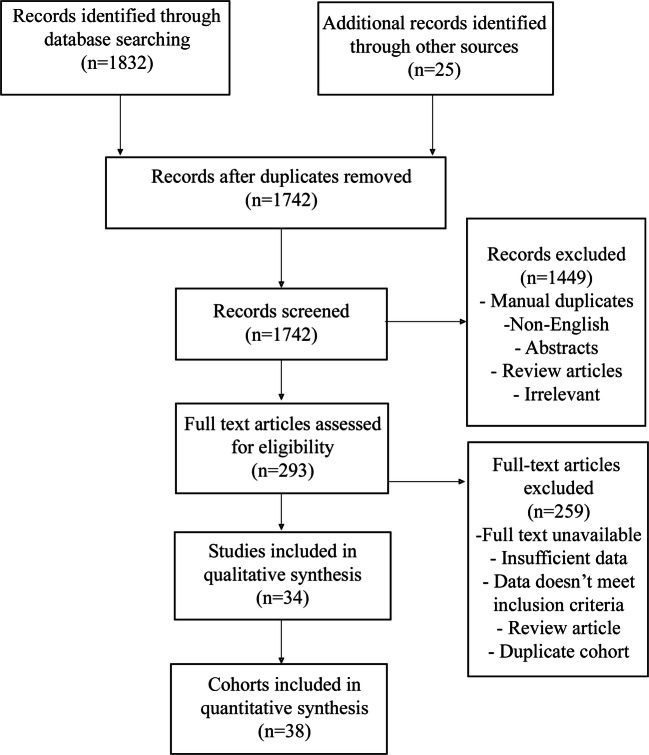
We performed a systematic review of PubMed, Web of Science, Scopus, Embase, and Cochrane databases, following the Preferred Reporting Items for Systematic Reviews and Meta-Analyses (PRISMA) guidelines. We identified studies reporting outcomes for patients with recurrent HGG treated via reRT ± BVZ. Cohorts were stratified by BVZ treatment status and re-irradiation modality (SRS, HFSRT, and FFRT). Outcome variables were overall survival (OS), progression-free survival (PFS), and radiation necrosis (RN).
Data on 1399 patients was analyzed, with 954 patients receiving reRT alone and 445 patients receiving reRT + BVZ. All patients initially underwent standard-of-care therapy for their primary HGG. In a multivariate analysis that adjusted for median patient age, WHO grade, RT dosing, reRT fractionation regimen, time between primary and re-irradiation, and re-irradiation target volume, BVZ therapy was associated with significantly improved OS (2.51, 95% CI [0.11, 4.92] months, P = .041) but no significant improvement in PFS (1.40, 95% CI [- 0.36, 3.18] months, P = .099). Patients receiving BVZ also had significantly lower rates of RN (2.2% vs 6.5%, P < .001).
Combination of reRT + BVZ may improve OS and reduce RN rates in recurrent HGG, but further controlled studies are needed to confirm these effects.
高级别胶质瘤(HGG)是最常见的成人原发性脑癌,普遍会复发。对复发性 HGG 患者进行再放疗(reRT)联合贝伐珠单抗(BVZ)治疗很常见,但报道的疗效不一。
评估接受立体定向放射外科(SRS)、低分割放射外科(HFSRT)或全分割放射治疗(FFRT)的复发性 HGG 患者接受 reRT ± BVZ 治疗后的临床结果。
我们按照系统评价和荟萃分析的首选报告项目(PRISMA)指南,对 PubMed、Web of Science、Scopus、Embase 和 Cochrane 数据库进行了系统评价。我们确定了报道复发性 HGG 患者接受 reRT ± BVZ 治疗后结果的研究。根据 BVZ 治疗状况和再放疗方式(SRS、HFSRT 和 FFRT)对队列进行分层。结果变量为总生存期(OS)、无进展生存期(PFS)和放射性坏死(RN)。
对 1399 名患者的数据进行了分析,其中 954 名患者单独接受 reRT,445 名患者接受 reRT + BVZ。所有患者最初均接受了其原发性 HGG 的标准治疗。在一项调整了患者中位年龄、世界卫生组织(WHO)分级、放疗剂量、再放疗分割方案、原发与再放疗之间的时间以及再放疗靶体积的多变量分析中,BVZ 治疗与显著改善的 OS(2.51,95%CI [0.11,4.92] 个月,P =.041)相关,但与 PFS 无显著改善(1.40,95%CI [-0.36,3.18] 个月,P =.099)相关。接受 BVZ 治疗的患者也具有显著较低的 RN 发生率(2.2% vs 6.5%,P <.001)。
再放疗(reRT)联合 BVZ 可能改善复发性 HGG 的 OS 并降低 RN 发生率,但需要进一步的对照研究来证实这些效果。