Clinical Psychology, KU Leuven, Leuven, Belgium.
Clinical Child and Family Studies, Vrije Universiteit Amsterdam, Amsterdam, The Netherlands.
J Youth Adolesc. 2021 Aug;50(8):1649-1662. doi: 10.1007/s10964-021-01426-y. Epub 2021 Apr 1.
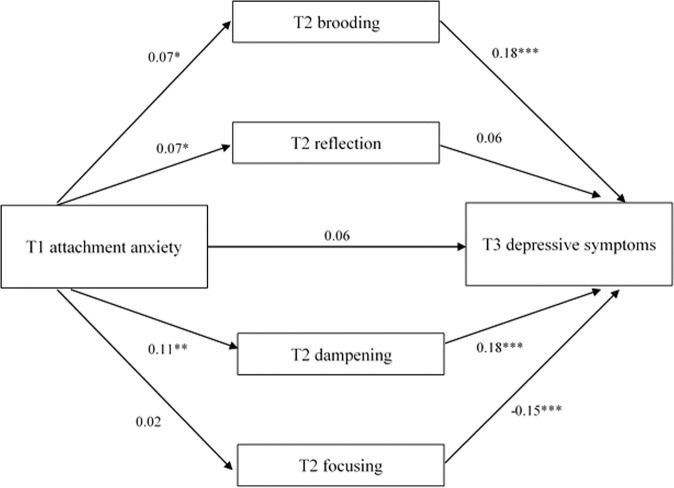
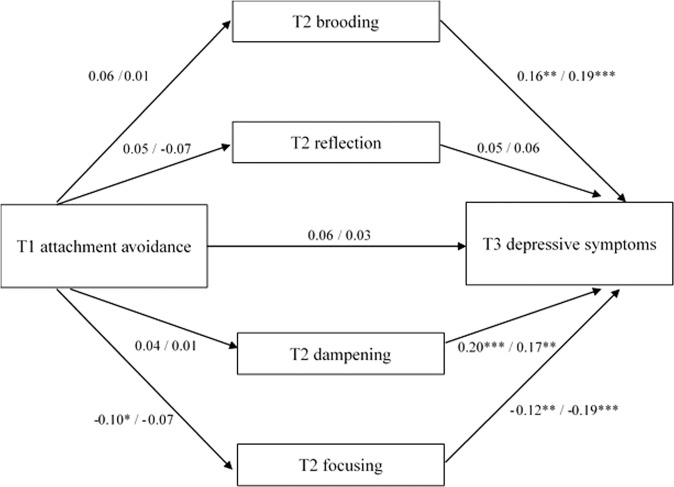
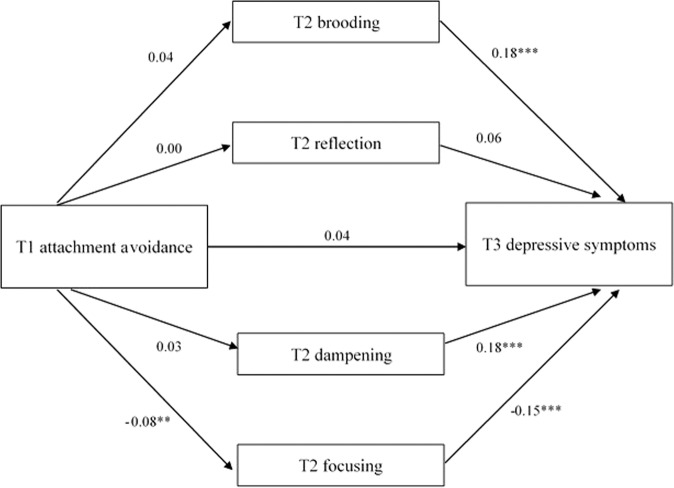
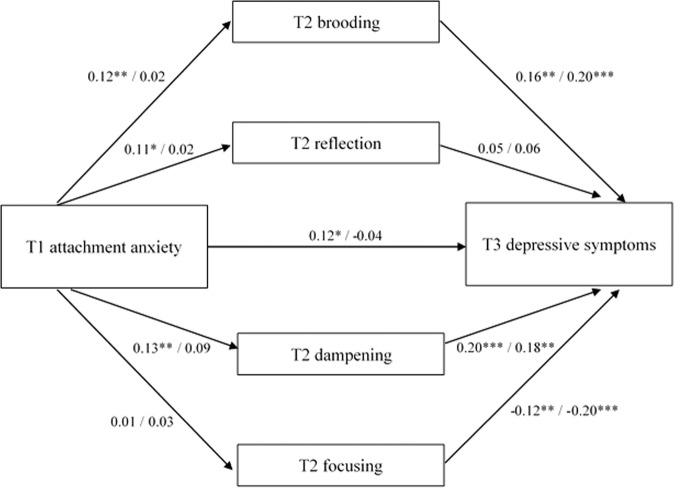
Although widely accepted, attachment theory's hypothesis that insecure attachment is associated with the development of depressive symptoms through emotion regulation strategies has never been longitudinally tested in adolescence. Additionally, previous research only focused on strategies for regulating negative affect, whereas strategies for regulating positive affect may also serve as a mechanism linking insecure attachment to depressive symptoms. This study aimed to fill these research gaps by testing whether the association between attachment and change in depressive symptoms over time is explained by strategies for regulating negative and positive affect in adolescence. Adolescents (N = 1706; 53% girls; M = 12.78 years, SD = 1.54 at Time 1) were tested three times, with a 1-year interval between measurement times. They reported on their attachment anxiety and avoidance at Time 1, depressive symptoms at Times 1 and 3, and regulation of negative affect (brooding and dampening) and positive affect (focusing and reflection) at Time 2. The results from multiple mediation analyses showed that more anxiously attached adolescents developed more depressive symptoms via increased brooding and dampening. More avoidantly attached adolescents developed more depressive symptoms via decreased focusing. These findings provide longitudinal support for attachment theory's emotion regulation hypothesis, and show that the regulation of both negative and positive affect is important.
尽管 Attachment 理论假设不安全的依恋通过情绪调节策略与抑郁症状的发展有关已被广泛接受,但该假设从未在青少年中进行过纵向测试。此外,先前的研究仅关注调节负性情绪的策略,而调节正性情绪的策略也可能是将不安全依恋与抑郁症状联系起来的机制。本研究旨在通过测试依恋与青少年时期抑郁症状随时间变化的关系是否可以通过调节负性和正性情绪的策略来解释,来填补这些研究空白。研究共纳入 1706 名青少年(53%为女生,Mage=12.78 岁,SD=1.54),平均在三个时间点(Time1、Time2 和 Time3)接受测试,两次测试的间隔时间为 1 年。他们在 Time1 时报告了他们的依恋焦虑和回避,在 Time1 和 Time3 时报告了抑郁症状,在 Time2 时报告了负性情绪调节(沉思和压抑)和正性情绪调节(专注和反思)。多元中介分析的结果表明,更焦虑的青少年通过增加沉思和压抑而发展出更多的抑郁症状。更回避的青少年通过减少专注而发展出更多的抑郁症状。这些发现为 Attachment 理论的情绪调节假设提供了纵向支持,并表明调节负性和正性情绪都很重要。