Division of Fetomaternal Medicine, Department of Obstetrics and Gynecology, Medical University of Vienna, Waehringer Guertel 18-20, 1090, Vienna, Austria.
Clinical Institute of Pathology, Medical University of Vienna, Vienna, Austria.
Arch Gynecol Obstet. 2021 Oct;304(4):935-942. doi: 10.1007/s00404-021-06042-6. Epub 2021 Apr 2.
To explore whether epidemiological shifts regarding reproduction and pregnancy have influenced the spectrum of indications for late termination of singleton pregnancies (TOP) above 17 weeks of gestation and to evaluate temporal changes in maternal demographics and fetal indications over the last 16 years.
Retrospective single-center cohort study involving all late TOPs preceded by feticide between 1 January 2004 and 31 December 2019 at a tertiary referral hospital in Austria. Outcome variables were retrieved and a time trend assessed between two 8-year intervals (2004-2011 versus 2012-2019).
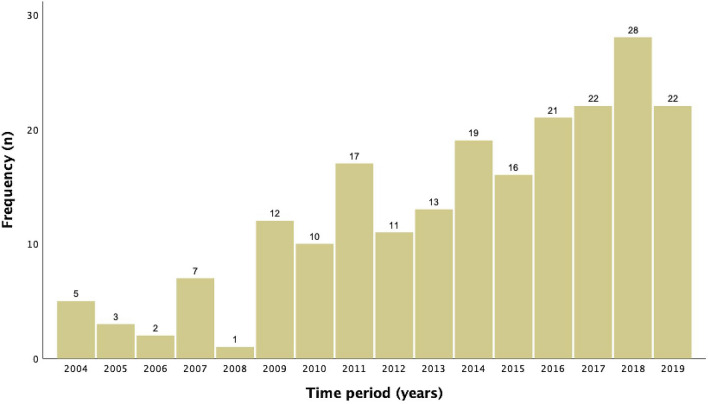
Between January 2004 and December 2019, a total of 209 singleton pregnancies (50.7% male; 46.9% female fetuses, 2.4% no disclosed sex) were terminated medically at a median gestational age of 25 (17-37) weeks at our institution. Predominant conditions legally justifying the late medical abortion were abnormaltities of the brain/central nervous system (n = 83; 39.7%), chromosomal aberrations (n = 33; 15.8%), complex malformations (n = 31; 4.8%) and abnormaltities of the musculosceletal system including diaphragmatic hernias (n = 18; 8.6%), as reflected by the ICD-10-categories "Congenital malformation of the central nervous system", "Other congenital malformations" and "Chromosomal abnormalities". No changes were observed with regards to maternal age (30.1 ± 5.9 vs. 31.0 ± 6.0 years; p = 0.315) nor frequency of assisted reproductive technologies (7.0% vs. 8.5%; p = 0.550). Despite a 2.5-fold increase in incidence of late TOPs, no epidemiological changes in maternal or fetal characteristics were observed over the last 16 years.
Population profile and indications for late TOPs followed by feticide remain unchanged over time.
探讨生殖和妊娠方面的流行病学变化是否影响了 17 周以上的单胎妊娠晚期终止(TOP)的适应证谱,并评估过去 16 年中孕产妇人口统计学和胎儿适应证的时间变化。
回顾性单中心队列研究,纳入了 2004 年 1 月 1 日至 2019 年 12 月 31 日期间,在奥地利一家三级转诊医院进行的所有经胎儿死亡后进行的晚期 TOP。检索了结局变量,并评估了两个 8 年间隔(2004-2011 年与 2012-2019 年)之间的时间趋势。
2004 年 1 月至 2019 年 12 月期间,在我院共进行了 209 例单胎妊娠的医学性晚期 TOP,中位孕龄为 25(17-37)周。法律上证明晚期药物流产合理的主要条件是脑/中枢神经系统异常(n=83;39.7%)、染色体异常(n=33;15.8%)、复杂畸形(n=31;4.8%)和包括膈疝在内的肌肉骨骼系统异常(n=18;8.6%),这反映在 ICD-10 类别“中枢神经系统先天性畸形”、“其他先天性畸形”和“染色体异常”中。未观察到孕产妇年龄(30.1±5.9 岁 vs. 31.0±6.0 岁;p=0.315)或辅助生殖技术频率(7.0% vs. 8.5%;p=0.550)方面的变化。尽管晚期 TOP 的发生率增加了 2.5 倍,但在过去的 16 年中,孕产妇或胎儿特征没有观察到流行病学变化。
经胎儿死亡后进行的晚期 TOP 的人群特征和适应证在时间上保持不变。