Department of Simulation and Graphics, Research Campus STIMULATE, Otto-von-Guericke-University, Magdeburg, Germany.
Int J Comput Assist Radiol Surg. 2021 Sep;16(9):1577-1586. doi: 10.1007/s11548-021-02336-x. Epub 2021 Apr 2.
Resection site repair during laparoscopic oncological surgery (e.g. laparoscopic partial nephrectomy) poses some unique challenges and opportunities for augmented reality (AR) navigation support. This work introduces an AR registration workflow that addresses the time pressure that is present during resection site repair.
We propose a two-step registration process: the AR content is registered as accurately as possible prior to the tumour resection (the primary registration). This accurate registration is used to apply artificial fiducials to the physical organ and the virtual model. After the resection, these fiducials can be used for rapid re-registration (the secondary registration). We tested this pipeline in a simulated-use study with [Formula: see text] participants. We compared the registration accuracy and speed for our method and for landmark-based registration as a reference.
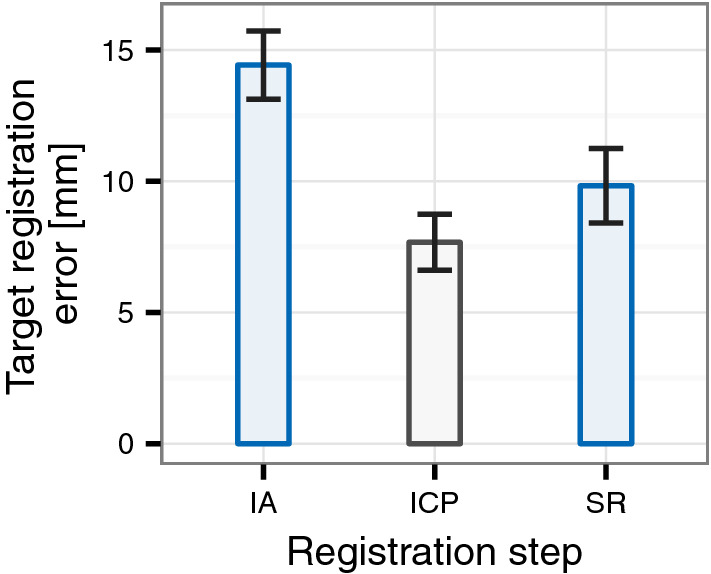
Acquisition of and, thereby, registration with the artificial fiducials were significantly faster than the initial use of anatomical landmarks. Our method also had a trend to be more accurate in cases in which the primary registration was successful. The accuracy loss between the elaborate primary registration and the rapid secondary registration could be quantified with a mean target registration error increase of 2.35 mm.
This work introduces a registration pipeline for AR navigation support during laparoscopic resection site repair and provides a successful proof-of-concept evaluation thereof. Our results indicate that the concept is better suited than landmark-based registration during this phase, but further work is required to demonstrate clinical suitability and applicability.
在腹腔镜肿瘤手术(如腹腔镜部分肾切除术)中,切除部位的修复给增强现实(AR)导航支持带来了一些独特的挑战和机遇。这项工作介绍了一种 AR 配准工作流程,用于解决切除部位修复过程中的时间压力问题。
我们提出了一个两步配准过程:在肿瘤切除之前(初次配准)尽可能准确地注册 AR 内容。这个准确的注册用于将人工基准标记应用于物理器官和虚拟模型。切除后,可以使用这些基准标记进行快速重新配准(二次配准)。我们在[Formula: see text]名参与者的模拟使用研究中测试了该流水线。我们将我们的方法与基于地标配准的方法进行了比较,以评估注册的准确性和速度。
获取和注册人工基准标记的速度明显快于初始使用解剖地标。在初次配准成功的情况下,我们的方法也有更高的准确性趋势。在精细的初次配准和快速的二次配准之间的准确性损失可以通过目标注册误差增加 2.35 毫米来量化。
这项工作介绍了一种用于腹腔镜切除部位修复期间 AR 导航支持的配准管道,并对其进行了成功的概念验证评估。我们的结果表明,在这个阶段,该概念比基于地标配准更适合,但需要进一步的工作来证明其临床适用性和适用性。