Chair of Environmental Medicine, Technical University of Munich, Augsburg 86156, Germany;
Institute of Environmental Medicine, Helmholtz Centre Munich, Augsburg 86156, Germany.
Proc Natl Acad Sci U S A. 2021 Mar 23;118(12). doi: 10.1073/pnas.2019034118.
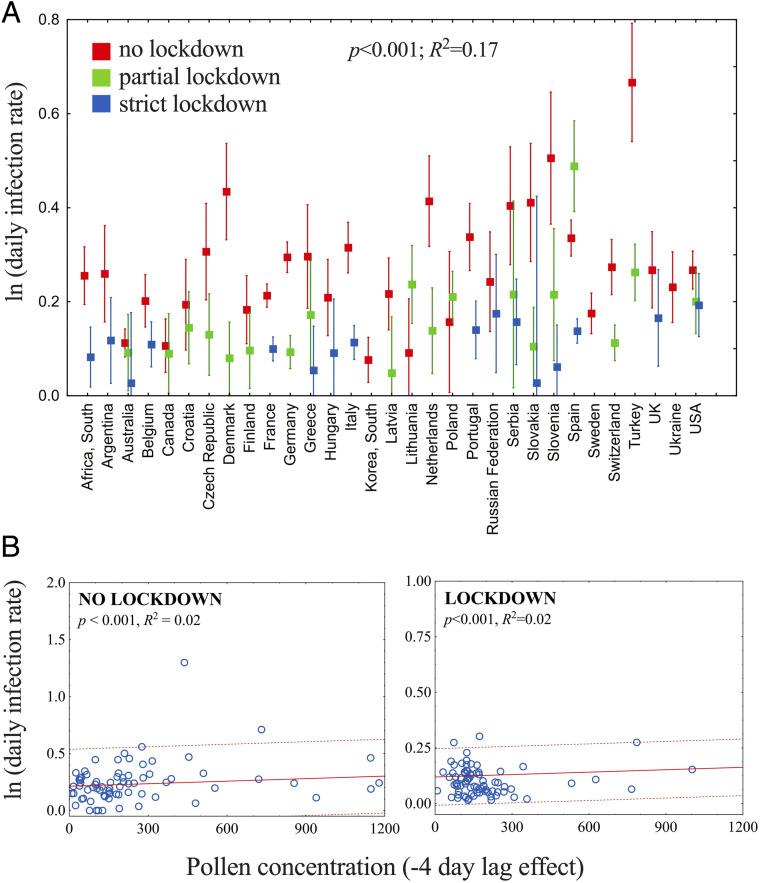
Pollen exposure weakens the immunity against certain seasonal respiratory viruses by diminishing the antiviral interferon response. Here we investigate whether the same applies to the pandemic severe acute respiratory syndrome coronavirus 2 (SARS-CoV-2), which is sensitive to antiviral interferons, if infection waves coincide with high airborne pollen concentrations. Our original hypothesis was that more airborne pollen would lead to increases in infection rates. To examine this, we performed a cross-sectional and longitudinal data analysis on SARS-CoV-2 infection, airborne pollen, and meteorological factors. Our dataset is the most comprehensive, largest possible worldwide from 130 stations, across 31 countries and five continents. To explicitly investigate the effects of social contact, we additionally considered population density of each study area, as well as lockdown effects, in all possible combinations: without any lockdown, with mixed lockdown-no lockdown regime, and under complete lockdown. We found that airborne pollen, sometimes in synergy with humidity and temperature, explained, on average, 44% of the infection rate variability. Infection rates increased after higher pollen concentrations most frequently during the four previous days. Without lockdown, an increase of pollen abundance by 100 pollen/m resulted in a 4% average increase of infection rates. Lockdown halved infection rates under similar pollen concentrations. As there can be no preventive measures against airborne pollen exposure, we suggest wide dissemination of pollen-virus coexposure dire effect information to encourage high-risk individuals to wear particle filter masks during high springtime pollen concentrations.
花粉暴露通过减弱抗病毒干扰素反应,削弱了对某些季节性呼吸道病毒的免疫力。在这里,我们研究了这是否同样适用于对抗病毒干扰素敏感的大流行严重急性呼吸综合征冠状病毒 2(SARS-CoV-2),如果感染波与高空气传播花粉浓度同时发生。我们的原始假设是,更多的空气传播花粉会导致感染率增加。为了检验这一点,我们对 SARS-CoV-2 感染、空气传播花粉和气象因素进行了横断面和纵向数据分析。我们的数据集是全球最全面、最大的数据集,来自 31 个国家和五个大陆的 130 个站点。为了明确研究社会接触的影响,我们还考虑了每个研究区域的人口密度以及所有可能的组合中的封锁效应:没有任何封锁、混合封锁-非封锁制度以及完全封锁。我们发现,空气传播花粉,有时与湿度和温度协同作用,平均解释了 44%的感染率可变性。在之前的四天中,花粉浓度较高时,感染率通常会增加。在没有封锁的情况下,花粉丰度增加 100 个花粉/立方米,平均感染率增加 4%。在类似的花粉浓度下,封锁使感染率减半。由于无法采取针对空气传播花粉暴露的预防措施,我们建议广泛传播花粉-病毒共暴露的直接影响信息,以鼓励高风险个体在高花粉浓度的春季佩戴颗粒过滤口罩。