Chen Yongxuan, Xie Kefeng, He Yucheng, Hu Wenbing
Department of Polymer Science and Engineering, State Key Laboratory of Coordination Chemistry, School of Chemistry and Chemical Engineering, Nanjing University, Nanjing 210023, China.
Polymers (Basel). 2021 Mar 14;13(6):891. doi: 10.3390/polym13060891.
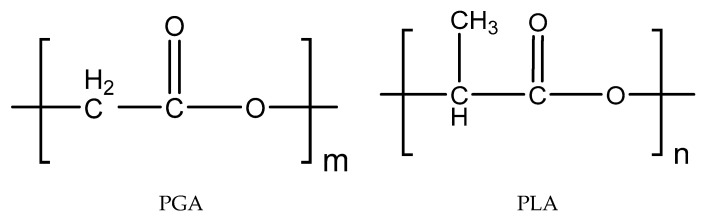
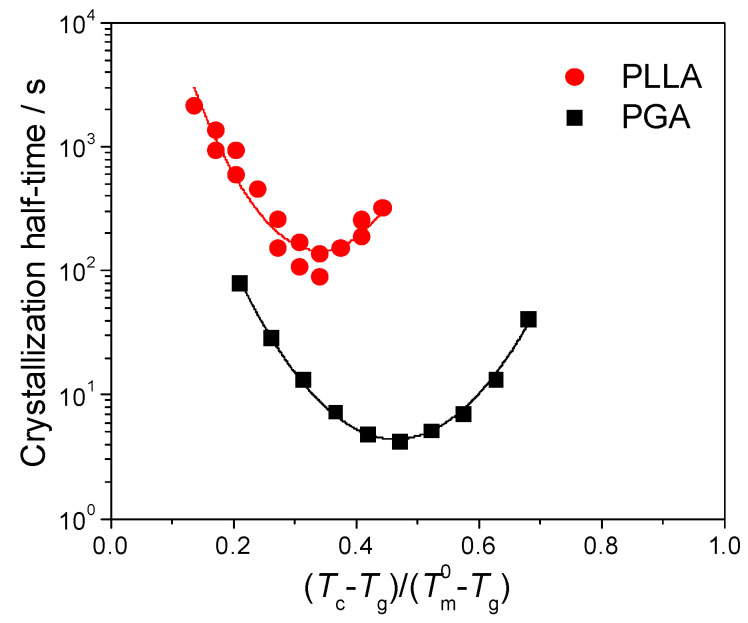
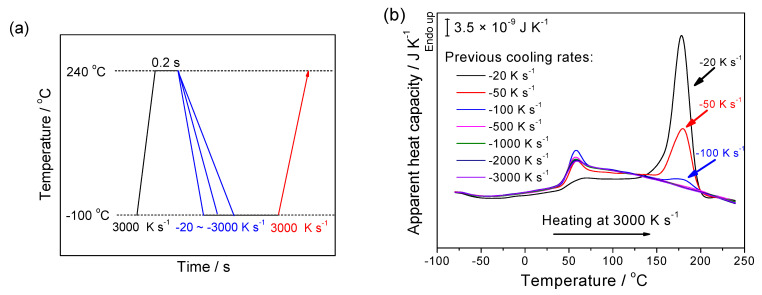
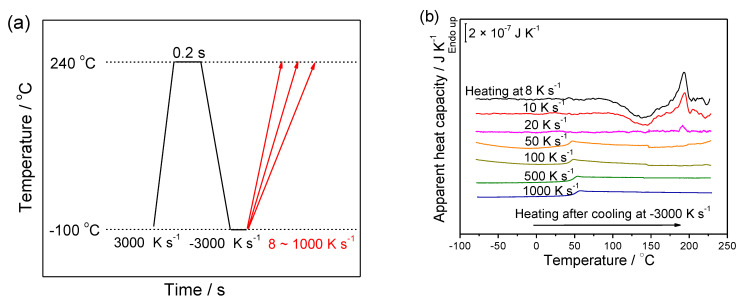
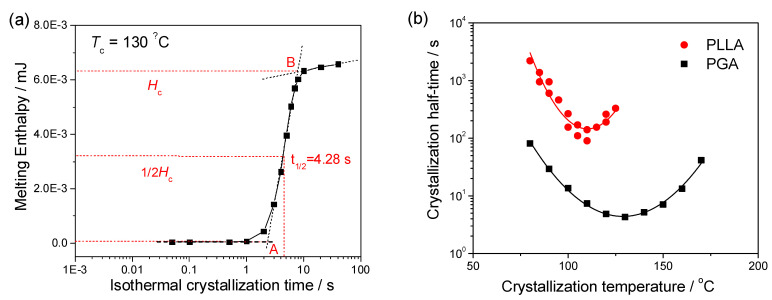
We report fast-scanning chip-calorimetry measurement of isothermal crystallization kinetics of poly(glycolic acid) (PGA) in a broad temperature range. We observed that PGA crystallization could be suppressed by cooling rates beyond -100 K s and, after fast cooling, by heating rates beyond 50 K s. In addition, the parabolic curve of crystallization half-time versus crystallization temperature shows that PGA crystallizes the fastest at 130 °C with the minimum crystallization half-time of 4.28 s. We compared our results to those of poly(-lactic acid) (PLLA) with nearby molecular weights previously reported by Androsch et al. We found that PGA crystallizes generally more quickly than PLLA. In comparison to PLLA, PGA has a much smaller hydrogen side group than the methyl side group in PLLA; therefore, crystal nucleation is favored by the higher molecular mobility of PGA in the low temperature region as well as by the denser molecular packing of PGA in the high temperature region, and the two factors together decide the higher crystallization rates of PGA in the whole temperature range.
我们报道了在很宽温度范围内聚乙醇酸(PGA)等温结晶动力学的快速扫描芯片量热法测量结果。我们观察到,当冷却速率超过-100 K/s时,PGA的结晶会受到抑制;快速冷却后,当加热速率超过50 K/s时,结晶也会受到抑制。此外,结晶半衰期与结晶温度的抛物线表明,PGA在130℃时结晶最快,最小结晶半衰期为4.28 s。我们将我们的结果与Androsch等人之前报道的分子量相近的聚(-乳酸)(PLLA)的结果进行了比较。我们发现PGA通常比PLLA结晶更快。与PLLA相比,PGA的氢侧基比PLLA中的甲基侧基小得多;因此,在低温区域,PGA较高的分子迁移率以及在高温区域PGA更紧密的分子堆积有利于晶核形成,这两个因素共同决定了PGA在整个温度范围内较高的结晶速率。