Barra Bernardo J, Varela Luis F, Maldonado José R, Calvo Pilar, Bastidas Anna, Sánchez Roberto, Pintor Luis
Department of Psychiatry, Hospital Clinic i Provincial of Barcelona, University of Barcelona, Casanova Street, 143, 08036 Barcelona, Spain.
Department of Psychiatry, Medicine School, Andrés Bello University of Santiago (UNAB), Santiago 8320000, Chile.
Medicina (Kaunas). 2021 Mar 11;57(3):256. doi: 10.3390/medicina57030256.
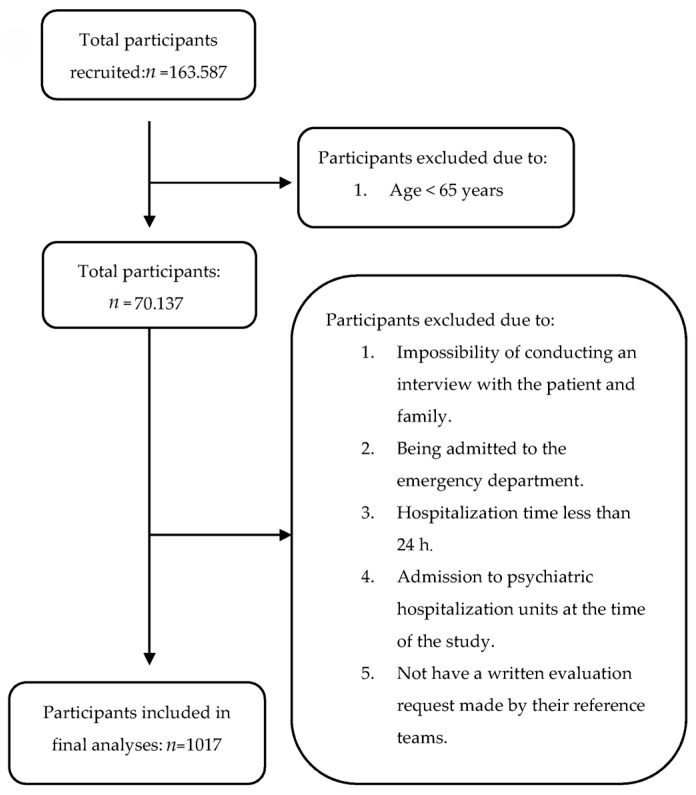
: There has been a recent increase in older patients admitted to general hospitals. A significant percentage of hospitalized older patients are ≥75 years old, which differ from the patients aged 65 to 74 years old in terms of functional status at patient discharge. This study aims to compare sociodemographic, clinical features, and factors associated with length of hospital stay in youngest-old and oldest-old populations of inpatients referred to the consultation liaison psychiatry unit. : This is an observational, cross-sectional, retrospective, and comparative study. We obtained data from a sample of 1017 patients (≥65 years) admitted to a general hospital and referred from different services (medicine, surgery, etc.) to the consultation liaison psychiatry unit. The sample was divided into two groups of patients: youngest-old (65-74 years) and oldest-old (≥75 years). Psychiatric evaluations were performed while the patients were on wards at the hospital. Psychopharmacs were started as needed. A comparative analysis was carried out and predictive factors related to length of hospital stay were calculated. : The reference rate to consultation liaison psychiatry unit was 1.45% of the total older patients hospitalized. Our study demonstrates differences between the groups of older people: the oldest-old group were mainly female ( < 0.001), had more previous psychiatric diagnoses ( < 0.001), physical disabilities ( = 0.02), and neurocognitive disorders ( < 0.001), they used more antipsychotics ( < 0.001), and more frequently had a discharge disposition to a nursing home ( = 0.036). The presence of physical disability ( = 0.07, < 0.001) and logtime to referral to consultation liaison psychiatry unit ( = 0.58, < 0.001) were associated with increased length of hospital stay. : Youngest-old and oldest-old people should be considered as two different types of patients when we consider clinical features. The time to referral to consultation liaison psychiatry unit seems to be a relevant factor associated with length of hospital stay.
综合医院收治的老年患者数量近期有所增加。住院老年患者中有很大比例年龄≥75岁,这在患者出院时的功能状态方面与65至74岁的患者有所不同。本研究旨在比较转诊至会诊联络精神科的最年轻老年患者和最年长老年患者群体的社会人口学特征、临床特征以及与住院时间相关的因素。 :这是一项观察性、横断面、回顾性和比较性研究。我们从一家综合医院收治的1017名(≥65岁)患者样本中获取数据,这些患者来自不同科室(内科、外科等)并转诊至会诊联络精神科。样本分为两组患者:最年轻老年组(65 - 74岁)和最年长老年组(≥75岁)。在患者住院期间进行精神科评估。根据需要启动精神药物治疗。进行了比较分析并计算了与住院时间相关的预测因素。 :会诊联络精神科的转诊率占住院老年患者总数的1.45%。我们的研究表明老年人群体之间存在差异:最年长老年组主要为女性(<0.001),既往有更多精神科诊断(<0.001)、身体残疾(=0.02)和神经认知障碍(<0.001),他们使用更多抗精神病药物(<0.001),并且更频繁地出院后入住养老院(=0.036)。身体残疾的存在(=0.07,<0.001)以及转诊至会诊联络精神科的时间较长(=0.58,<0.001)与住院时间延长相关。 :在考虑临床特征时,应将最年轻老年患者和最年长老年患者视为两种不同类型的患者。转诊至会诊联络精神科的时间似乎是与住院时间相关的一个重要因素。