Advanced Radiation Technology Institute, Korea Atomic Energy Research Institute, Jeongeup 56212, Korea.
Functional Biomaterial Research Center, Korea Research Institute of Bioscience and Biotechnology, Jeongeup 56212, Korea.
Molecules. 2021 Mar 11;26(6):1532. doi: 10.3390/molecules26061532.
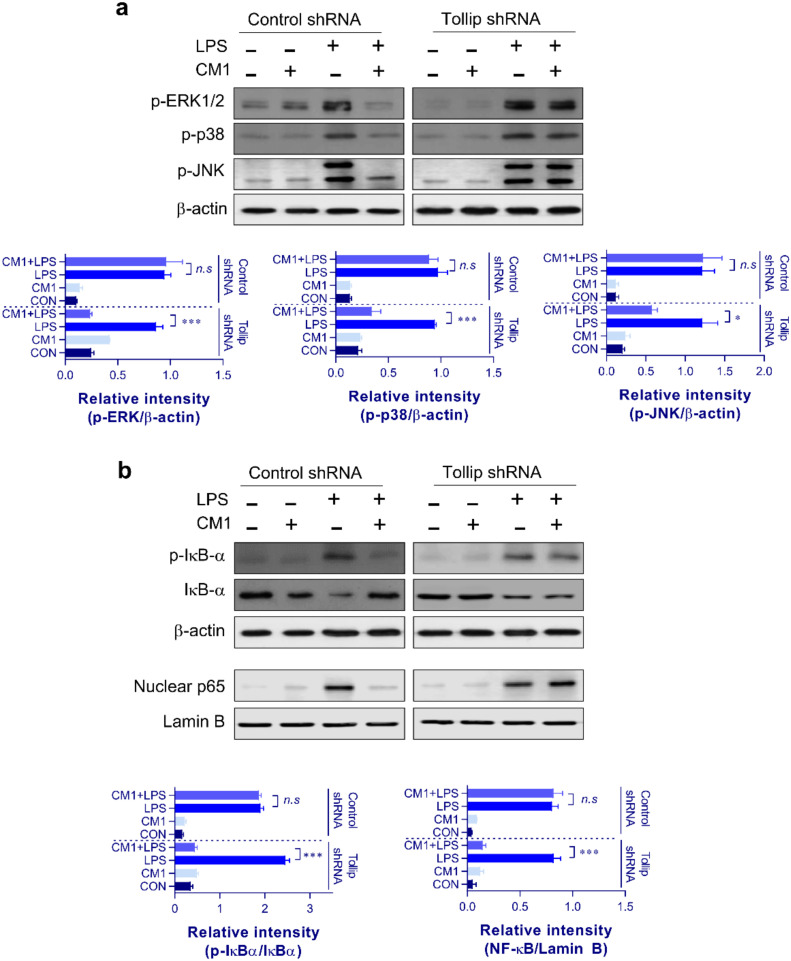
Although our previous study revealed that gamma-irradiated chrysin enhanced anti-inflammatory activity compared to intact chrysin, it remains unclear whether the chrysin derivative, CM1, produced by gamma irradiation, negatively regulates toll-like receptor (TLR) signaling. In this study, we investigated the molecular basis for the downregulation of TLR4 signal transduction by CM1 in macrophages. We initially determined the appropriate concentration of CM1 and found no cellular toxicity below 2 μg/mL. Upon stimulation with lipopolysaccharide (LPS), CM1 modulated LPS-stimulated inflammatory action by suppressing the release of proinflammatory mediators (cytokines TNF-α and IL-6) and nitric oxide (NO) and downregulated the mitogen-activated protein kinase (MAPK) and nuclear factor-κB (NF-κB) signaling pathways. Furthermore, CM1 markedly elevated the expression of the TLR negative regulator toll-interacting protein (Tollip) in dose- and time-dependent manners. LPS-induced expression of cell surface molecules (CD80, CD86, and MHC class I/II), proinflammatory cytokines (TNF-α and IL-6), COX-2, and iNOS-mediated NO were inhibited by CM1; these effects were prevented by the knockdown of Tollip expression. Additionally, CM1 did not affect the downregulation of LPS-induced expression of MAPKs and NF-κB signaling in Tollip-downregulated cells. These findings provide insight into effective therapeutic intervention of inflammatory disease by increasing the understanding of the negative regulation of TLR signaling induced by CM1.
虽然我们之前的研究表明,与完整的白杨素相比,伽马辐照的白杨素增强了抗炎活性,但尚不清楚伽马辐照产生的白杨素衍生物 CM1 是否负调控 Toll 样受体 (TLR) 信号。在这项研究中,我们研究了 CM1 在巨噬细胞中下调 TLR4 信号转导的分子基础。我们首先确定了 CM1 的适当浓度,发现低于 2μg/mL 时没有细胞毒性。在脂多糖 (LPS) 刺激下,CM1 通过抑制促炎介质 (细胞因子 TNF-α 和 IL-6) 和一氧化氮 (NO) 的释放来调节 LPS 刺激的炎症作用,并下调丝裂原激活蛋白激酶 (MAPK) 和核因子-κB (NF-κB) 信号通路。此外,CM1 以剂量和时间依赖的方式显着增加 TLR 负调节因子 toll 相互作用蛋白 (Tollip) 的表达。CM1 抑制 LPS 诱导的细胞表面分子 (CD80、CD86 和 MHC Ⅰ/Ⅱ)、促炎细胞因子 (TNF-α 和 IL-6)、COX-2 和 iNOS 介导的 NO 的表达;这些作用被 Tollip 表达的敲低所阻止。此外,CM1 不影响 Tollip 下调细胞中 LPS 诱导的 MAPK 和 NF-κB 信号转导的下调。这些发现为通过增加对 CM1 诱导的 TLR 信号负调控的理解来有效干预炎症性疾病提供了新的见解。