Yoo Daegwang, Park Seo Young, Hwang Dae Wook, Lee Jae Hoon, Song Ki Byung, Lee Woohyung, Park Yejong, Jun Eunsung, Kim Song Cheol
Division of Hepatobiliary and Pancreatic Surgery, Department of Surgery, Asan Medical Center, University of Ulsan College of Medicine, Seoul 05505, Korea.
Department of Clinical Epidemiology and Biostatistics, Asan Medical Center, University of Ulsan College of Medicine, Seoul 05505, Korea.
J Clin Med. 2021 Mar 11;10(6):1179. doi: 10.3390/jcm10061179.
Prediction of post-pancreaticoduodenectomy (PD) morbidity is difficult, especially in the early postoperative period when CT (Computed Tomography) scans are not available. Elevated serum amylase and lipase in postoperative day 0 or 1 may be used to define postoperative acute pancreatitis (POAP), but the existing literature does not agree on whether POAP is significantly associated with postoperative pancreatic fistula (POPF).
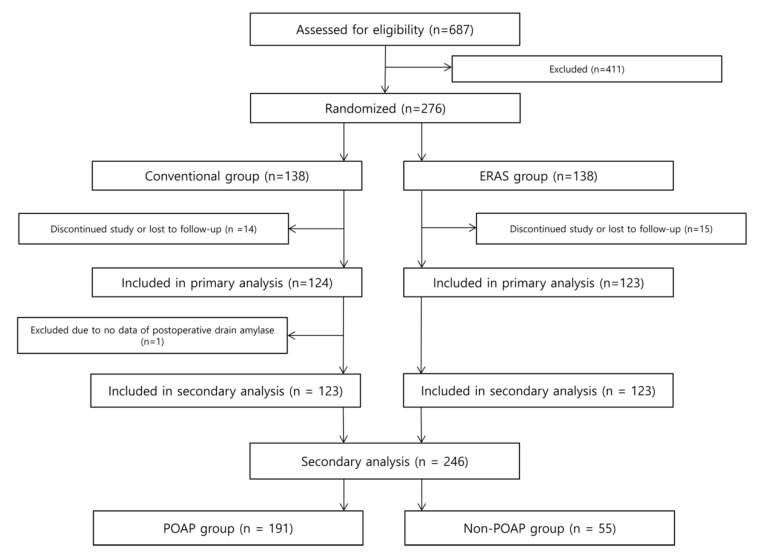
We analyzed the data obtained from a previously published randomized controlled trial. POAP was defined as elevations in serum amylase above 110 U/L on postoperative day 0 or 1. Clinically relevant POAP (CR-POAP) was defined as elevations in C-reactive protein level (CRP) on postoperative day 2 in those with POAP. Postoperative complications including severe complications (Clavien-Dindo ≥ IIIa), POPF, and clinically relevant POPF (CR-POPF) were analyzed.
In 246 patients, POAP did not show significant associations with total postoperative complications (odds ratio (OR) 0.697; 95% CI, 0.360-1.313; = 0.271), severe complications (OR 0.647; 95% CI, 0.258-1.747; = 0.367), and CR-POPF (OR 0.998; 95% CI, 0.310-3.886; = 0.998) in multivariable analysis.
In patients undergoing PD, POAP was not significantly associated with postoperative complications including POPF. Caution should be taken when using POAP as a predictor of POPF.
胰十二指肠切除术(PD)后并发症的预测较为困难,尤其是在术后早期无法进行CT(计算机断层扫描)检查时。术后第0天或第1天血清淀粉酶和脂肪酶升高可用于定义术后急性胰腺炎(POAP),但现有文献对于POAP是否与术后胰瘘(POPF)显著相关尚无定论。
我们分析了先前发表的一项随机对照试验的数据。POAP定义为术后第0天或第1天血清淀粉酶高于110 U/L。临床相关POAP(CR-POAP)定义为POAP患者术后第2天C反应蛋白水平(CRP)升高。分析术后并发症,包括严重并发症(Clavien-Dindo≥IIIa级)、POPF和临床相关POPF(CR-POPF)。
在246例患者中,多变量分析显示POAP与术后总并发症(比值比(OR)0.697;95%可信区间,0.360-1.313;P = 0.271)、严重并发症(OR 0.647;95%可信区间,0.258-1.747;P = 0.367)和CR-POPF(OR 0.998;95%可信区间,0.310-3.886;P = 0.998)均无显著相关性。
在接受PD的患者中,POAP与包括POPF在内的术后并发症无显著相关性。将POAP用作POPF的预测指标时应谨慎。