Lemmi Tsegaye Sh, Barburski Marcin, Kabziński Adam, Frukacz Krzysztof
Faculty of Material Technologies and Textile Design, Institute of Architecture of Textiles, Lodz University of Technology, 90-924 Lodz, Poland.
Sempertrans Bełchatów Sp. z o.o., 97-427 Rogowiec, Poland.
Materials (Basel). 2021 Mar 28;14(7):1666. doi: 10.3390/ma14071666.
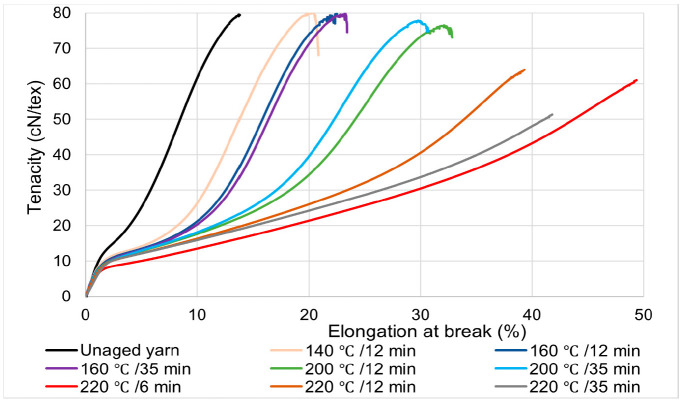
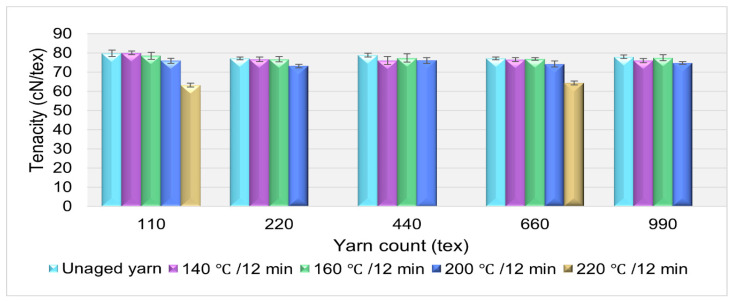
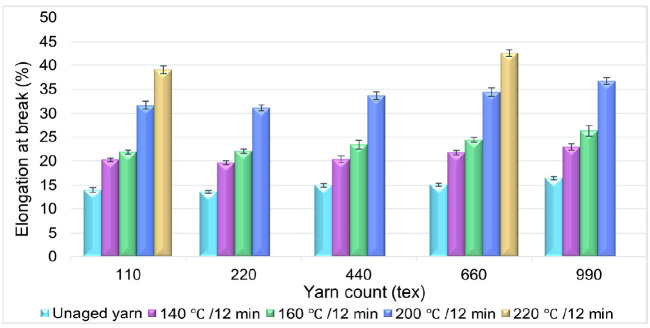
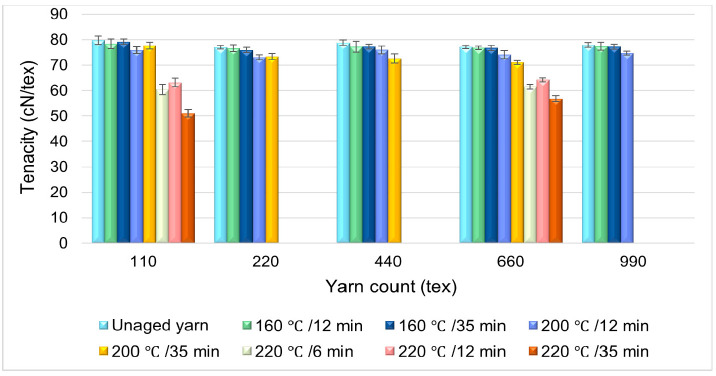
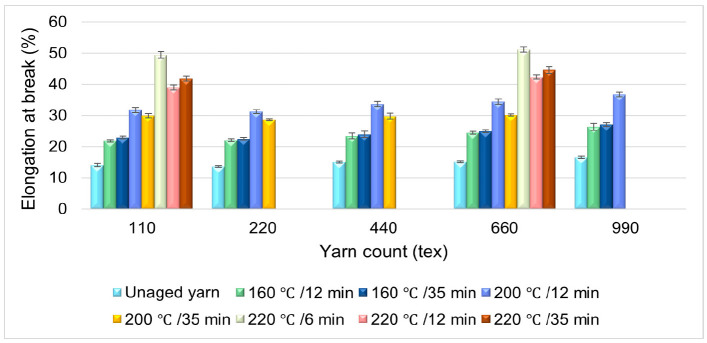
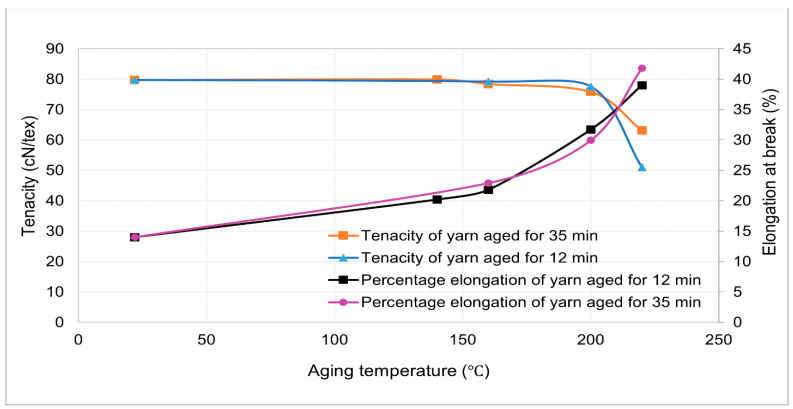
Textile materials produced from a high tenacity industrial polyester fiber are most widely used in the mechanical rubber goods industry to reinforce conveyor belts, tire cords, and hoses. Reinforcement of textile rubber undergoes a vulcanization process to adhere the textile materials with the rubber and to enhance the physio-mechanical properties of the product. The vulcanization process has an influence on the textile material being used as a reinforcement. In this work, the effects of aging temperature and time on the high tenacity polyester yarn's mechanical and surface structural properties were investigated. An experiment was carried out on a pre-activated high tenacity polyester yarn of different linear densities, by aging the yarn specimens under various aging temperatures of 140, 160, 200, and 220 °C for six, twelve, and thirty-five minutes of aging time. The tensile properties and surface structural change in the yarns pre- and post-aging were studied. The investigation illustrates that aging time and temperature influence the surface structure of the fiber, tenacity, and elongation properties of the yarn. Compared to unaged yarn, an almost five times higher percentage of elongation was obtained for the samples aged at 220 °C for 6 min, while the lowest tenacity was obtained for the sample subjected to aging under 220 °C for 35 min.
由高强力工业聚酯纤维制成的纺织材料在机械橡胶制品行业中应用最为广泛,用于增强输送带、轮胎帘子线和软管。纺织橡胶增强材料要经过硫化过程,以使纺织材料与橡胶粘合,并提高产品的物理机械性能。硫化过程会对用作增强材料的纺织材料产生影响。在这项工作中,研究了老化温度和时间对高强力聚酯纱线机械性能和表面结构性能的影响。对不同线密度的预活化高强力聚酯纱线进行了实验,将纱线试样在140、160、200和220°C的各种老化温度下分别老化6、12和35分钟。研究了纱线老化前后的拉伸性能和表面结构变化。研究表明,老化时间和温度会影响纤维的表面结构、纱线的强度和伸长性能。与未老化的纱线相比,在220°C下老化6分钟的样品伸长率提高了近五倍,而在220°C下老化35分钟的样品强度最低。