Mihalca Vlad, Kerezsi Andreea Diana, Weber Achim, Gruber-Traub Carmen, Schmucker Jürgen, Vodnar Dan Cristian, Dulf Francisc Vasile, Socaci Sonia Ancuța, Fărcaș Anca, Mureșan Carmen Ioana, Suharoschi Ramona, Pop Oana Lelia
Department of Food Science, University of Agricultural Science and Veterinary Medicine, 400372 Cluj-Napoca, Romania.
TERRA Research and Teaching Center, Gembloux Agro-Bio Tech, University of Liege, Department of Food Science and Formulation, Passage des Deportes-2, B-5030 Gembloux, Belgium.
Polymers (Basel). 2021 Mar 2;13(5):769. doi: 10.3390/polym13050769.
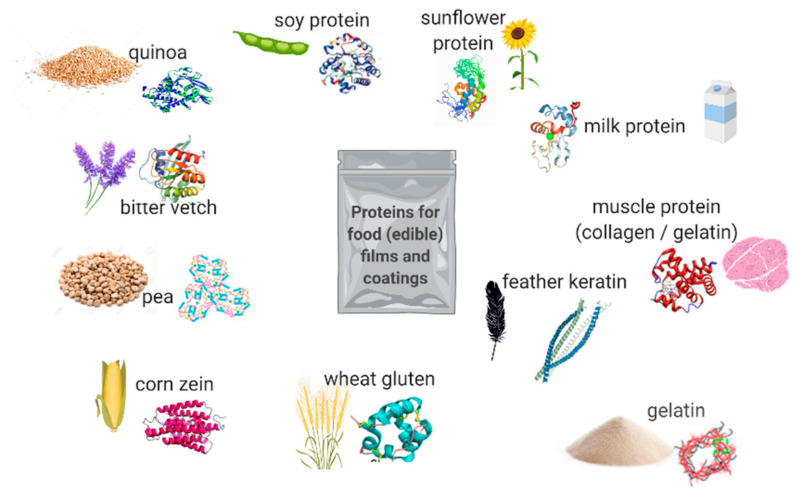
Food packaging is an area of interest not just for food producers or food marketing, but also for consumers who are more and more aware about the fact that food packaging has a great impact on food product quality and on the environment. The most used materials for the packaging of food are plastic, glass, metal, and paper. Still, over time edible films have become widely used for a variety of different products and different food categories such as meat products, vegetables, or dairy products. For example, proteins are excellent materials used for obtaining edible or non-edible coatings and films. The scope of this review is to overview the literature on protein utilization in food packages and edible packages, their functionalization, antioxidant, antimicrobial and antifungal activities, and economic perspectives. Different vegetable (corn, soy, mung bean, pea, grass pea, wild and Pasankalla quinoa, bitter vetch) and animal (whey, casein, keratin, collagen, gelatin, surimi, egg white) protein sources are discussed. Mechanical properties, thickness, moisture content, water vapor permeability, sensorial properties, and suitability for the environment also have a significant impact on protein-based packages utilization.
食品包装不仅是食品生产商或食品营销领域关注的一个方面,对于越来越意识到食品包装对食品产品质量和环境有重大影响的消费者来说也是如此。用于食品包装的最常用材料是塑料、玻璃、金属和纸张。然而,随着时间的推移,可食用薄膜已广泛应用于各种不同的产品和不同的食品类别,如肉类产品、蔬菜或乳制品。例如,蛋白质是用于制备可食用或不可食用涂层及薄膜的优良材料。本综述的范围是概述有关蛋白质在食品包装和可食用包装中的利用、其功能化、抗氧化、抗菌和抗真菌活性以及经济前景的文献。文中讨论了不同的植物性(玉米、大豆、绿豆、豌豆、草豌豆、野生藜麦和帕桑卡拉藜麦、苦巢菜)和动物性(乳清、酪蛋白、角蛋白、胶原蛋白、明胶、鱼糜、蛋清)蛋白质来源。机械性能、厚度、水分含量、水蒸气透过率、感官特性以及对环境的适应性也对基于蛋白质的包装的应用有重大影响。