DeGrandi-Hoffman Gloria, Corby-Harris Vanessa, Carroll Mark, Toth Amy L, Gage Stephanie, Watkins deJong Emily, Graham Henry, Chambers Mona, Meador Charlotte, Obernesser Bethany
Carl Hayden Bee Research Center, USDA Agricultural Research Service, 2000 East Allen Road, Tucson, AZ 85719, USA.
Department of Entomology, Iowa State University, 2310 Pammel Drive, 339 Science Hall II, Ames, IA 50011, USA.
Insects. 2021 Mar 10;12(3):235. doi: 10.3390/insects12030235.
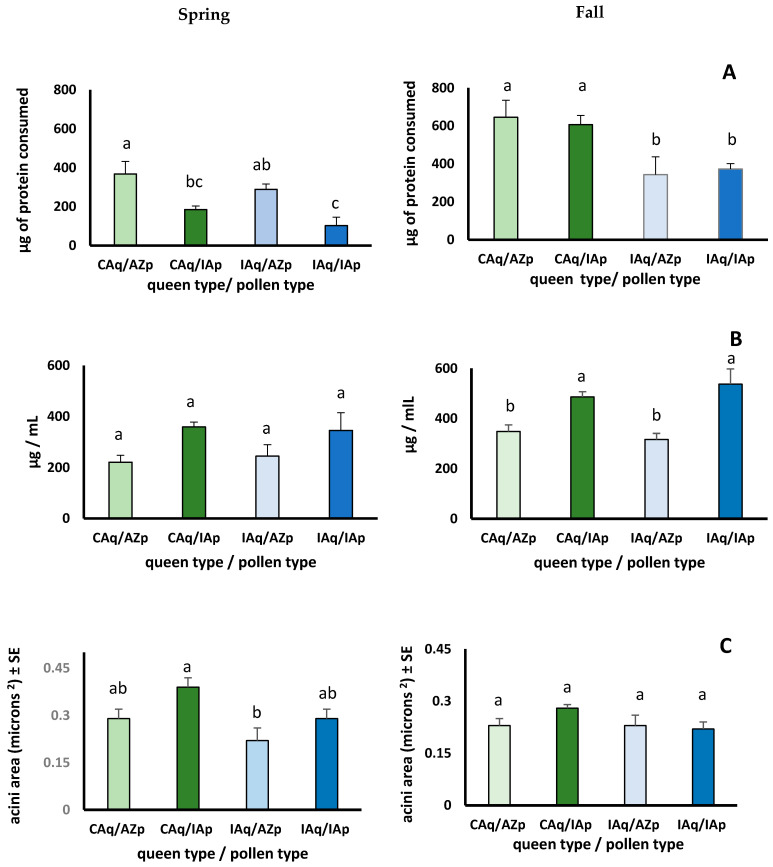
Honey bee colonies have a yearly cycle that is supported nutritionally by the seasonal progression of flowering plants. In the spring, colonies grow by rearing brood, but in the fall, brood rearing declines in preparation for overwintering. Depending on where colonies are located, the yearly cycle can differ especially in overwintering activities. In temperate climates of Europe and North America, colonies reduce or end brood rearing in the fall while in warmer climates bees can rear brood and forage throughout the year. To test the hypothesis that nutrients available in seasonal pollens and honey bee responses to them can differ we analyzed pollen in the spring and fall collected by colonies in environments where brood rearing either stops in the fall (Iowa) or continues through the winter (Arizona). We fed both types of pollen to worker offspring of queens that emerged and open mated in each type of environment. We measured physiological responses to test if they differed depending on the location and season when the pollen was collected and the queen line of the workers that consumed it. Specifically, we measured pollen and protein consumption, gene expression levels (, , and ) and hypopharyngeal gland (HPG) development. We found differences in macronutrient content and amino and fatty acids between spring and fall pollens from the same location and differences in nutrient content between locations during the same season. We also detected queen type and seasonal effects in HPG size and differences in gene expression between bees consuming spring vs. fall pollen with larger HPG and higher gene expression levels in those consuming spring pollen. The effects might have emerged from the seasonal differences in nutritional content of the pollens and genetic factors associated with the queen lines we used.
蜂群有一个年度周期,这个周期在营养上依赖于开花植物的季节性变化。在春季,蜂群通过培育幼虫来发展壮大,但在秋季,为了准备过冬,幼虫培育活动会减少。根据蜂群所处的位置,年度周期可能会有所不同,尤其是在过冬活动方面。在欧洲和北美的温带气候地区,蜂群在秋季会减少或停止幼虫培育,而在气候较温暖的地区,蜜蜂全年都可以培育幼虫并觅食。为了验证季节性花粉中可利用的营养物质以及蜜蜂对它们的反应可能存在差异这一假设,我们分析了在秋季幼虫培育停止(爱荷华州)或整个冬季持续进行(亚利桑那州)的环境中,蜂群在春季和秋季采集的花粉。我们将这两种花粉分别喂给在每种环境中羽化并进行开放式交尾的蜂王的工蜂后代。我们测量了生理反应,以测试这些反应是否因花粉采集的地点和季节以及食用花粉的工蜂的蜂王品系不同而有所差异。具体来说,我们测量了花粉和蛋白质的消耗量、基因表达水平(、和)以及下咽腺(HPG)的发育情况。我们发现,同一地点春季和秋季花粉中的常量营养素含量、氨基酸和脂肪酸存在差异,同一季节不同地点的花粉营养成分也存在差异。我们还检测到了蜂王类型和季节对下咽腺大小的影响,以及食用春季花粉与秋季花粉的蜜蜂之间基因表达的差异,食用春季花粉的蜜蜂下咽腺更大,基因表达水平更高。这些影响可能源于花粉营养成分的季节性差异以及我们所使用的蜂王品系相关的遗传因素。