Department of Industrial Chemistry, Faculty of Applied Science, King Mongkut's University of Technology North Bangkok, 1518 Pracharat 1 Rd., Wongsawang, Bangsue, Bangkok 10800, Thailand.
Department of Food and Human Nutritional Sciences, University of Manitoba, Winnipeg, MB R3T 2N2, Canada.
Molecules. 2021 Mar 10;26(6):1515. doi: 10.3390/molecules26061515.
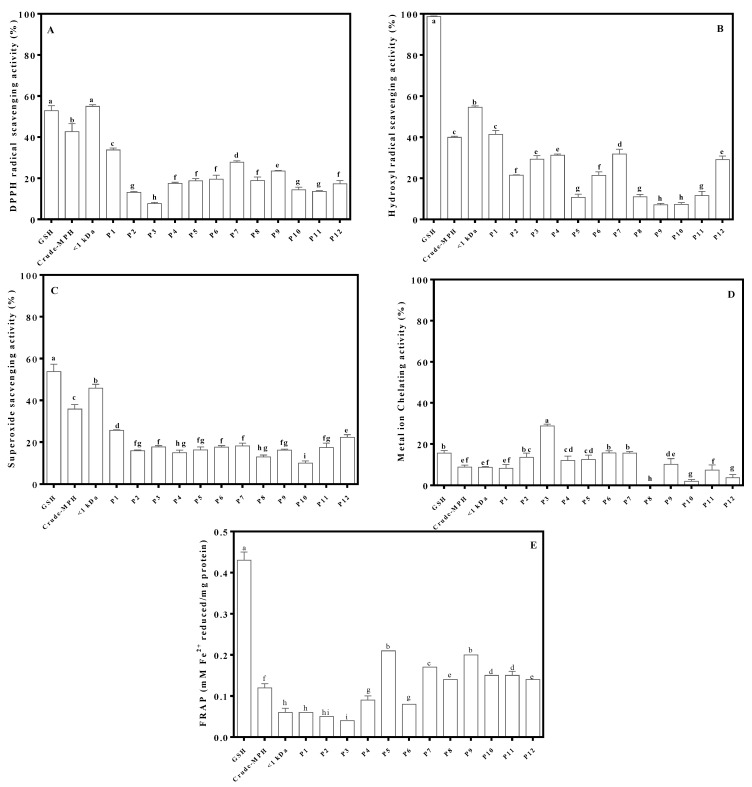
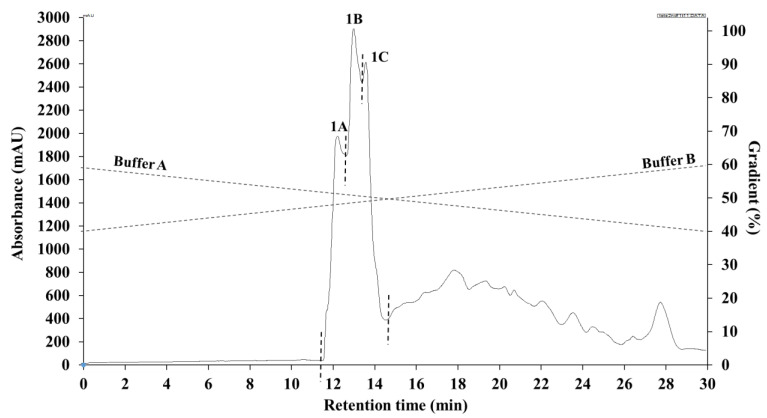
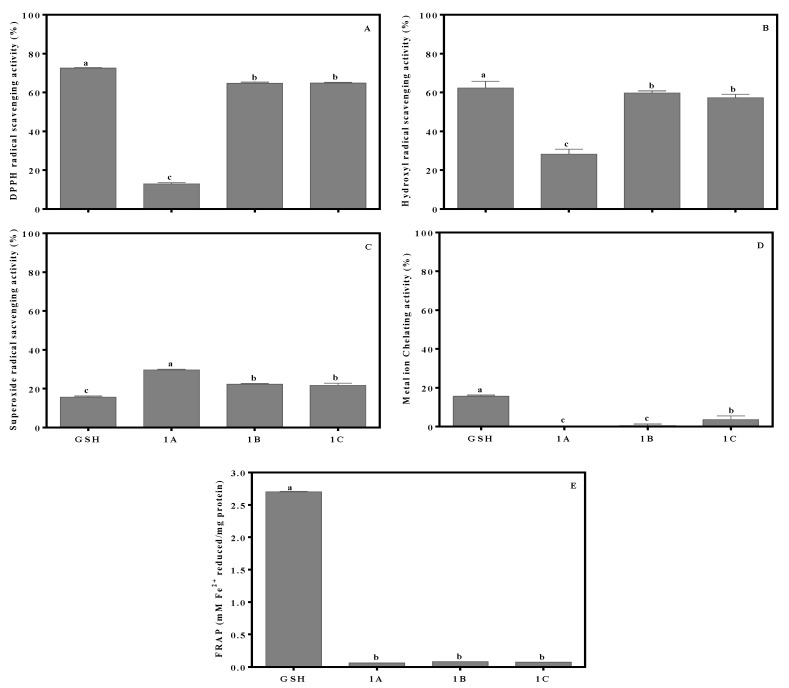
The aim of this work was to characterize the antioxidant properties of some of the peptides present in bromelain mung bean meal protein hydrolysate (MMPH). The MMPH was subjected to two rounds of bioassay-guided reversed-phase HPLC separation followed by peptide identification in the most potent fractions using tandem mass spectrometry. Twelve antioxidant peptides, namely, HC, CGN, LAN, CTN, LAF, CSGD, MMGW, QFAAD, ERF, EYW, FLQL, and QFAW were identified and assayed for antioxidant properties. CTN, HC, CGN, and CSGD were the most potent ( < 0.05) DPPH radical scavengers with EC values of 0.30, 0.29, 0.28, and 0.30 mg/mL, respectively, which are lower than the 0.03 mg/mL obtained for reduced glutathione (GSH). CTN, HC, CGN, and CSGD exhibited the most potent ( < 0.05) scavenging activities against hydroxyl and superoxide radicals with EC values that are similar to those of GSH. The cysteine-containing peptides also had stronger ferric reducing antioxidant power and metal chelation activity than peptides devoid of cysteine. In contrast, MMGW, ERF, and EYW had poor radical scavenging and metal chelation activities. We conclude that the availability of the sulfhydryl group may have enhanced antioxidant potency while the presence of bulky groups such phenylalanine and tryptophan had an opposite effect.
本工作旨在研究菠萝蛋白酶绿豆蛋白水解物(MMPH)中某些肽的抗氧化特性。MMPH 经两轮生物测定指导的反相 HPLC 分离,随后在最强的级分中使用串联质谱对肽进行鉴定。鉴定并测试了 12 种抗氧化肽,即 HC、CGN、LAN、CTN、LAF、CSGD、MMGW、QFAAD、ERF、EYW、FLQL 和 QFAW。CTN、HC、CGN 和 CSGD 是最强的(<0.05)DPPH 自由基清除剂,EC 值分别为 0.30、0.29、0.28 和 0.30mg/mL,低于还原型谷胱甘肽(GSH)的 0.03mg/mL。CTN、HC、CGN 和 CSGD 对羟基自由基和超氧自由基具有最强的(<0.05)清除活性,EC 值与 GSH 相似。含半胱氨酸的肽还具有比不含半胱氨酸的肽更强的铁还原抗氧化能力和金属螯合活性。相比之下,MMGW、ERF 和 EYW 对自由基的清除和金属螯合活性较差。我们得出结论,巯基的可用性可能增强了抗氧化能力,而苯丙氨酸和色氨酸等大基团的存在则产生了相反的效果。