Department of Clinical Nursing, Wroclaw Medical University, 51-618 Wrocław, Poland.
Department of Internal Medicine, Occupational Diseases, Hypertension and Clinical Oncology, Wroclaw Medical University, 50-556 Wrocław, Poland.
Int J Environ Res Public Health. 2021 Mar 10;18(6):2825. doi: 10.3390/ijerph18062825.
Non-adherence to pharmaceutical treatment is one of the most common causes of uncontrolled hypertension. Non-adherence may be intentional or unintentional. In the case of intentional non-adherence, it is crucial to understand the reasons behind it. The literature increasingly addresses the issue of beliefs and concerns about medication, but studies on this subject performed in a Polish population of hypertensive patients are still lacking. The aim of the study was to assess the level of intentional non-adherence among patients with hypertension, and to determine the relationship between beliefs about medication and the level of intentional non-adherence to treatment in elderly patients with hypertension.
The study included 300 patients (106 of whom were male, mean age (SD) 71.71 (8.12) years) with hypertension, treated at a hypertension clinic. The following instruments were used: the Intentional Non-Adherence Scale (INAS) for evaluating intentional non-adherence, and the Beliefs about Medicines Questionnaire (BMQ) for evaluating patients' beliefs and opinions regarding medication. Socio-demographic and clinical data were obtained from patients' medical records.
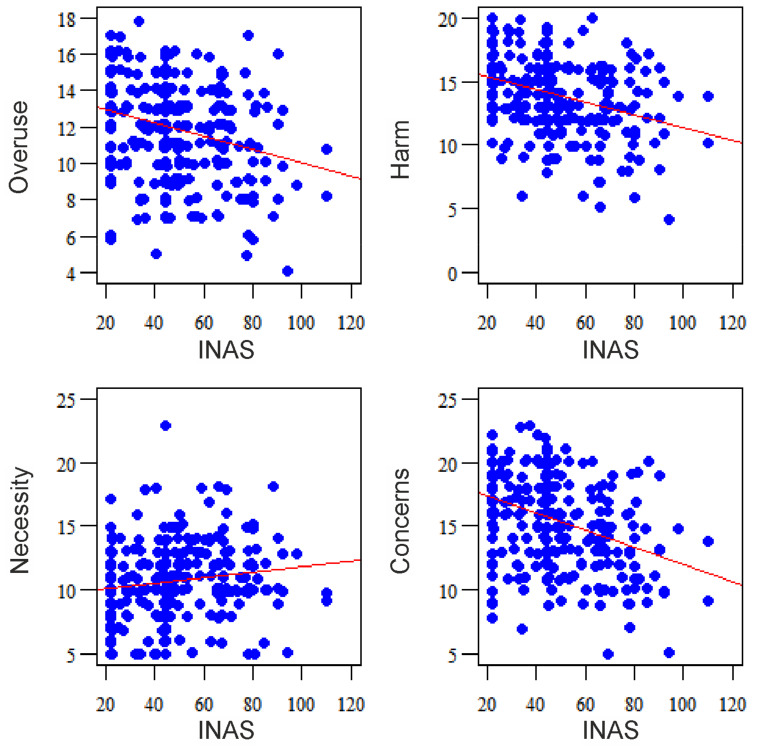
The mean (SD) INAS score in the study was 47.28 (19.12). Patients were most concerned about the harm caused by medication, and least concerned about the necessity to take medication (mean score per item 3.49 vs. 2.14). Correlation analysis demonstrated weak correlations between BMQ and INAS: higher scores for necessity were associated with more intentional non-adherence (r = 0.174, = 0.003), while higher scores for overuse, harm, and concerns were associated with less intentional non-adherence (respectively: r = -0.253, < 0.001 vs. r = -0.336, < 0.001 vs. r = -0.351, < 0.001). In multiple-factor analysis, factors increasing the level of intentional non-adherence were elderly age (β = -0.352, = 0.009), multimorbidity (β = -2.374, = 0.035), and a higher BMQ concerns score (β = -1.376, < 0.001), while being single was an independent predictor decreasing intentional non-adherence (β = 5.646, = 0.013).
The overall level of intentional non-adherence among patients with hypertension is moderate, but approximately one third of patients with hypertension demonstrate a high level of non-adherence. Independent determinants of intentional non-adherence include concerns, elderly age, multimorbidity, and being single.
不遵守药物治疗是高血压控制不良的最常见原因之一。不遵守治疗可能是故意的,也可能是无意的。在故意不遵守治疗的情况下,了解背后的原因至关重要。文献越来越多地讨论了关于药物的信念和担忧问题,但在波兰高血压患者群体中进行的关于该主题的研究仍然缺乏。本研究的目的是评估高血压患者中故意不遵守治疗的程度,并确定老年高血压患者对药物的信念与故意不遵守治疗之间的关系。
该研究纳入了 300 名高血压患者(其中 106 名为男性,平均年龄(标准差)为 71.71(8.12)岁),这些患者在高血压诊所接受治疗。研究中使用了以下工具:评估故意不遵守治疗的故意不遵守量表(INAS)和评估患者对药物的信念和看法的药物信念问卷(BMQ)。从患者的病历中获得了社会人口统计学和临床数据。
研究中平均(标准差)INAS 得分为 47.28(19.12)。患者最关心药物引起的危害,而最不关心服药的必要性(每项的平均得分分别为 3.49 分和 2.14 分)。相关性分析显示 BMQ 和 INAS 之间存在弱相关性:必要性得分越高,故意不遵守的程度越高(r = 0.174, = 0.003),而过度使用、危害和担忧得分越高,故意不遵守的程度越低(分别为 r = -0.253, < 0.001 vs. r = -0.336, < 0.001 vs. r = -0.351, < 0.001)。在多因素分析中,增加故意不遵守程度的因素包括老年(β = -0.352, = 0.009)、多病共存(β = -2.374, = 0.035)和较高的 BMQ 担忧得分(β = -1.376, < 0.001),而单身是降低故意不遵守的独立预测因素(β = 5.646, = 0.013)。
高血压患者的整体故意不遵守治疗程度为中度,但约三分之一的高血压患者表现出高度的不遵守治疗。故意不遵守的独立决定因素包括担忧、年龄较大、多病共存和单身。