Division of Molecular Medicine, Department of Internal Medicine, University of New Mexico Health Sciences Center, Albuquerque, NM 87131, USA.
Center of Biomedical Research Excellence in Autophagy, Inflammation and Metabolism, University of New Mexico Health Sciences Center, Albuquerque, NM 87131, USA.
Cells. 2021 Mar 17;10(3):672. doi: 10.3390/cells10030672.
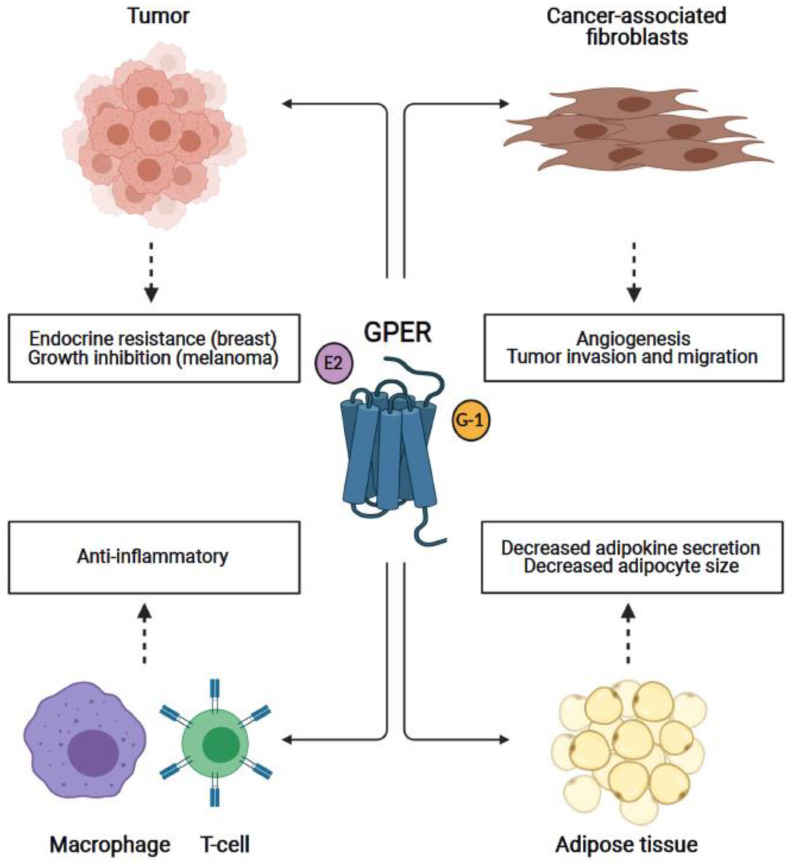
Estrogen is involved in numerous physiological and pathophysiological systems. Its role in driving estrogen receptor-expressing breast cancers is well established, but it also has important roles in a number of other cancers, acting both on tumor cells directly as well as in the function of multiple cells of the tumor microenvironment, including fibroblasts, immune cells, and adipocytes, which can greatly impact carcinogenesis. One of its receptors, the G protein-coupled estrogen receptor (GPER), has gained much interest over the last decade in both health and disease. Increasing evidence shows that GPER contributes to clinically observed endocrine therapy resistance in breast cancer while also playing a complex role in a number of other cancers. Recent discoveries regarding the targeting of GPER in combination with immune checkpoint inhibition, particularly in melanoma, have led to the initiation of the first Phase I clinical trial for the GPER-selective agonist G-1. Furthermore, its functions in metabolism and corresponding pathophysiological states, such as obesity and diabetes, are becoming more evident and suggest additional therapeutic value in targeting GPER for both cancer and other diseases. Here, we highlight the roles of GPER in several cancers, as well as in metabolism and immune regulation, and discuss the therapeutic value of targeting this estrogen receptor as a potential treatment for cancer as well as contributing metabolic and inflammatory diseases and conditions.
雌激素参与了许多生理和病理生理系统。它在驱动雌激素受体表达的乳腺癌中的作用已得到充分证实,但它在许多其他癌症中也具有重要作用,既直接作用于肿瘤细胞,也作用于肿瘤微环境中的多种细胞的功能,包括成纤维细胞、免疫细胞和脂肪细胞,这极大地影响了癌变。它的一个受体,G 蛋白偶联雌激素受体(GPER),在过去十年中在健康和疾病方面引起了广泛关注。越来越多的证据表明,GPER 有助于临床观察到的乳腺癌内分泌治疗耐药,同时在许多其他癌症中也发挥着复杂的作用。最近关于与免疫检查点抑制联合靶向 GPER 的发现,特别是在黑色素瘤中,导致了第一个针对 GPER 选择性激动剂 G-1 的 I 期临床试验的启动。此外,它在代谢和相应的病理生理状态(如肥胖和糖尿病)中的功能变得更加明显,并表明针对 GPER 具有额外的治疗价值,不仅可用于癌症,还可用于治疗其他疾病和病症。在这里,我们强调了 GPER 在几种癌症以及代谢和免疫调节中的作用,并讨论了靶向这种雌激素受体作为癌症以及代谢和炎症性疾病和病症的潜在治疗方法的治疗价值。