Gatto Francesca, Milletti Giacomo, Carai Andrea, Mastronuzzi Angela, Nazio Francesca
Department of Pediatric Hemato-Oncology and Cell and Gene Therapy, Bambino Gesù Children's Hospital, IRCCS, 00165 Rome, Italy.
Department of Biology, University of Rome 'Tor Vergata', 00133 Rome, Italy.
Diagnostics (Basel). 2021 Mar 9;11(3):481. doi: 10.3390/diagnostics11030481.
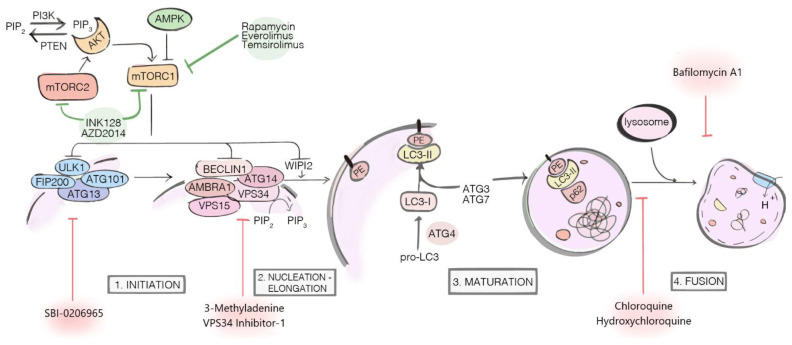
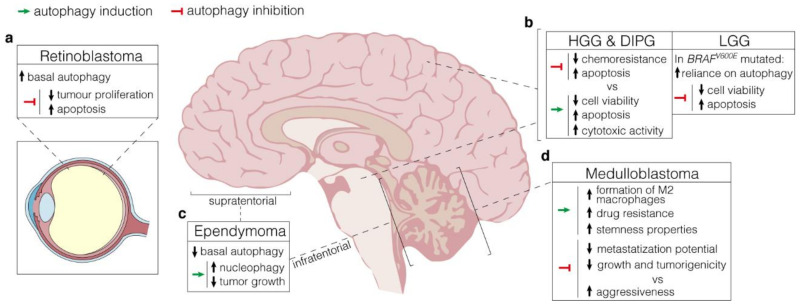
Autophagy is a degradative process occurring in eukaryotic cells to maintain homeostasis and cell survival. After stressful conditions including nutrient deprivation, hypoxia or drugs administration, autophagy is induced to counteract pathways that could lead to cell death. In cancer, autophagy plays a paradoxical role, acting both as tumour suppressor-by cleaning cells from damaged organelles and inhibiting inflammation or, alternatively, by promoting genomic stability and tumour adaptive response-or as a pro-survival mechanism to protect cells from stresses such as chemotherapy. Neural-derived paediatric solid tumours represent a variety of childhood cancers with unique anatomical location, cellular origins, and clinical presentation. These tumours are a leading cause of morbidity and mortality among children and new molecular diagnostics and therapies are necessary for longer survival and reduced morbidity. Here, we review advances in our understanding of how autophagy modulation exhibits antitumor properties in experimental models of paediatric brain tumours, i.e., medulloblastoma (MB), ependymoma (EPN), paediatric low-grade and high-grade gliomas (LGGs, HGGs), atypical teratoid/rhabdoid tumours (ATRTs), and retinoblastoma (RB). We also discuss clinical perspectives to consider how targeting autophagy may be relevant in these specific paediatric tumours.
自噬是真核细胞中发生的一种降解过程,以维持体内平衡和细胞存活。在包括营养剥夺、缺氧或药物给药等应激条件下,自噬被诱导以对抗可能导致细胞死亡的途径。在癌症中,自噬发挥着矛盾的作用,既作为肿瘤抑制因子——通过清除受损细胞器中的细胞并抑制炎症,或者通过促进基因组稳定性和肿瘤适应性反应,又作为一种促生存机制来保护细胞免受化疗等应激。神经源性小儿实体瘤代表了多种儿童癌症,具有独特的解剖位置、细胞起源和临床表现。这些肿瘤是儿童发病和死亡的主要原因,新的分子诊断和治疗方法对于延长生存期和降低发病率是必要的。在这里,我们综述了我们对自噬调节在小儿脑肿瘤实验模型(即髓母细胞瘤(MB)、室管膜瘤(EPN)、小儿低级别和高级别胶质瘤(LGGs、HGGs)、非典型畸胎样/横纹肌样肿瘤(ATRTs)和成视网膜细胞瘤(RB))中如何展现抗肿瘤特性的理解进展。我们还讨论了临床前景,以考虑靶向自噬在这些特定小儿肿瘤中可能的相关性。