Savage Amanda, Minshew Lana M, Anksorus Heidi N, McLaughlin Jacqueline E
UNC Eshelman School of Pharmacy, University of North Carolina at Chapel Hill, Chapel Hill, NC 27599-7355, USA.
Center for Innovative Pharmacy Education and Research, UNC Eshelman School of Pharmacy, University of North Carolina, Chapel Hill, NC 27599-7355, USA.
Pharmacy (Basel). 2021 Mar 18;9(1):62. doi: 10.3390/pharmacy9010062.
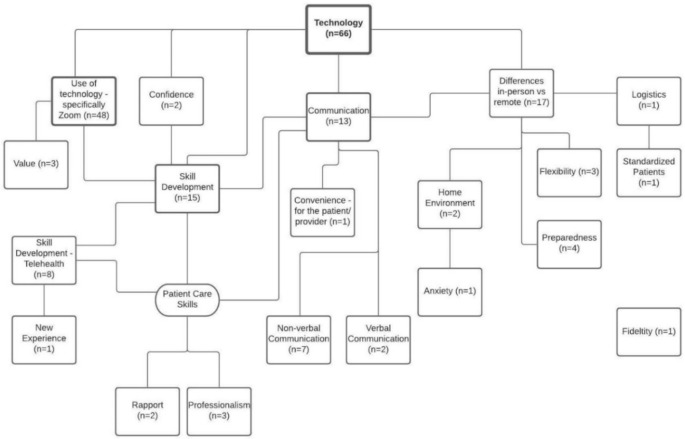
During the wake of the COVID-19 pandemic, many schools quickly transitioned their teaching and assessment strategies to online formats. In Spring 2020, a 3-station remote Objective Structured Clinical Examination (OSCE) was implemented for first-year pharmacy students. The day following the remote OSCEs students answered three open-text prompts about the remote OSCE experience: (1) "I liked...", (2) "I learned…", and (3) "I suggest…". Responses were open-coded and frequency counts were calculated to determine the most prevalent codes. Concept maps were created to visualize and explore connections between the codes. Out of 157 students, 156 students completed the reflection assignment, a 99.36% response rate. The three major themes in the Liked data were: Logistics ( = 65, 41.7%), Differences In-person Versus Remote ( = 59, 37.8%), and Skill Development ( = 43, 27.6%). The three major themes in the Learned data were: Technology ( = 66, 42.3%), Communication ( = 58, 37.2%), and Skill Development ( = 56, 35.9%). The three major themes in the Suggest data were: Logistics ( = 89, 57.1%), Technology ( = 31, 19.9%), and Continuation of Remote OSCE ( = 31, 19.9%). Overall, the remote OSCE experience was well-received, and students described it as applicable to their future pharmacy practice. Future work should explore the design, implementation, and outcomes of remote OSCEs.
在新冠疫情期间,许多学校迅速将其教学和评估策略转变为在线形式。2020年春季,为一年级药学专业学生实施了一场三站式远程客观结构化临床考试(OSCE)。在远程OSCE考试后的第二天,学生们回答了三个关于远程OSCE体验的开放式文本提示:(1)“我喜欢……”,(2)“我学到了……”,以及(3)“我建议……”。对回答进行了开放式编码,并计算了频数以确定最普遍的编码。创建了概念图以可视化并探索编码之间的联系。在157名学生中,有156名学生完成了反思作业,回复率为99.36%。“喜欢”数据中的三个主要主题是:后勤(n = 65,41.7%)、面对面与远程的差异(n = 59,37.8%)以及技能发展(n = 43,27.6%)。“学到”数据中的三个主要主题是:技术(n = 66,42.3%)、沟通(n = 58,37.2%)以及技能发展(n = 56,35.9%)。“建议”数据中的三个主要主题是:后勤(n = 89,57.1%)、技术(n = 31,19.9%)以及远程OSCE的延续(n = 31,19.9%)。总体而言,远程OSCE体验受到了好评,学生们将其描述为适用于他们未来的药学实践。未来的工作应该探索远程OSCE的设计、实施和结果。