Rudolf-Zenker-Institute for Experimental Surgery, Medical University Rostock, 18057 Rostock, Germany.
Department of Psychosomatic Medicine and Psychotherapy, University of Rostock, 18147 Rostock, Germany.
Nutrients. 2021 Mar 18;13(3):985. doi: 10.3390/nu13030985.
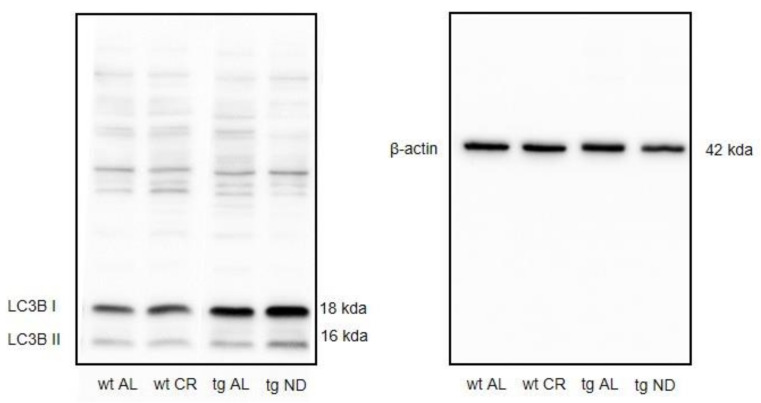
Caloric restriction (CR) slows the aging process, extends lifespan, and exerts neuroprotective effects. It is widely accepted that CR attenuates β-amyloid (Aβ) neuropathology in models of Alzheimer's disease (AD) by so-far unknown mechanisms. One promising process induced by CR is autophagy, which is known to degrade aggregated proteins such as amyloids. In addition, autophagy positively regulates glucose uptake and may improve cerebral hypometabolism-a hallmark of AD-and, consequently, neural activity. To evaluate this hypothesis, APPswe/PS1delta9 (tg) mice and their littermates (wild-type, wt) underwent CR for either 16 or 68 weeks. Whereas short-term CR for 16 weeks revealed no noteworthy changes of AD phenotype in tg mice, long-term CR for 68 weeks showed beneficial effects. Thus, cerebral glucose metabolism and neuronal integrity were markedly increased upon 68 weeks CR in tg mice, indicated by an elevated hippocampal fluorodeoxyglucose [F] ([F]FDG) uptake and increased N-acetylaspartate-to-creatine ratio using positron emission tomography/computer tomography (PET/CT) imaging and magnet resonance spectroscopy (MRS). Improved neuronal activity and integrity resulted in a better cognitive performance within the Morris Water Maze. Moreover, CR for 68 weeks caused a significant increase of LC3BII and p62 protein expression, showing enhanced autophagy. Additionally, a significant decrease of Aβ plaques in tg mice in the hippocampus was observed, accompanied by reduced microgliosis as indicated by significantly decreased numbers of iba1-positive cells. In summary, long-term CR revealed an overall neuroprotective effect in tg mice. Further, this study shows, for the first time, that CR-induced autophagy in tg mice accompanies the observed attenuation of Aβ pathology.
热量限制(CR)可减缓衰老过程、延长寿命并发挥神经保护作用。人们普遍认为,CR 通过迄今为止未知的机制减轻了阿尔茨海默病(AD)模型中的β-淀粉样蛋白(Aβ)神经病理学。CR 诱导的一个有前途的过程是自噬,已知自噬可降解淀粉样蛋白等聚集蛋白。此外,自噬还积极调节葡萄糖摄取,可能改善 AD 的标志性脑低代谢,并因此改善神经活动。为了评估这一假设,APPswe/PS1delta9(tg)小鼠及其同窝仔鼠(野生型,wt)接受了 16 或 68 周的 CR。尽管 16 周的短期 CR 并未显示 tg 小鼠的 AD 表型有明显变化,但 68 周的长期 CR 显示出有益的效果。因此,在 tg 小鼠中进行 68 周的 CR 后,大脑葡萄糖代谢和神经元完整性显著增加,这表现为使用正电子发射断层扫描/计算机断层扫描(PET/CT)成像和磁共振光谱(MRS)测量,海马区氟脱氧葡萄糖[F]摄取[F]FDG 增加,N-乙酰天冬氨酸与肌酸比增加。在 Morris 水迷宫中,改善的神经元活性和完整性导致认知表现更好。此外,CR 进行 68 周可导致 LC3BII 和 p62 蛋白表达显著增加,表明自噬增强。此外,在 tg 小鼠的海马体中还观察到 Aβ斑块的显著减少,同时伴随着小胶质细胞减少,表现为 iba1 阳性细胞数量显著减少。总之,长期 CR 在 tg 小鼠中显示出整体神经保护作用。此外,本研究首次表明,CR 诱导的 tg 小鼠自噬伴随着观察到的 Aβ 病理学减轻。