• 文献检索
  • 文档翻译
  • 深度研究
  • 学术资讯
  • Suppr Zotero 插件Zotero 插件
  • 邀请有礼
  • 套餐&价格
  • 历史记录
应用&插件
Suppr Zotero 插件Zotero 插件浏览器插件Mac 客户端Windows 客户端微信小程序
定价
高级版会员购买积分包购买API积分包
服务
文献检索文档翻译深度研究API 文档MCP 服务
关于我们
关于 Suppr公司介绍联系我们用户协议隐私条款
关注我们

Suppr 超能文献

核心技术专利:CN118964589B侵权必究
粤ICP备2023148730 号-1Suppr @ 2026

文献检索

告别复杂PubMed语法,用中文像聊天一样搜索,搜遍4000万医学文献。AI智能推荐,让科研检索更轻松。

立即免费搜索

文件翻译

保留排版,准确专业,支持PDF/Word/PPT等文件格式,支持 12+语言互译。

免费翻译文档

深度研究

AI帮你快速写综述,25分钟生成高质量综述,智能提取关键信息,辅助科研写作。

立即免费体验

基于传感器的人机活动识别的时空深度学习。

Sensor-Based Human Activity Recognition with Spatio-Temporal Deep Learning.

机构信息

Department of Computer Science, College of Computer Science and Engineering, Taibah University, Medina 42353, Saudi Arabia.

Department of Computer Engineering, College of Computer and Information Sciences, King Saud University, Riyadh 11543, Saudi Arabia.

出版信息

Sensors (Basel). 2021 Mar 18;21(6):2141. doi: 10.3390/s21062141.

DOI:10.3390/s21062141
PMID:33803891
原文链接:https://pmc.ncbi.nlm.nih.gov/articles/PMC8003187/
Abstract

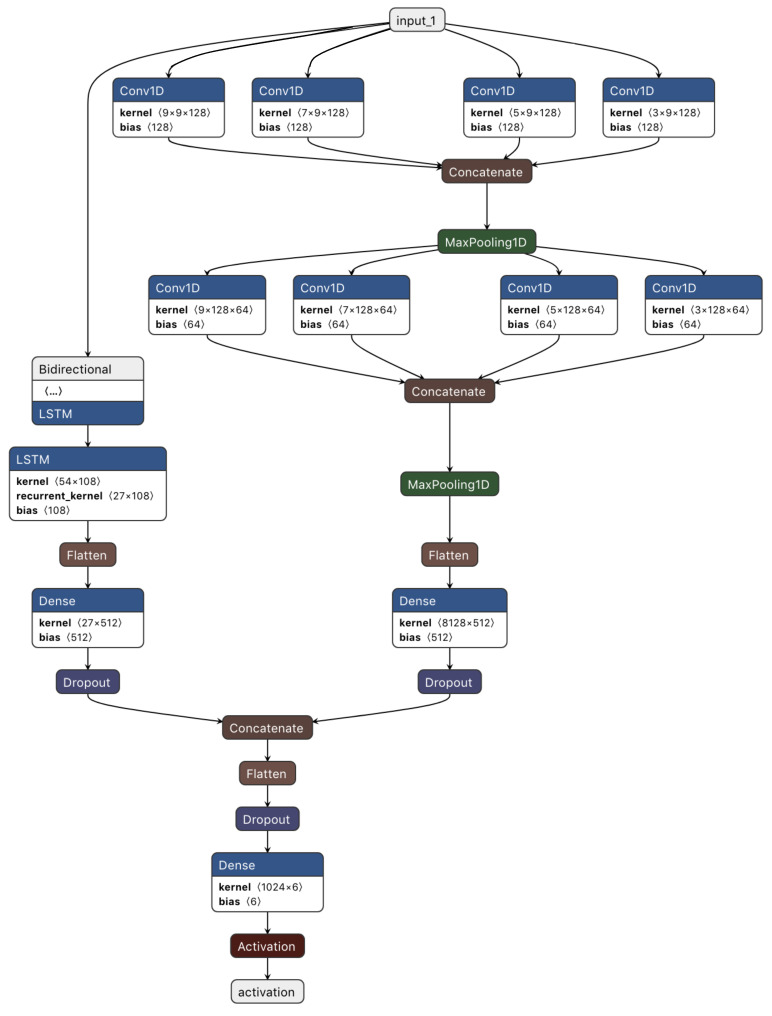
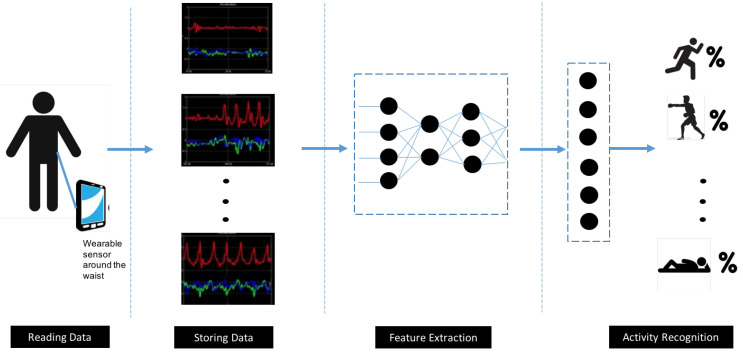
Human activity recognition (HAR) remains a challenging yet crucial problem to address in computer vision. HAR is primarily intended to be used with other technologies, such as the Internet of Things, to assist in healthcare and eldercare. With the development of deep learning, automatic high-level feature extraction has become a possibility and has been used to optimize HAR performance. Furthermore, deep-learning techniques have been applied in various fields for sensor-based HAR. This study introduces a new methodology using convolution neural networks (CNN) with varying kernel dimensions along with bi-directional long short-term memory (BiLSTM) to capture features at various resolutions. The novelty of this research lies in the effective selection of the optimal video representation and in the effective extraction of spatial and temporal features from sensor data using traditional CNN and BiLSTM. Wireless sensor data mining (WISDM) and UCI datasets are used for this proposed methodology in which data are collected through diverse methods, including accelerometers, sensors, and gyroscopes. The results indicate that the proposed scheme is efficient in improving HAR. It was thus found that unlike other available methods, the proposed method improved accuracy, attaining a higher score in the WISDM dataset compared to the UCI dataset (98.53% vs. 97.05%).

摘要

人体活动识别 (HAR) 仍然是计算机视觉中一个具有挑战性但至关重要的问题。HAR 主要用于与物联网等其他技术结合,以帮助医疗保健和老年人护理。随着深度学习的发展,自动高级特征提取成为可能,并已用于优化 HAR 性能。此外,深度学习技术已在各种领域中应用于基于传感器的 HAR。本研究提出了一种新的方法,使用具有不同核尺寸的卷积神经网络 (CNN) 以及双向长短期记忆 (BiLSTM) 来以各种分辨率捕获特征。本研究的新颖之处在于有效选择最佳视频表示,以及有效提取传感器数据的空间和时间特征,使用传统的 CNN 和 BiLSTM。该方法使用 WISDM 和 UCI 数据集,其中数据通过包括加速度计、传感器和陀螺仪在内的各种方法收集。结果表明,所提出的方案在提高 HAR 方面非常有效。与其他可用方法不同,与 UCI 数据集相比,该方法在 WISDM 数据集上提高了准确性,达到了更高的分数(98.53% 对 97.05%)。
https://cdn.ncbi.nlm.nih.gov/pmc/blobs/226c/8003187/a07ba07a324a/sensors-21-02141-g008.jpg
https://cdn.ncbi.nlm.nih.gov/pmc/blobs/226c/8003187/010090b20ec6/sensors-21-02141-g001.jpg
https://cdn.ncbi.nlm.nih.gov/pmc/blobs/226c/8003187/06e61eb33d08/sensors-21-02141-g002.jpg
https://cdn.ncbi.nlm.nih.gov/pmc/blobs/226c/8003187/72f343a5b966/sensors-21-02141-g003.jpg
https://cdn.ncbi.nlm.nih.gov/pmc/blobs/226c/8003187/fc193447d789/sensors-21-02141-g004.jpg
https://cdn.ncbi.nlm.nih.gov/pmc/blobs/226c/8003187/54930bc912ef/sensors-21-02141-g005.jpg
https://cdn.ncbi.nlm.nih.gov/pmc/blobs/226c/8003187/05299e3c272e/sensors-21-02141-g006.jpg
https://cdn.ncbi.nlm.nih.gov/pmc/blobs/226c/8003187/0b40300aca52/sensors-21-02141-g007.jpg
https://cdn.ncbi.nlm.nih.gov/pmc/blobs/226c/8003187/a07ba07a324a/sensors-21-02141-g008.jpg
https://cdn.ncbi.nlm.nih.gov/pmc/blobs/226c/8003187/010090b20ec6/sensors-21-02141-g001.jpg
https://cdn.ncbi.nlm.nih.gov/pmc/blobs/226c/8003187/06e61eb33d08/sensors-21-02141-g002.jpg
https://cdn.ncbi.nlm.nih.gov/pmc/blobs/226c/8003187/72f343a5b966/sensors-21-02141-g003.jpg
https://cdn.ncbi.nlm.nih.gov/pmc/blobs/226c/8003187/fc193447d789/sensors-21-02141-g004.jpg
https://cdn.ncbi.nlm.nih.gov/pmc/blobs/226c/8003187/54930bc912ef/sensors-21-02141-g005.jpg
https://cdn.ncbi.nlm.nih.gov/pmc/blobs/226c/8003187/05299e3c272e/sensors-21-02141-g006.jpg
https://cdn.ncbi.nlm.nih.gov/pmc/blobs/226c/8003187/0b40300aca52/sensors-21-02141-g007.jpg
https://cdn.ncbi.nlm.nih.gov/pmc/blobs/226c/8003187/a07ba07a324a/sensors-21-02141-g008.jpg

相似文献

1
Sensor-Based Human Activity Recognition with Spatio-Temporal Deep Learning.基于传感器的人机活动识别的时空深度学习。
Sensors (Basel). 2021 Mar 18;21(6):2141. doi: 10.3390/s21062141.
2
Achieving More with Less: A Lightweight Deep Learning Solution for Advanced Human Activity Recognition (HAR).以更少的资源实现更多:高级人体活动识别的轻量级深度学习解决方案。
Sensors (Basel). 2024 Aug 22;24(16):5436. doi: 10.3390/s24165436.
3
Human Activity Recognition Using Attention-Mechanism-Based Deep Learning Feature Combination.基于注意力机制的深度学习特征组合的人体活动识别。
Sensors (Basel). 2023 Jun 19;23(12):5715. doi: 10.3390/s23125715.
4
Ensem-HAR: An Ensemble Deep Learning Model for Smartphone Sensor-Based Human Activity Recognition for Measurement of Elderly Health Monitoring.基于智能手机传感器的人类活动识别的集成深度学习模型 Ensem-HAR:用于测量老年人健康监测。
Biosensors (Basel). 2022 Jun 7;12(6):393. doi: 10.3390/bios12060393.
5
Human Activity Recognition Based on Residual Network and BiLSTM.基于残差网络和双向长短时记忆网络的人体活动识别。
Sensors (Basel). 2022 Jan 14;22(2):635. doi: 10.3390/s22020635.
6
LSTM Networks Using Smartphone Data for Sensor-Based Human Activity Recognition in Smart Homes.基于智能手机数据的 LSTM 网络在智能家居中用于基于传感器的人体活动识别。
Sensors (Basel). 2021 Feb 26;21(5):1636. doi: 10.3390/s21051636.
7
Human Activity Recognition via Hybrid Deep Learning Based Model.基于混合深度学习的人体活动识别。
Sensors (Basel). 2022 Jan 1;22(1):323. doi: 10.3390/s22010323.
8
Federated Learning for IoMT-Enhanced Human Activity Recognition with Hybrid LSTM-GRU Networks.基于混合长短期记忆门控循环单元网络的物联网增强型人类活动识别联合学习
Sensors (Basel). 2025 Feb 3;25(3):907. doi: 10.3390/s25030907.
9
Feature Representation and Data Augmentation for Human Activity Classification Based on Wearable IMU Sensor Data Using a Deep LSTM Neural Network.基于穿戴式 IMU 传感器数据的深度学习 LSTM 神经网络的人体活动分类的特征表示和数据增强。
Sensors (Basel). 2018 Aug 31;18(9):2892. doi: 10.3390/s18092892.
10
MSTCN: A multiscale temporal convolutional network for user independent human activity recognition.MSTCN:用于用户无关的人体活动识别的多尺度时间卷积网络。
F1000Res. 2021 Dec 8;10:1261. doi: 10.12688/f1000research.73175.2. eCollection 2021.

引用本文的文献

1
Advanced smart human activity recognition system for disabled people using artificial intelligence with snake optimizer techniques.基于人工智能和蛇优化器技术的先进智能残疾人活动识别系统。
Sci Rep. 2025 Aug 26;15(1):31372. doi: 10.1038/s41598-025-16180-5.
2
Intelligent deep learning for human activity recognition in individuals with disabilities using sensor based IoT and edge cloud continuum.利用基于传感器的物联网和边缘云连续体,对残疾人士的人类活动识别进行智能深度学习。
Sci Rep. 2025 Aug 13;15(1):29640. doi: 10.1038/s41598-025-09514-w.
3
A Comprehensive Methodological Survey of Human Activity Recognition Across Diverse Data Modalities.

本文引用的文献

1
Deep Learning for Activity Recognition in Older People Using a Pocket-Worn Smartphone.使用可穿戴智能手机进行老年人活动识别的深度学习。
Sensors (Basel). 2020 Dec 15;20(24):7195. doi: 10.3390/s20247195.
2
A Comparative Analysis of Hybrid Deep Learning Models for Human Activity Recognition.混合深度学习模型在人体活动识别中的对比分析。
Sensors (Basel). 2020 Oct 7;20(19):5707. doi: 10.3390/s20195707.
3
A fast learning algorithm for deep belief nets.一种用于深度信念网络的快速学习算法。
跨多种数据模态的人类活动识别综合方法学综述
Sensors (Basel). 2025 Jun 27;25(13):4028. doi: 10.3390/s25134028.
4
Smart indoor monitoring for disabled individuals using an ensemble of deep learning models in an IoT environment.在物联网环境中使用深度学习模型集成对残疾人进行智能室内监测。
Sci Rep. 2025 May 8;15(1):16087. doi: 10.1038/s41598-025-00374-y.
5
Artificial intelligence-driven ensemble deep learning models for smart monitoring of indoor activities in IoT environment for people with disabilities.用于物联网环境中智能监测残疾人室内活动的人工智能驱动的集成深度学习模型。
Sci Rep. 2025 Feb 5;15(1):4337. doi: 10.1038/s41598-025-88450-1.
6
Generisch-Net: A Generic Deep Model for Analyzing Human Motion with Wearable Sensors in the Internet of Health Things.通用网络:一种用于在健康物联网中分析人类运动的通用深度模型。
Sensors (Basel). 2024 Sep 24;24(19):6167. doi: 10.3390/s24196167.
7
Research on the Human Motion Recognition Method Based on Wearable.基于可穿戴设备的人体运动识别方法研究
Biosensors (Basel). 2024 Jul 10;14(7):337. doi: 10.3390/bios14070337.
8
Human behavior recognition based on sparse transformer with channel attention mechanism.基于带有通道注意力机制的稀疏变压器的人类行为识别
Front Physiol. 2023 Nov 2;14:1239453. doi: 10.3389/fphys.2023.1239453. eCollection 2023.
9
A novel WGF-LN based edge driven intelligence for wearable devices in human activity recognition.基于新型 WGF-LN 的边缘驱动智能可穿戴设备在人体活动识别中的应用。
Sci Rep. 2023 Oct 19;13(1):17822. doi: 10.1038/s41598-023-44213-4.
10
Exploring Regularization Methods for Domain Generalization in Accelerometer-Based Human Activity Recognition.探索基于加速度计的人体活动识别中域泛化的正则化方法。
Sensors (Basel). 2023 Jul 19;23(14):6511. doi: 10.3390/s23146511.
Neural Comput. 2006 Jul;18(7):1527-54. doi: 10.1162/neco.2006.18.7.1527.