Demirkesen-Bicak Hilal, Arici Muhammet, Yaman Mustafa, Karasu Salih, Sagdic Osman
Department of Nutrition and Dietetics, Faculty of Health Sciences, Istanbul Yeni Yuzyıl University, Istanbul 34010, Turkey.
Department of Food Engineering, Faculty of Chemical and Metallurgical Engineering, Yildiz Technical University, Istanbul 34210, Turkey.
Foods. 2021 Mar 1;10(3):514. doi: 10.3390/foods10030514.
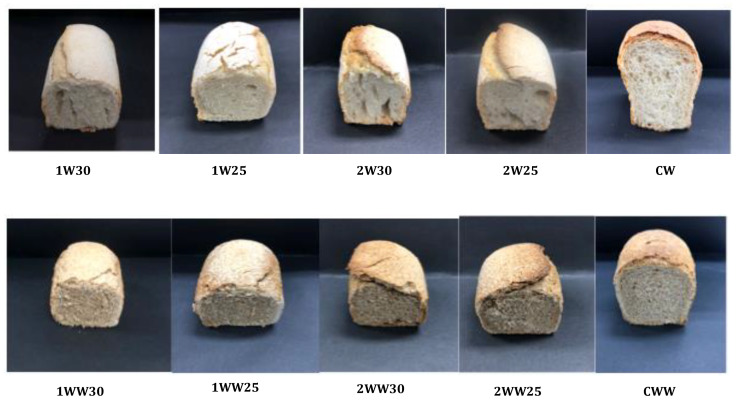
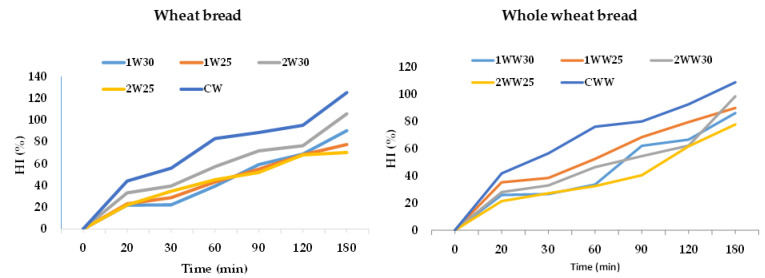
This study aimed to evaluate the influence of sourdough fermentation on the estimated glycemic index (eGI), in vitro starch digestibility, and textural and sensory properties of eight experimentally prepared sourdough breads. Wheat and whole wheat flour bread samples were produced under different fermentation conditions (25 °C and 30 °C) and fermentation methods (type-1 and type-2). In type-1 fermentation, sourdough was obtained via spontaneous fermentation. Indigenous strains (, , and ) were used for type-2 fermentation. Fermentation type and temperature significantly affected eGI, the hydrolysis index (HI), the starch fraction, and the textural properties of the samples ( < 0.05). The resistant starch (RS) content increased after fermentation, while rapidly digestible starch (RDS), HI, and eGI decreased. RS values were significantly higher in type-2 than in type-1 at the same temperature for both flour types ( < 0.05). At 25 °C, RS values were higher in both fermentation types. In the white flour samples, eGI values were in the range of 60.8-78.94 and 62.10-78.94 for type-1 and type-2, respectively. The effect of fermentation type on eGI was insignificant ( < 0.05). In the whole flour samples, fermentation type and temperature significantly affected eGI ( < 0.05). The greatest eGI decreases were in whole wheat sourdough bread at 30 °C using type-2 (29.74%). The 30 °C and type-2 samples showed lower hardness and higher specific volume. This study suggests that fermentation type and temperature could affect the eGI and the textural and sensory properties of sourdough bread, and these factors should be considered during bread production. The findings also support the consumption of wheat and whole wheat breads produced by type-2 fermentation due to higher RS and slowly digestible starch (SDS) and lower RDS and eGI values.
本研究旨在评估酸面团发酵对8种实验制备的酸面团面包的估计血糖指数(eGI)、体外淀粉消化率以及质地和感官特性的影响。小麦粉和全麦粉面包样品在不同发酵条件(25℃和30℃)和发酵方法(1型和2型)下制作。在1型发酵中,酸面团通过自然发酵获得。2型发酵使用本土菌株(、和)。发酵类型和温度显著影响样品的eGI、水解指数(HI)、淀粉组分和质地特性(P<0.05)。发酵后抗性淀粉(RS)含量增加,而快速消化淀粉(RDS)、HI和eGI降低。对于两种面粉类型,在相同温度下,2型发酵的RS值显著高于1型发酵(P<0.05)。在25℃时,两种发酵类型的RS值均较高。在白面粉样品中,1型和2型发酵的eGI值分别在60.8 - 78.94和62.10 - 78.94范围内。发酵类型对eGI的影响不显著(P>0.05)。在全麦粉样品中,发酵类型和温度显著影响eGI(P<0.05)。eGI降低幅度最大的是30℃下使用2型发酵的全麦酸面团面包(29.74%)。30℃和2型发酵的样品硬度较低,比容较高。本研究表明,发酵类型和温度会影响酸面团面包的eGI以及质地和感官特性,在面包生产过程中应考虑这些因素。研究结果还支持食用2型发酵生产的小麦面包和全麦面包,因为其RS和慢消化淀粉(SDS)含量较高,RDS和eGI值较低。