Sasaki Ryoki, Otsuru Naofumi, Miyaguchi Shota, Kojima Sho, Watanabe Hiraku, Ohno Ken, Sakurai Noriko, Kodama Naoki, Sato Daisuke, Onishi Hideaki
Institute for Human Movement and Medical Sciences, Niigata University of Health and Welfare, Niigata City, Niigata 950-3198, Japan.
Discipline of Physiology, Adelaide Medical School, The University of Adelaide, Adelaide 5000, Australia.
Brain Sci. 2021 Mar 20;11(3):395. doi: 10.3390/brainsci11030395.
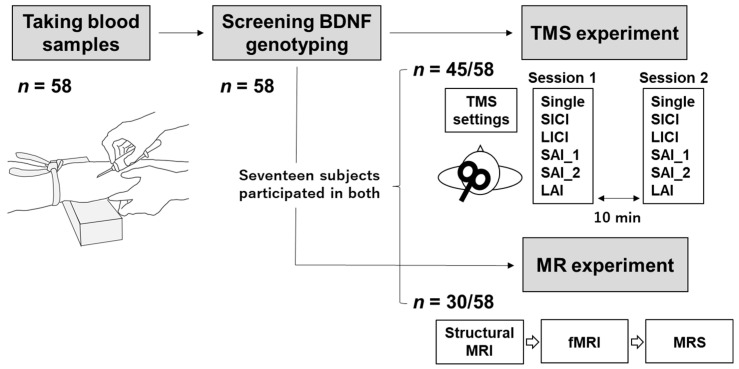
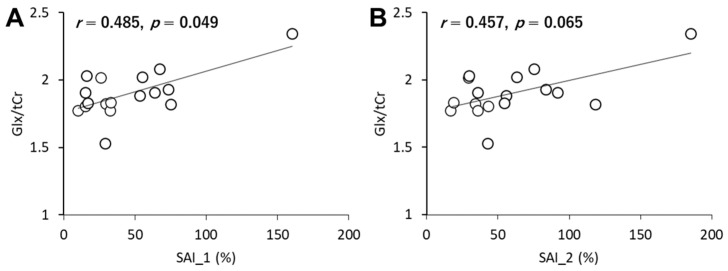
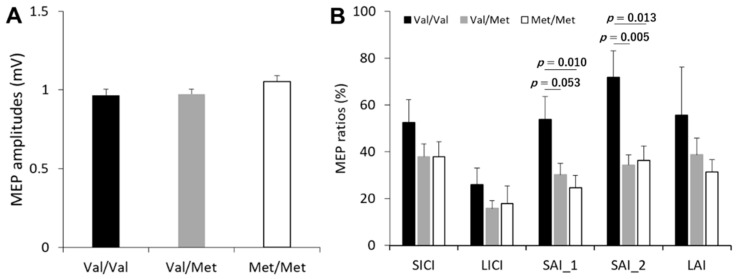
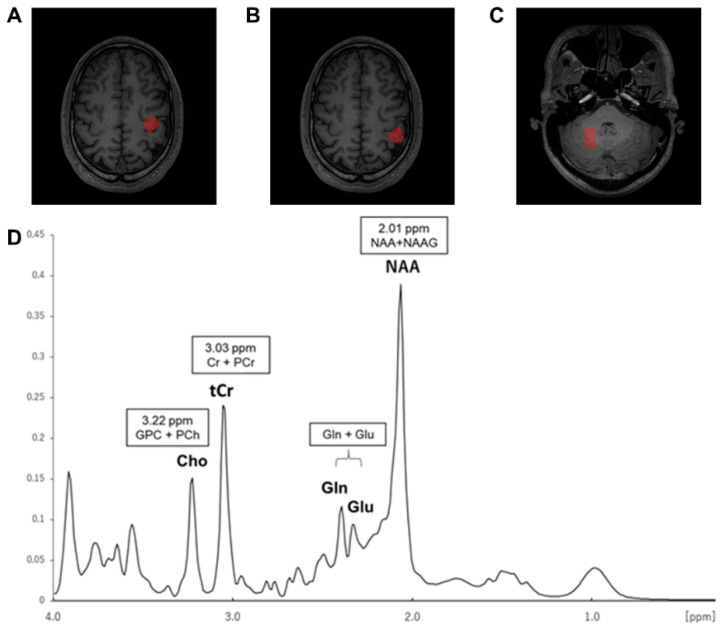
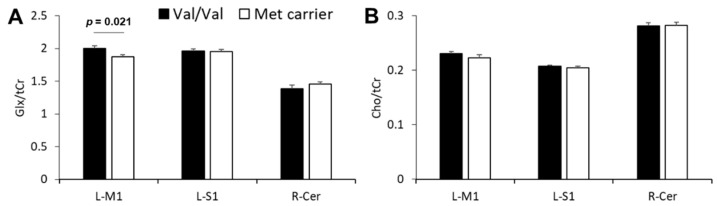
The Met allele of the brain-derived neurotrophic factor (BDNF) gene confers reduced cortical BDNF expression and associated neurobehavioral changes. BDNF signaling influences the survival, development, and synaptic function of cortical networks. Here, we compared gamma-aminobutyric acid (GABA)ergic network activity in the human primary motor cortex (M1) between the Met (Val/Met and Met/Met) and non-Met (Val/Val) genotype groups. Short- and long-interval intracortical inhibition, short-latency afferent inhibition (SAI), and long-latency afferent inhibition were measured using transcranial magnetic stimulation (TMS) as indices of GABAergic activity. Furthermore, the considerable inter-individual variability in inhibitory network activity typically measured by TMS may be affected not only by GABA but also by other pathways, including glutamatergic and cholinergic activities; therefore, we used 3-T magnetic resonance spectroscopy (MRS) to measure the dynamics of glutamate plus glutamine (Glx) and choline concentrations in the left M1, left somatosensory cortex, and right cerebellum. All inhibitory TMS conditions produced significantly smaller motor-evoked potentials than single-pulses. SAI was significantly stronger in the Met group than in the Val/Val group. Only the M1 Glx concentration was significantly lower in the Met group, while the BDNF genotype did not affect choline concentration in any region. Further, a positive correlation was observed between SAI and Glx concentrations only in M1. Our findings provide evidence that the BDNF genotype regulates both the inhibitory and excitatory circuits in human M1. In addition, lower Glx concentration in the M1 of Met carriers may alter specific inhibitory network on M1, thereby influencing the cortical signal processing required for neurobehavioral functions.
脑源性神经营养因子(BDNF)基因的Met等位基因会导致皮质BDNF表达降低以及相关的神经行为变化。BDNF信号传导影响皮质网络的存活、发育和突触功能。在此,我们比较了Met(Val/Met和Met/Met)和非Met(Val/Val)基因型组之间人类初级运动皮层(M1)中γ-氨基丁酸(GABA)能网络活动。使用经颅磁刺激(TMS)测量短间隔和长间隔皮质内抑制、短潜伏期传入抑制(SAI)和长潜伏期传入抑制,作为GABA能活动的指标。此外,通常通过TMS测量的抑制性网络活动中相当大的个体间变异性可能不仅受GABA影响,还受其他途径影响,包括谷氨酸能和胆碱能活动;因此,我们使用3-T磁共振波谱(MRS)测量左侧M1、左侧体感皮层和右侧小脑中谷氨酸加谷氨酰胺(Glx)和胆碱浓度的动态变化。所有抑制性TMS条件下产生的运动诱发电位均比单脉冲明显更小。Met组的SAI明显强于Val/Val组。仅Met组的M1 Glx浓度显著较低,而BDNF基因型在任何区域均不影响胆碱浓度。此外,仅在M1中观察到SAI与Glx浓度之间呈正相关。我们的研究结果提供了证据,表明BDNF基因型调节人类M1中的抑制性和兴奋性回路。此外,Met携带者M1中较低的Glx浓度可能会改变M1上的特定抑制性网络,从而影响神经行为功能所需的皮质信号处理。