German Center for Cardiovascular Research (DZHK), Partner Site Heidelberg/Mannheim, Im Neuenheimer Feld 669, 69120 Heidelberg, Germany.
Section of Bioinformatics and Systems Cardiology, Klaus Tschira Institute for Integrative Computational Cardiology and Department of Internal Medicine III, Im Neuenheimer Feld 669, 69120 Heidelberg, Germany.
Cells. 2021 Mar 20;10(3):692. doi: 10.3390/cells10030692.
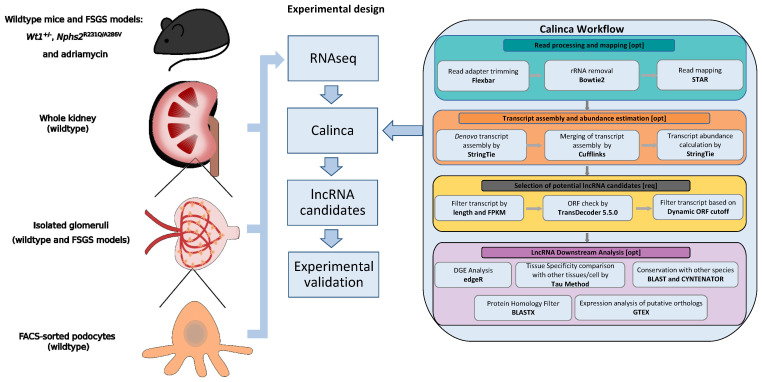
Diseases of the renal filtration unit-the glomerulus-are the most common cause of chronic kidney disease. Podocytes are the pivotal cell type for the function of this filter and focal-segmental glomerulosclerosis (FSGS) is a classic example of a podocytopathy leading to proteinuria and glomerular scarring. Currently, no targeted treatment of FSGS is available. This lack of therapeutic strategies is explained by a limited understanding of the defects in podocyte cell biology leading to FSGS. To date, most studies in the field have focused on protein-coding genes and their gene products. However, more than 80% of all transcripts produced by mammalian cells are actually non-coding. Here, long non-coding RNAs (lncRNAs) are a relatively novel class of transcripts and have not been systematically studied in FSGS to date. The appropriate tools to facilitate lncRNA research for the renal scientific community are urgently required due to a row of challenges compared to classical analysis pipelines optimized for coding RNA expression analysis. Here, we present the bioinformatic pipeline CALINCA as a solution for this problem. CALINCA automatically analyzes datasets from murine FSGS models and quantifies both annotated and de novo assembled lncRNAs. In addition, the tool provides in-depth information on podocyte specificity of these lncRNAs, as well as evolutionary conservation and expression in human datasets making this pipeline a crucial basis to lncRNA studies in FSGS.
肾脏滤过单位(肾小球)的疾病是慢性肾脏病的最常见原因。足细胞是该滤器功能的关键细胞类型,局灶节段性肾小球硬化症(FSGS)是导致蛋白尿和肾小球瘢痕形成的足细胞病的典型例子。目前,FSGS 尚无靶向治疗方法。这种缺乏治疗策略的情况是由于对导致 FSGS 的足细胞细胞生物学缺陷的了解有限所导致的。迄今为止,该领域的大多数研究都集中在蛋白质编码基因及其基因产物上。然而,哺乳动物细胞产生的所有转录本中,实际上有超过 80%是非编码的。在这里,长非编码 RNA(lncRNA)是一类相对较新的转录本,迄今为止尚未在 FSGS 中进行系统研究。与针对编码 RNA 表达分析进行优化的经典分析管道相比,由于存在一系列挑战,因此迫切需要为肾脏科学界提供适当的工具来促进 lncRNA 研究。在这里,我们提出了生物信息学管道 CALINCA 作为该问题的解决方案。CALINCA 自动分析来自鼠 FSGS 模型的数据集,并定量分析注释和从头组装的 lncRNA。此外,该工具还提供了这些 lncRNA 的足细胞特异性、进化保守性和在人类数据集中的表达的深入信息,使该管道成为 FSGS 中 lncRNA 研究的重要基础。