Andreucci Alessandro, Groenewald Cornelius B, Rathleff Michael Skovdal, Palermo Tonya M
Center for General Practice, Aalborg University, 9220 Aalborg Øst, Denmark.
Department of Anesthesiology and Pain Medicine, University of Washington School of Medicine, Seattle, WA 98105, USA.
Children (Basel). 2021 Mar 20;8(3):241. doi: 10.3390/children8030241.
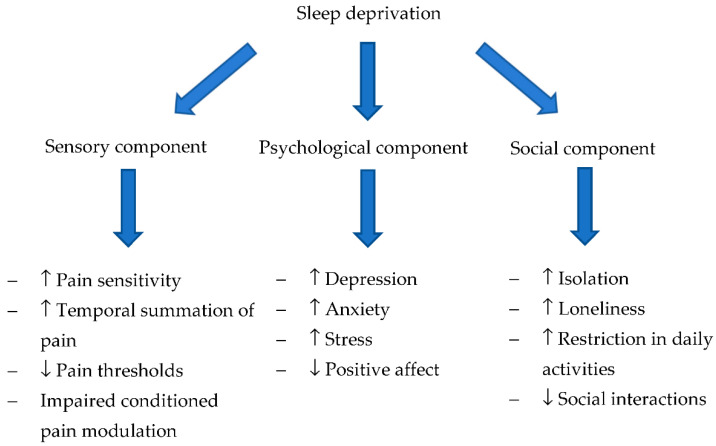
Musculoskeletal pain is common in the general pediatric population and is a challenge to youth, their parents, and society. The majority of children experiencing musculoskeletal pain will recover; however, a small subgroup of youth develops chronic pain. There is limited understanding of the factors that affect the transition from acute to chronic pain in youth. This review introduces sleep deficiency in the acute to chronic pain transition, exploring the potential mediational or mechanistic role and pathways of sleep in this process, including the interaction with sensory, psychological, and social components of pain and highlighting new avenues for treatment. Biological mechanisms include the increased production of inflammatory mediators and the effect on the hypothalamus-pituitary-adrenal (HPA) axis and on the dopaminergic signaling. Psychological and social components include the effect of sleep on the emotional-affective and behavioral components of pain, the negative impact on daily and social activities and coping strategies and on the reward system, increased pain catastrophizing, fear of pain, pain-related anxiety, hypervigilance, and social isolation. Future longitudinal studies are needed to elucidate these mechanistic pathways of the effect of sleep on the transition from acute to chronic pain, which may lead to the development of new treatment targets to prevent this transition.
肌肉骨骼疼痛在普通儿科人群中很常见,对青少年、他们的父母以及社会来说都是一项挑战。大多数经历肌肉骨骼疼痛的儿童会康复;然而,一小部分青少年会发展为慢性疼痛。对于影响青少年从急性疼痛转变为慢性疼痛的因素,人们了解有限。这篇综述介绍了在急性疼痛向慢性疼痛转变过程中的睡眠不足情况,探讨了睡眠在此过程中的潜在中介作用或机制性作用及途径,包括与疼痛的感觉、心理和社会成分的相互作用,并突出了新的治疗途径。生物学机制包括炎症介质产生增加以及对下丘脑 - 垂体 - 肾上腺(HPA)轴和多巴胺能信号传导的影响。心理和社会成分包括睡眠对疼痛的情绪情感和行为成分的影响、对日常和社交活动及应对策略以及奖励系统的负面影响、疼痛灾难化加剧、对疼痛的恐惧、与疼痛相关的焦虑、过度警觉和社会隔离。未来需要进行纵向研究来阐明睡眠对从急性疼痛转变为慢性疼痛影响的这些机制途径,这可能会促成新的治疗靶点的开发以预防这种转变。