Jimbu Laura, Mesaros Oana, Popescu Cristian, Neaga Alexandra, Berceanu Iulia, Dima Delia, Gaman Mihaela, Zdrenghea Mihnea
Department of Hematology, Iuliu Hatieganu University of Medicine and Pharmacy, 8 Babes Str., 400012 Cluj-Napoca, Romania.
Department of Hematology, Ion Chiricuta Oncology Institute, 34-36 Republicii Str., 400015 Cluj-Napoca, Romania.
Pharmaceuticals (Basel). 2021 Mar 24;14(4):288. doi: 10.3390/ph14040288.
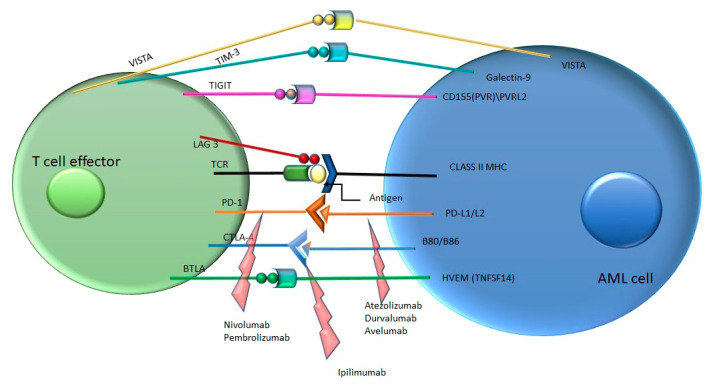
Checkpoint inhibitors were a major breakthrough in the field of oncology. In September 2014, based on the KEYNOTE-001 study, the Food and Drug Administration (FDA) approved pembrolizumab, a programmed cell death protein 1 (PD-1) inhibitor, for advanced or unresectable melanoma. Up until now, seven PD-1/PD-ligand(L)-1 inhibitors are approved in various solid cancers and hundreds of clinical studies are currently ongoing. In hematology, PD-1 inhibitors nivolumab and pembrolizumab were approved for the treatment of relapsed/refractory (R/R) classic Hodgkin lymphoma, and later pembrolizumab was approved for R/R primary mediastinal large B-cell lymphoma. In acute myeloid leukemia (AML), the combination of hypomethylating agents and PD-1/PD-L1 inhibitors has shown promising results, worth of further investigation, while other combinations or single agent therapy have disappointing results. On the other hand, rather than in first line, these therapies could be useful in the consolidation or maintenance setting, for achieving minimal residual disease negativity. Furthermore, an interesting application could be the use of PD-1/PD-L1 inhibitors in the post allogeneic hematopoietic stem cell transplantation relapse. There are several reasons why checkpoint inhibitors are not very effective in treating AML, including the characteristics of the disease (systemic, rapidly progressive, and high tumor burden disease), low mutational burden, and dysregulation of the immune system. We here review the results of PD-1/PD-L1 inhibition in AML and discuss their potential future in the management of this disease.
检查点抑制剂是肿瘤学领域的一项重大突破。2014年9月,基于KEYNOTE - 001研究,美国食品药品监督管理局(FDA)批准了程序性细胞死亡蛋白1(PD - 1)抑制剂帕博利珠单抗用于治疗晚期或不可切除的黑色素瘤。截至目前,已有7种PD - 1/PD -配体(L)-1抑制剂被批准用于多种实体癌治疗,目前还有数百项临床研究正在进行。在血液学领域,PD - 1抑制剂纳武利尤单抗和帕博利珠单抗被批准用于治疗复发/难治性(R/R)经典型霍奇金淋巴瘤,随后帕博利珠单抗又被批准用于R/R原发性纵隔大B细胞淋巴瘤。在急性髓系白血病(AML)中,去甲基化药物与PD - 1/PD - L1抑制剂联合使用已显示出有前景的结果,值得进一步研究,而其他联合或单药治疗效果不佳。另一方面,这些疗法并非用于一线治疗,而是在巩固或维持治疗中可能有用,以实现微小残留病阴性。此外,一个有趣的应用可能是在异基因造血干细胞移植后复发时使用PD - 1/PD - L1抑制剂。检查点抑制剂在治疗AML时效果不佳有几个原因,包括疾病的特征(全身性、快速进展且肿瘤负荷高的疾病)、低突变负荷以及免疫系统失调。我们在此回顾PD - 1/PD - L1抑制在AML中的研究结果,并讨论其在该疾病治疗中的潜在未来发展。