Merz Pharmaceuticals GmbH, 60318 Frankfurt, Germany.
Robert-Koch-Institut, Zentrum für Biologische Gefahren und Spezielle Pathogene: Hochpathogene Viren (ZBS 1), 13353 Berlin, Germany.
Viruses. 2021 Mar 24;13(4):539. doi: 10.3390/v13040539.
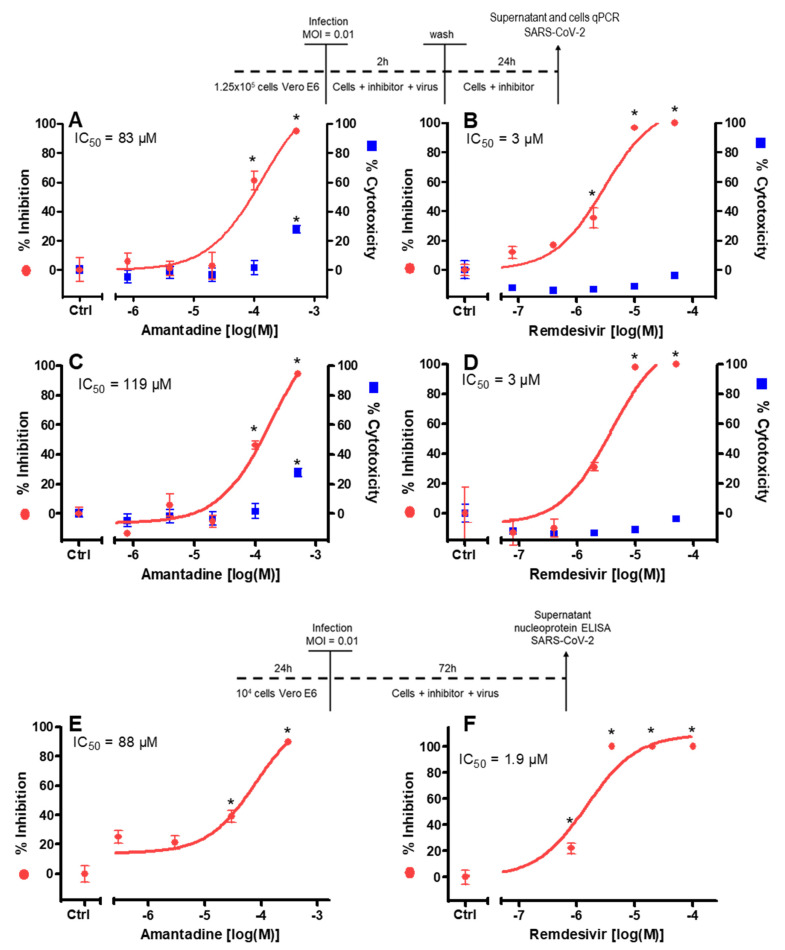
Since the SARS-CoV-2 pandemic started in late 2019, the search for protective vaccines and for drug treatments has become mandatory to fight the global health emergency. Travel restrictions, social distancing, and face masks are suitable counter measures, but may not bring the pandemic under control because people will inadvertently or at a certain degree of restriction severity or duration become incompliant with the regulations. Even if vaccines are approved, the need for antiviral agents against SARS-CoV-2 will persist. However, unequivocal evidence for efficacy against SARS-CoV-2 has not been demonstrated for any of the repurposed antiviral drugs so far. Amantadine was approved as an antiviral drug against influenza A, and antiviral activity against SARS-CoV-2 has been reasoned by analogy but without data. We tested the efficacy of amantadine in vitro in Vero E6 cells infected with SARS-CoV-2. Indeed, amantadine inhibited SARS-CoV-2 replication in two separate experiments with IC concentrations between 83 and 119 µM. Although these IC concentrations are above therapeutic amantadine levels after systemic administration, topical administration by inhalation or intranasal instillation may result in sufficient amantadine concentration in the airway epithelium without high systemic exposure. However, further studies in other models are needed to prove this hypothesis.
自 2019 年底 COVID-19 大流行开始以来,寻找保护性疫苗和药物治疗方法已成为对抗全球卫生紧急情况的必要措施。旅行限制、社交距离和口罩是合适的对策,但它们可能无法控制疫情,因为人们会在无意中或在一定程度的限制严重程度或持续时间内不遵守规定。即使疫苗获得批准,对 SARS-CoV-2 的抗病毒药物的需求仍将持续。然而,迄今为止,没有明确的证据表明任何已重新利用的抗病毒药物对 SARS-CoV-2 具有疗效。金刚烷胺被批准为抗甲型流感病毒的抗病毒药物,并且通过类推推断出对 SARS-CoV-2 的抗病毒活性,但没有数据支持。我们在感染 SARS-CoV-2 的 Vero E6 细胞中体外测试了金刚烷胺的疗效。实际上,金刚烷胺在两项单独的实验中抑制了 SARS-CoV-2 的复制,IC 浓度在 83 和 119µM 之间。尽管这些 IC 浓度在系统给药后高于治疗性金刚烷胺水平,但通过吸入或鼻内滴注进行局部给药可能会导致气道上皮中的金刚烷胺浓度足够高,而不会出现高全身暴露。然而,需要在其他模型中进一步研究来证明这一假设。