• 文献检索
  • 文档翻译
  • 深度研究
  • 学术资讯
  • Suppr Zotero 插件Zotero 插件
  • 邀请有礼
  • 套餐&价格
  • 历史记录
应用&插件
Suppr Zotero 插件Zotero 插件浏览器插件Mac 客户端Windows 客户端微信小程序
定价
高级版会员购买积分包购买API积分包
服务
文献检索文档翻译深度研究API 文档MCP 服务
关于我们
关于 Suppr公司介绍联系我们用户协议隐私条款
关注我们

Suppr 超能文献

核心技术专利:CN118964589B侵权必究
粤ICP备2023148730 号-1Suppr @ 2026

文献检索

告别复杂PubMed语法,用中文像聊天一样搜索,搜遍4000万医学文献。AI智能推荐,让科研检索更轻松。

立即免费搜索

文件翻译

保留排版,准确专业,支持PDF/Word/PPT等文件格式,支持 12+语言互译。

免费翻译文档

深度研究

AI帮你快速写综述,25分钟生成高质量综述,智能提取关键信息,辅助科研写作。

立即免费体验

大数据分析在控制 COVID-19 大流行中的应用。

Applications of Big Data Analytics to Control COVID-19 Pandemic.

机构信息

Department of Computer Science, College of Computer Science and Information Technology, Imam Abdulrahman Bin Faisal University, P.O. Box 1982, Dammam 31441, Saudi Arabia.

Department of Networks and Communications, College of Computer Science and Information Technology, Imam Abdulrahman Bin Faisal University, P.O. Box 1982, Dammam 31441, Saudi Arabia.

出版信息

Sensors (Basel). 2021 Mar 24;21(7):2282. doi: 10.3390/s21072282.

DOI:10.3390/s21072282
PMID:33805218
原文链接:https://pmc.ncbi.nlm.nih.gov/articles/PMC8037067/
Abstract

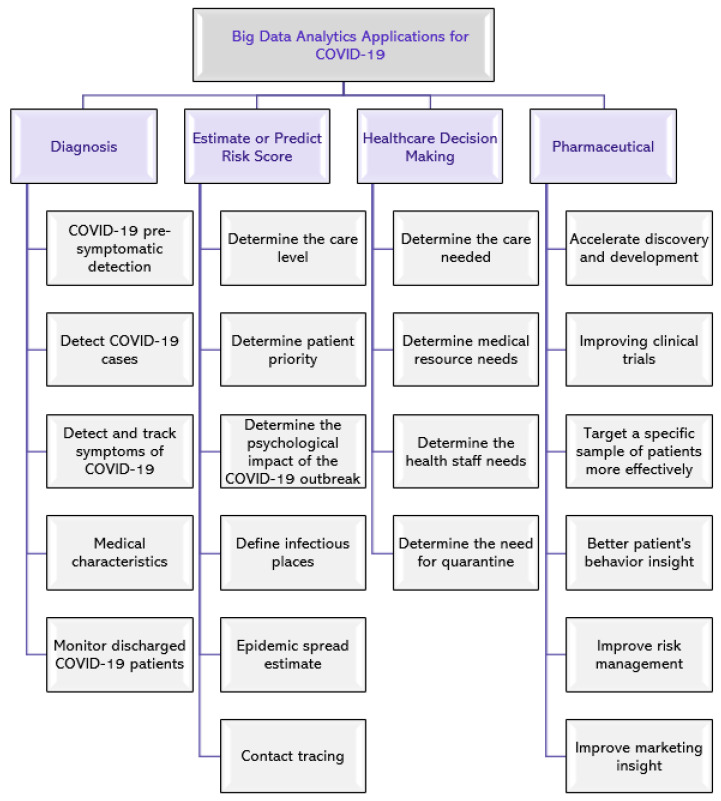
The COVID-19 epidemic has caused a large number of human losses and havoc in the economic, social, societal, and health systems around the world. Controlling such epidemic requires understanding its characteristics and behavior, which can be identified by collecting and analyzing the related big data. Big data analytics tools play a vital role in building knowledge required in making decisions and precautionary measures. However, due to the vast amount of data available on COVID-19 from various sources, there is a need to review the roles of big data analysis in controlling the spread of COVID-19, presenting the main challenges and directions of COVID-19 data analysis, as well as providing a framework on the related existing applications and studies to facilitate future research on COVID-19 analysis. Therefore, in this paper, we conduct a literature review to highlight the contributions of several studies in the domain of COVID-19-based big data analysis. The study presents as a taxonomy several applications used to manage and control the pandemic. Moreover, this study discusses several challenges encountered when analyzing COVID-19 data. The findings of this paper suggest valuable future directions to be considered for further research and applications.

摘要

COVID-19 疫情在全球范围内对经济、社会、公共卫生系统造成了大量人员伤亡和严重破坏。控制此类疫情需要了解其特征和行为,可以通过收集和分析相关大数据来识别。大数据分析工具在构建决策和预防措施所需的知识方面发挥着至关重要的作用。然而,由于 COVID-19 相关大数据的来源众多,数据量庞大,因此需要审查大数据分析在控制 COVID-19 传播方面的作用,提出 COVID-19 数据分析的主要挑战和方向,并提供一个关于现有相关应用和研究的框架,以促进未来 COVID-19 分析的研究。因此,在本文中,我们进行了文献综述,以突出强调基于 COVID-19 的大数据分析领域的几个研究的贡献。该研究提出了几种用于管理和控制大流行的应用程序的分类法。此外,本研究还讨论了在分析 COVID-19 数据时遇到的几个挑战。本文的研究结果为进一步研究和应用提出了有价值的未来方向。
https://cdn.ncbi.nlm.nih.gov/pmc/blobs/397e/8037067/f4d1dd5d09b4/sensors-21-02282-g005.jpg
https://cdn.ncbi.nlm.nih.gov/pmc/blobs/397e/8037067/beb016d41460/sensors-21-02282-g001.jpg
https://cdn.ncbi.nlm.nih.gov/pmc/blobs/397e/8037067/dfb1dd6c23c2/sensors-21-02282-g002.jpg
https://cdn.ncbi.nlm.nih.gov/pmc/blobs/397e/8037067/79f08a764673/sensors-21-02282-g003.jpg
https://cdn.ncbi.nlm.nih.gov/pmc/blobs/397e/8037067/c589a91d64b4/sensors-21-02282-g004.jpg
https://cdn.ncbi.nlm.nih.gov/pmc/blobs/397e/8037067/f4d1dd5d09b4/sensors-21-02282-g005.jpg
https://cdn.ncbi.nlm.nih.gov/pmc/blobs/397e/8037067/beb016d41460/sensors-21-02282-g001.jpg
https://cdn.ncbi.nlm.nih.gov/pmc/blobs/397e/8037067/dfb1dd6c23c2/sensors-21-02282-g002.jpg
https://cdn.ncbi.nlm.nih.gov/pmc/blobs/397e/8037067/79f08a764673/sensors-21-02282-g003.jpg
https://cdn.ncbi.nlm.nih.gov/pmc/blobs/397e/8037067/c589a91d64b4/sensors-21-02282-g004.jpg
https://cdn.ncbi.nlm.nih.gov/pmc/blobs/397e/8037067/f4d1dd5d09b4/sensors-21-02282-g005.jpg

相似文献

1
Applications of Big Data Analytics to Control COVID-19 Pandemic.大数据分析在控制 COVID-19 大流行中的应用。
Sensors (Basel). 2021 Mar 24;21(7):2282. doi: 10.3390/s21072282.
2
The medical and societal impact of big data analytics and artificial intelligence applications in combating pandemics: A review focused on Covid-19.大数据分析和人工智能应用在应对大流行病方面的医学和社会影响:以新冠病毒肺炎为例的综述。
Soc Sci Med. 2022 May;301:114973. doi: 10.1016/j.socscimed.2022.114973. Epub 2022 Apr 12.
3
Application of Big Data and Artificial Intelligence in COVID-19 Prevention, Diagnosis, Treatment and Management Decisions in China.大数据和人工智能在中国 COVID-19 预防、诊断、治疗和管理决策中的应用。
J Med Syst. 2021 Jul 24;45(9):84. doi: 10.1007/s10916-021-01757-0.
4
Big Data Analytics in the Fight against Major Public Health Incidents (Including COVID-19): A Conceptual Framework.大数据分析在应对重大公共卫生事件(包括 COVID-19)中的应用:概念框架。
Int J Environ Res Public Health. 2020 Aug 25;17(17):6161. doi: 10.3390/ijerph17176161.
5
Putting the world back to work: An expert system using big data and artificial intelligence in combating the spread of COVID-19 and similar contagious diseases.让世界恢复运转:一种利用大数据和人工智能抗击新冠疫情及类似传染病传播的专家系统。
Work. 2020;67(3):557-572. doi: 10.3233/WOR-203309.
6
How Big Data and Artificial Intelligence Can Help Better Manage the COVID-19 Pandemic.大数据和人工智能如何帮助更好地管理 COVID-19 大流行。
Int J Environ Res Public Health. 2020 May 2;17(9):3176. doi: 10.3390/ijerph17093176.
7
Review of Big Data Analytics, Artificial Intelligence and Nature-Inspired Computing Models towards Accurate Detection of COVID-19 Pandemic Cases and Contact Tracing.大数据分析、人工智能和受自然启发的计算模型在新冠疫情病例的准确检测和接触者追踪方面的研究综述。
Int J Environ Res Public Health. 2020 Jul 24;17(15):5330. doi: 10.3390/ijerph17155330.
8
Applications of Artificial Intelligence and Big Data Analytics in m-Health: A Healthcare System Perspective.人工智能和大数据分析在移动医疗中的应用:医疗保健系统视角。
J Healthc Eng. 2020 Aug 30;2020:8894694. doi: 10.1155/2020/8894694. eCollection 2020.
9
Modeling and tracking Covid-19 cases using Big Data analytics on HPCC system platformm.在惠普高性能计算集群(HPCC)系统平台上使用大数据分析对新冠病毒疾病(Covid-19)病例进行建模和追踪。
J Big Data. 2021;8(1):33. doi: 10.1186/s40537-021-00423-z. Epub 2021 Feb 15.
10
Decision-Making based on Big Data Analytics for People Management in Healthcare Organizations.基于大数据分析的医疗保健组织人员管理决策。
J Med Syst. 2019 Jul 22;43(9):290. doi: 10.1007/s10916-019-1419-x.

引用本文的文献

1
Artificial Intelligence in Public Health: Bridging Today's Trends with Tomorrow's Possibilities.公共卫生领域的人工智能:连接当今趋势与未来可能性
Bioengineering (Basel). 2025 May 23;12(6):559. doi: 10.3390/bioengineering12060559.
2
Non-linear correlation analysis between internet searches and epidemic trends.互联网搜索与疫情趋势之间的非线性相关性分析。
Front Public Health. 2025 Apr 4;13:1435513. doi: 10.3389/fpubh.2025.1435513. eCollection 2025.
3
Smartwatch-based algorithm for early detection of pulmonary infection: Validation and performance evaluation.

本文引用的文献

1
Tracking COVID-19 by Tracking Infectious Trajectories.通过追踪感染轨迹来追踪新冠病毒。
IEEE Access. 2020 Aug 7;8:145242-145255. doi: 10.1109/ACCESS.2020.3015002. eCollection 2020.
2
Survival Analysis with Electronic Health Record Data: Experiments with Chronic Kidney Disease.利用电子健康记录数据进行生存分析:慢性肾脏病实验
Stat Anal Data Min. 2014 Oct;7(5):385-403. doi: 10.1002/sam.11236. Epub 2014 Aug 19.
3
A Lightweight Three-Factor Authentication Scheme for WHSN Architecture.WHSN 架构的轻量级三因素身份验证方案。
基于智能手表的肺部感染早期检测算法:验证与性能评估。
Digit Health. 2024 Oct 25;10:20552076241290684. doi: 10.1177/20552076241290684. eCollection 2024 Jan-Dec.
4
The predation relationship between online medical search and online medical consultation-empirical research based on Baidu platform data.在线医疗搜索与在线医疗咨询之间的捕食关系——基于百度平台数据的实证研究。
Front Public Health. 2024 Aug 29;12:1392743. doi: 10.3389/fpubh.2024.1392743. eCollection 2024.
5
An architecture for COVID-19 analysis and detection using big data, AI, and data architectures.一种使用大数据、人工智能和数据架构进行新冠病毒疾病(COVID-19)分析与检测的架构。
PLoS One. 2024 Aug 1;19(8):e0305483. doi: 10.1371/journal.pone.0305483. eCollection 2024.
6
A non-invasive AI-based system for precise grading of anosmia in COVID-19 using neuroimaging.一种基于人工智能的非侵入性系统,用于利用神经影像学对新冠肺炎患者的嗅觉丧失进行精确分级。
Heliyon. 2024 Jun 12;10(12):e32726. doi: 10.1016/j.heliyon.2024.e32726. eCollection 2024 Jun 30.
7
Assessing the Impact of COVID-19 on Amateur Runners' Performance: An Analysis through Monitoring Devices.评估新冠疫情对业余跑步者表现的影响:通过监测设备进行的分析
Sensors (Basel). 2024 Apr 20;24(8):2635. doi: 10.3390/s24082635.
8
COVID-19 multiwaves as multiphase percolation: a general N-sigmoidal equation to model the spread.作为多相渗流的新冠疫情多波:用于模拟传播的通用N型西格玛方程
Eur Phys J Plus. 2023;138(5):393. doi: 10.1140/epjp/s13360-023-04014-0. Epub 2023 May 8.
9
Human behavior in the time of COVID-19: Learning from big data.新冠疫情期间的人类行为:从大数据中学习
Front Big Data. 2023 Apr 6;6:1099182. doi: 10.3389/fdata.2023.1099182. eCollection 2023.
10
Constructing big data prevention and control model for public health emergencies in China: A grounded theory study.构建中国突发公共卫生事件大数据防控模型:一项扎根理论研究
Front Public Health. 2023 Mar 16;11:1112547. doi: 10.3389/fpubh.2023.1112547. eCollection 2023.
Sensors (Basel). 2020 Nov 30;20(23):6860. doi: 10.3390/s20236860.
4
Remote Patient Monitoring Program for Hospital Discharged COVID-19 Patients.远程新冠肺炎出院患者监测项目。
Appl Clin Inform. 2020 Oct;11(5):792-801. doi: 10.1055/s-0040-1721039. Epub 2020 Nov 25.
5
Pre-symptomatic detection of COVID-19 from smartwatch data.从智能手表数据中进行 COVID-19 的症状前检测。
Nat Biomed Eng. 2020 Dec;4(12):1208-1220. doi: 10.1038/s41551-020-00640-6. Epub 2020 Nov 18.
6
Identifying patients with symptoms suspicious for COVID-19 at elevated risk of adverse events: The COVAS score.识别有 COVID-19 症状且有发生不良事件高风险的患者:COVAS 评分。
Am J Emerg Med. 2021 Aug;46:489-494. doi: 10.1016/j.ajem.2020.10.068. Epub 2020 Nov 5.
7
Clinical characteristics of 116 hospitalized patients with COVID-19 in Wuhan, China: a single-centered, retrospective, observational study.中国武汉 116 例 COVID-19 住院患者的临床特征:一项以医院为中心、回顾性、观察性研究。
BMC Infect Dis. 2020 Oct 22;20(1):787. doi: 10.1186/s12879-020-05452-2.
8
Clinical Characteristics and Prognostic Factors for Intensive Care Unit Admission of Patients With COVID-19: Retrospective Study Using Machine Learning and Natural Language Processing.新型冠状病毒肺炎患者入住重症监护病房的临床特征及预后因素:运用机器学习和自然语言处理的回顾性研究
J Med Internet Res. 2020 Oct 28;22(10):e21801. doi: 10.2196/21801.
9
Applications of Artificial Intelligence and Big Data Analytics in m-Health: A Healthcare System Perspective.人工智能和大数据分析在移动医疗中的应用:医疗保健系统视角。
J Healthc Eng. 2020 Aug 30;2020:8894694. doi: 10.1155/2020/8894694. eCollection 2020.
10
Definitions, components and processes of data harmonisation in healthcare: a scoping review.医疗保健数据协调的定义、组成部分和流程:范围综述。
BMC Med Inform Decis Mak. 2020 Sep 14;20(1):222. doi: 10.1186/s12911-020-01218-7.