Cain Cassie J, Woodruff Kimberly A, Smith David R
Department of Pathobiology and Population Medicine, Mississippi State University College of Veterinary Medicine, Mississippi State, MS 39762, USA.
Department of Clinical Sciences, Mississippi State University College of Veterinary Medicine, Mississippi State, MS 39762, USA.
Animals (Basel). 2021 Mar 25;11(4):927. doi: 10.3390/ani11040927.
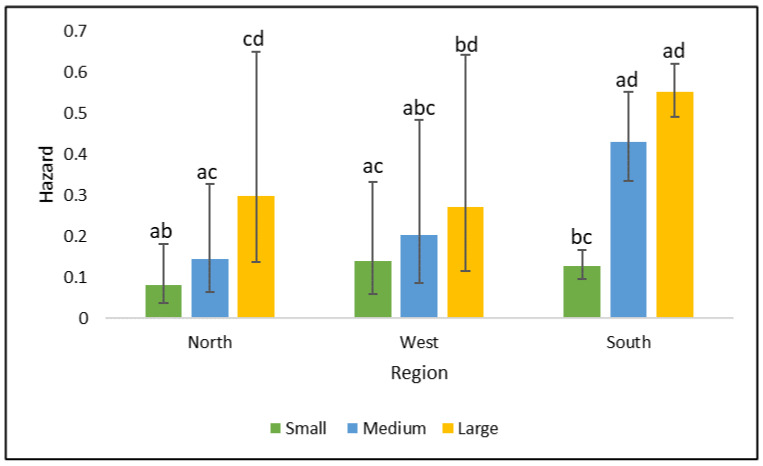
The objective of this study was to identify phenotypic characteristics predicting the outcome of euthanasia for dogs entering shelters compared to live release. Individual dog records for 2017 were requested from shelters in five states (Mississippi, Pennsylvania, Michigan, Colorado, and Oklahoma) receiving municipal funding and using electronic records. Duplicate dogs were removed and records from 17 shelters were merged into a dataset of 25,047 unique dogs with variables of breed, gender, coat color, size, age, region, and time in shelter. Only data from dogs with the potential to be adopted ( = 19,514) were analyzed. From these data, a simple random sample of 6200 dogs was used for modelling. Variables describing coat length, estimated adult size, and skull type were imputed from the breed description. A Cox proportional hazard model with a random effect of shelter was developed for the outcome of euthanasia using manual forward variable selection and significance for variable retention at alpha = 0.05. A size by geographic region interaction was associated with the hazard of euthanasia ( = 0.0204). Additionally, age group and skull type were both associated with euthanasia compared to live release ( < 0.0001). The results of this study indicate that phenotypic characteristics of dogs are predictive of their hazard for euthanasia in shelters.
本研究的目的是确定与放归相比,进入收容所的犬只实施安乐死结局的预测表型特征。向五个州(密西西比州、宾夕法尼亚州、密歇根州、科罗拉多州和俄克拉何马州)接受市政资金并使用电子记录的收容所索取了2017年的犬只个体记录。去除重复的犬只后,将17个收容所的记录合并成一个包含25,047只独特犬只的数据集,这些犬只具有品种、性别、毛色、体型、年龄、地区和在收容所停留时间等变量。仅分析了有可能被领养的犬只(n = 19,514)的数据。从这些数据中,使用了一个简单随机抽样的6200只犬只进行建模。描述被毛长度、估计成年体型和头骨类型的变量从品种描述中推算得出。使用手动向前变量选择和在α = 0.05时变量保留的显著性,开发了一个具有收容所随机效应的Cox比例风险模型来预测安乐死结局。体型与地理区域的交互作用与安乐死风险相关(P = 0.0204)。此外,与放归相比,年龄组和头骨类型均与安乐死相关(P < 0.0001)。本研究结果表明,犬只的表型特征可预测其在收容所实施安乐死的风险。