Prieto-García Elena, Díaz-García C Vanesa, Agudo-López Alba, Pardo-Marqués Virginia, García-Consuegra Inés, Asensio-Peña Sara, Alonso-Riaño Marina, Pérez Carlos, Gómez Carlos, Adeva Jorge, Paz-Ares Luis, López-Martín José A, Agulló-Ortuño M Teresa
Laboratory of Clinical and Translational Oncology, Instituto de Investigación Hospital 12 de Octubre (i+12), Av. de Córdoba S/N, 28041 Madrid, Spain.
Proteomic Unit, Instituto de Investigación Hospital 12 de Octubre (i+12), Av. de Córdoba S/N, 28041 Madrid, Spain.
Biomedicines. 2021 Mar 31;9(4):364. doi: 10.3390/biomedicines9040364.
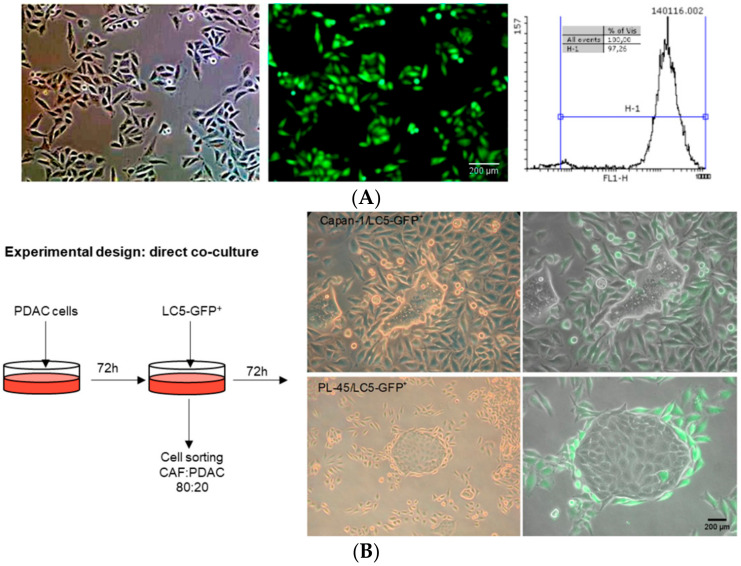
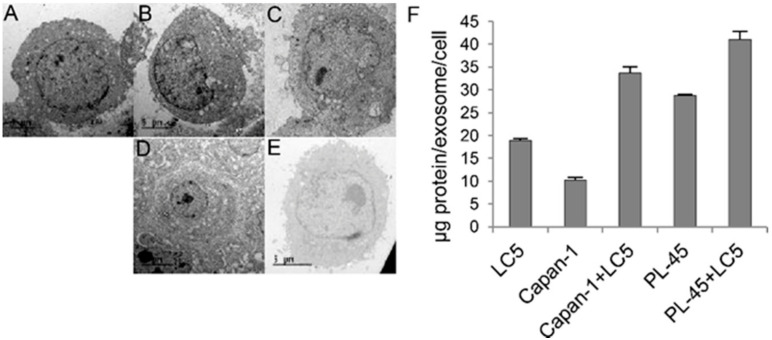
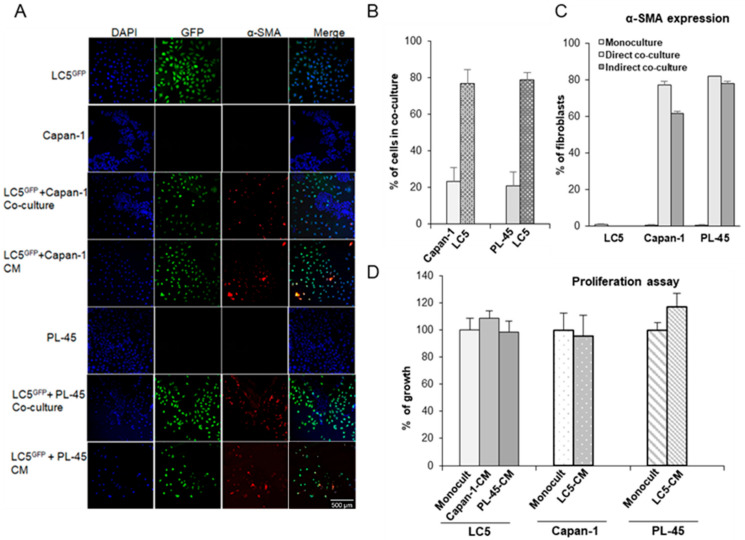
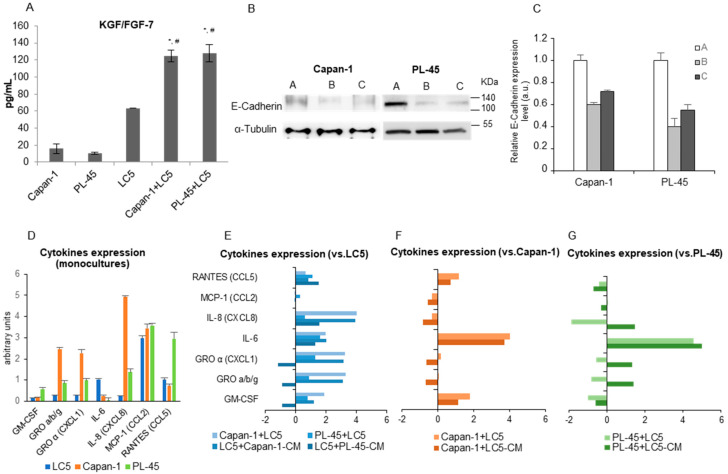
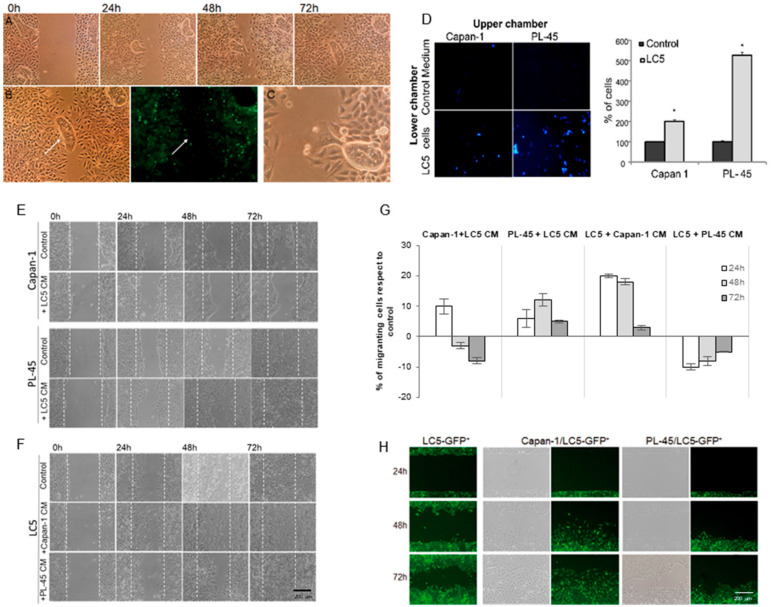
One key feature of pancreatic ductal adenocarcinoma (PDAC) is a dense desmoplastic reaction that has been recognized as playing important roles in metastasis and therapeutic resistance. We aim to study tumor-stromal interactions in an in vitro coculture model between human PDAC cells (Capan-1 or PL-45) and fibroblasts (LC5). Confocal immunofluorescence, Enzyme-Linked Immunosorbent Assay (ELISA), and Western blotting were used to evaluate the expressions of activation markers; cytokines arrays were performed to identify secretome profiles associated with migratory and invasive properties of tumor cells; extracellular vesicle production was examined by ELISA and transmission electron microscopy. Coculture conditions increased FGF-7 secretion and α-SMA expression, characterized by fibroblast activation and decreased epithelial marker E-cadherin in tumor cells. Interestingly, tumor cells and fibroblasts migrate together, with tumor cells in forming a center surrounded by fibroblasts, maximizing the contact between cells. We show a different mechanism for tumor spread through a cooperative migration between tumor cells and activated fibroblasts. Furthermore, IL-6 levels change significantly in coculture conditions, and this could affect the invasive and migratory capacities of cells. Targeting the interaction between tumor cells and the tumor microenvironment might represent a novel therapeutic approach to advanced PDAC.
胰腺导管腺癌(PDAC)的一个关键特征是致密的促纤维增生反应,该反应已被认为在转移和治疗抗性中发挥重要作用。我们旨在研究人PDAC细胞(Capan-1或PL-45)与成纤维细胞(LC5)之间的体外共培养模型中的肿瘤-基质相互作用。采用共聚焦免疫荧光、酶联免疫吸附测定(ELISA)和蛋白质印迹法评估激活标志物的表达;进行细胞因子阵列分析以鉴定与肿瘤细胞迁移和侵袭特性相关的分泌组谱;通过ELISA和透射电子显微镜检查细胞外囊泡的产生。共培养条件增加了FGF-7的分泌和α-SMA的表达,其特征在于成纤维细胞活化以及肿瘤细胞中上皮标志物E-钙黏蛋白减少。有趣的是,肿瘤细胞和成纤维细胞一起迁移,肿瘤细胞形成一个被成纤维细胞包围的中心,使细胞间的接触最大化。我们展示了一种通过肿瘤细胞与活化的成纤维细胞之间的协同迁移实现肿瘤扩散的不同机制。此外,共培养条件下IL-6水平发生显著变化,这可能会影响细胞的侵袭和迁移能力。靶向肿瘤细胞与肿瘤微环境之间的相互作用可能代表一种针对晚期PDAC的新型治疗方法。