Werge Mikkel Parsberg, McCann Adrian, Galsgaard Elisabeth Douglas, Holst Dorte, Bugge Anne, Albrechtsen Nicolai J Wewer, Gluud Lise Lotte
Gastro Unit, Copenhagen University Hospital Hvidovre, 2650 Hvidovre, Denmark.
Bevital AS, 5021 Bergen, Norway.
J Clin Med. 2021 Mar 5;10(5):1081. doi: 10.3390/jcm10051081.
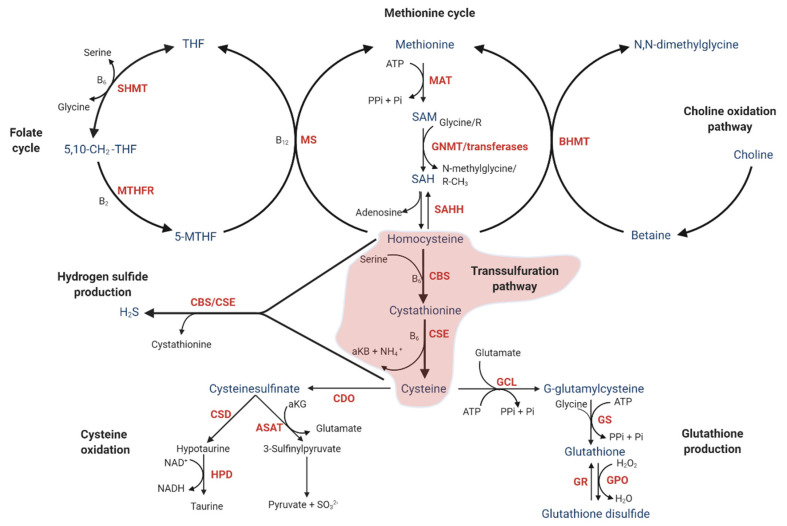
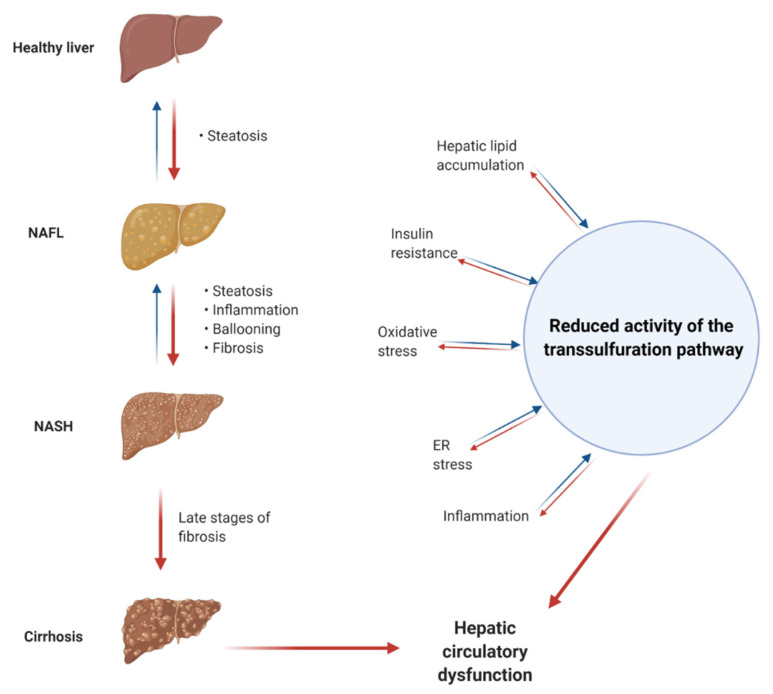
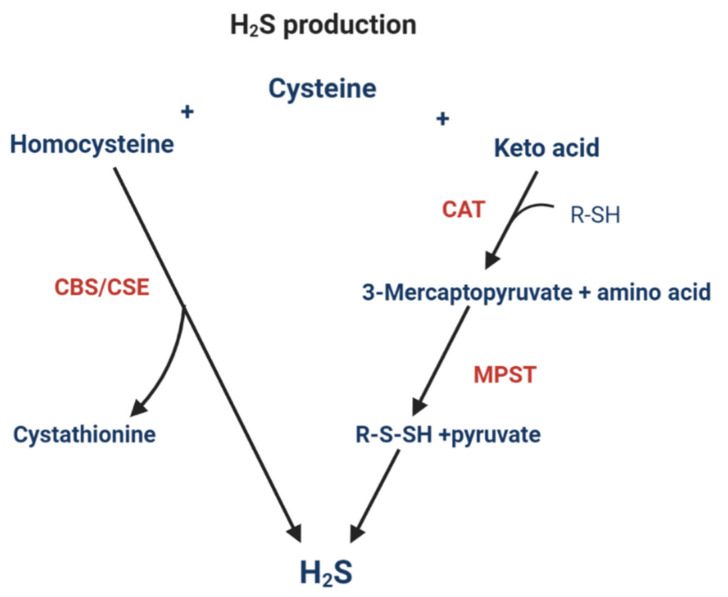
The prevalence of non-alcoholic fatty liver disease (NAFLD) is increasing and approximately 25% of the global population may have NAFLD. NAFLD is associated with obesity and metabolic syndrome, but its pathophysiology is complex and only partly understood. The transsulfuration pathway (TSP) is a metabolic pathway regulating homocysteine and cysteine metabolism and is vital in controlling sulfur balance in the organism. Precise control of this pathway is critical for maintenance of optimal cellular function. The TSP is closely linked to other pathways such as the folate and methionine cycles, hydrogen sulfide (HS) and glutathione (GSH) production. Impaired activity of the TSP will cause an increase in homocysteine and a decrease in cysteine levels. Homocysteine will also be increased due to impairment of the folate and methionine cycles. The key enzymes of the TSP, cystathionine β-synthase (CBS) and cystathionine γ-lyase (CSE), are highly expressed in the liver and deficient CBS and CSE expression causes hepatic steatosis, inflammation, and fibrosis in animal models. A causative link between the TSP and NAFLD has not been established. However, dysfunctions in the TSP and related pathways, in terms of enzyme expression and the plasma levels of the metabolites (e.g., homocysteine, cystathionine, and cysteine), have been reported in NAFLD and liver cirrhosis in both animal models and humans. Further investigation of the TSP in relation to NAFLD may reveal mechanisms involved in the development and progression of NAFLD.
非酒精性脂肪性肝病(NAFLD)的患病率正在上升,全球约25%的人口可能患有NAFLD。NAFLD与肥胖和代谢综合征有关,但其病理生理学很复杂,目前仅部分为人所知。转硫途径(TSP)是一条调节同型半胱氨酸和半胱氨酸代谢的代谢途径,对控制机体硫平衡至关重要。精确控制该途径对于维持最佳细胞功能至关重要。TSP与其他途径密切相关,如叶酸和甲硫氨酸循环、硫化氢(HS)和谷胱甘肽(GSH)的产生。TSP活性受损会导致同型半胱氨酸增加和半胱氨酸水平降低。由于叶酸和甲硫氨酸循环受损,同型半胱氨酸也会增加。TSP的关键酶,胱硫醚β-合酶(CBS)和胱硫醚γ-裂解酶(CSE),在肝脏中高度表达,CBS和CSE表达缺陷会在动物模型中导致肝脂肪变性、炎症和纤维化。TSP与NAFLD之间的因果关系尚未确立。然而,在动物模型和人类的NAFLD和肝硬化中,均已报道TSP及相关途径在酶表达和代谢产物(如同型半胱氨酸、胱硫醚和半胱氨酸)血浆水平方面存在功能障碍。进一步研究TSP与NAFLD的关系可能会揭示NAFLD发生和发展的机制。