Institute for Pharmaceutical Biology, University of Bonn, Nussallee 6, 53115 Bonn, Germany.
Mar Drugs. 2021 Mar 5;19(3):142. doi: 10.3390/md19030142.
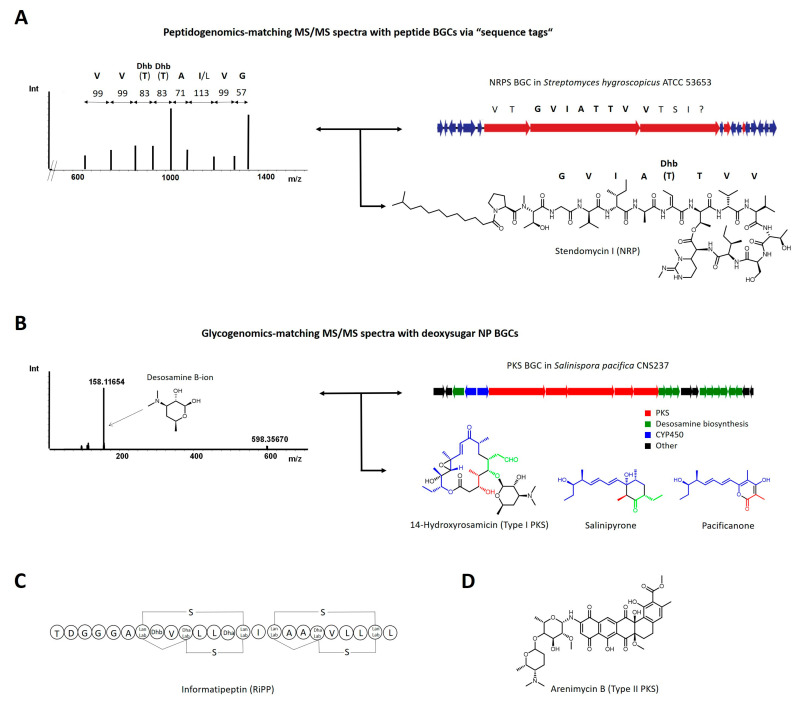
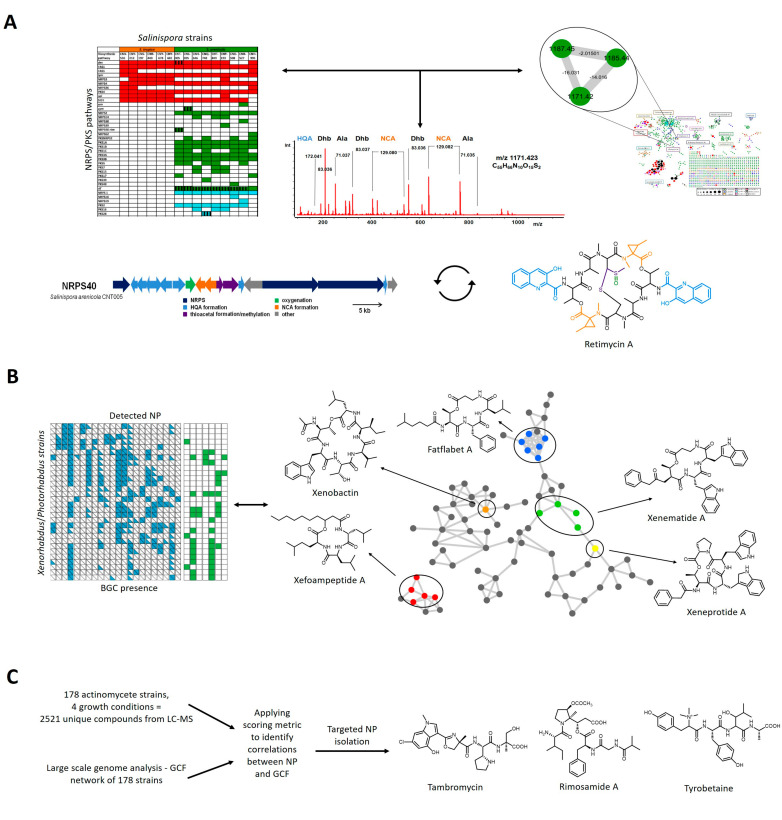
Bacterial natural products possess potent bioactivities and high structural diversity and are typically encoded in biosynthetic gene clusters. Traditional natural product discovery approaches rely on UV- and bioassay-guided fractionation and are limited in terms of dereplication. Recent advances in mass spectrometry, sequencing and bioinformatics have led to large-scale accumulation of genomic and mass spectral data that is increasingly used for signature-based or correlation-based mass spectrometry genome mining approaches that enable rapid linking of metabolomic and genomic information to accelerate and rationalize natural product discovery. In this mini-review, these approaches are presented, and discovery examples provided. Finally, future opportunities and challenges for paired omics-based natural products discovery workflows are discussed.
细菌天然产物具有强大的生物活性和高度的结构多样性,通常编码在生物合成基因簇中。传统的天然产物发现方法依赖于紫外光和生物测定引导的分离,并且在去重复方面受到限制。近年来,质谱、测序和生物信息学的进展导致了基因组和质谱数据的大规模积累,这些数据越来越多地用于基于特征或基于相关性的质谱基因组挖掘方法,这些方法能够快速将代谢组学和基因组信息联系起来,加速和合理化天然产物的发现。在这篇小综述中,介绍了这些方法,并提供了发现的实例。最后,讨论了基于组学的天然产物发现工作流程的未来机遇和挑战。