Sidi Salah Lakhdar, Ouslimani Nassira, Chouai Mohamed, Danlée Yann, Huynen Isabelle, Aksas Hammouche
Research Unit Materials, Processes and Environment (URMPE), Faculty of Technology, M'Hamed Bougara University, Boumerdes 35000, Algeria.
Processing and Shaping of Fibrous Polymers Laboratory, Faculty of Technology, University M'Hamed Bougara of Boumerdes, Avenue of Independence, Boumerdes 35000, Algeria.
Materials (Basel). 2021 Mar 30;14(7):1687. doi: 10.3390/ma14071687.
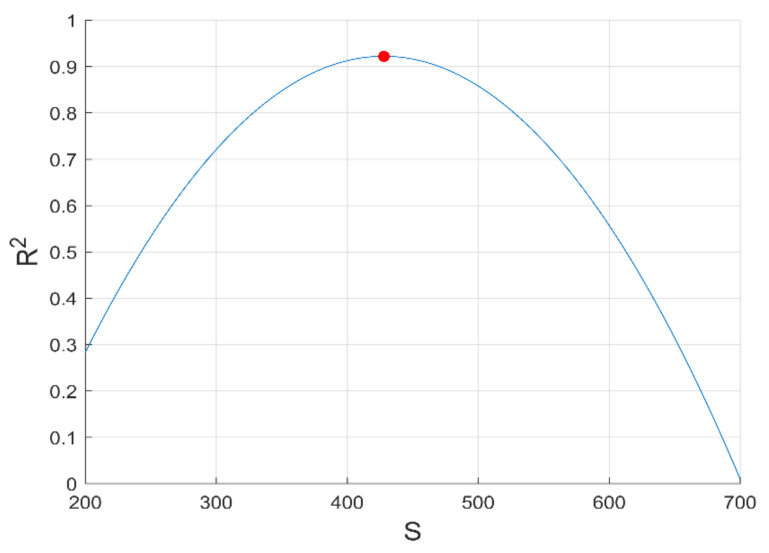
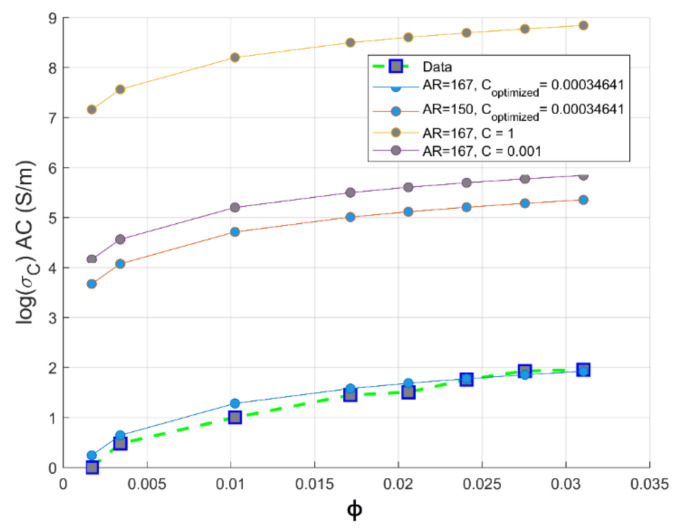
Polycarbonate-carbon nanotube (PC-CNT) conductive composites containing CNT concentration covering 0.25-4.5 wt.% were prepared by melt blending extrusion. The alternating current (AC) conductivity of the composites has been investigated. The percolation threshold of the PC-CNT composites was theoretically determined using the classical theory of percolation followed by numerical analysis, quantifying the conductivity of PC-CNT at the critical volume CNT concentration. Different theoretical models like Bueche, McCullough and Mamunya have been applied to predict the AC conductivity of the composites using a hyperparameter optimization method. Through multiple series of the hyperparameter optimization process, it was found that McCullough and Mamunya theoretical models for electrical conductivity fit remarkably with our experimental results; the degree of chain branching and the aspect ratio are estimated to be 0.91 and 167 according to these models. The development of a new model based on a modified Sohi model is in good agreement with our data, with a coefficient of determination R2=0.922 for an optimized design model. The conductivity is correlated to the electromagnetic absorption (EM) index showing a fine fit with Steffen-Boltzmann (SB) model, indicating the ultimate CNTs volume concentration for microwave absorption at the studied frequency range.
通过熔融共混挤出制备了碳纳米管(CNT)浓度为0.25-4.5 wt.%的聚碳酸酯-碳纳米管(PC-CNT)导电复合材料。研究了复合材料的交流电导率。采用经典渗流理论并结合数值分析方法,从理论上确定了PC-CNT复合材料的渗流阈值,量化了临界体积CNT浓度下PC-CNT的电导率。运用超参数优化方法,应用了不同的理论模型,如Bueche、McCullough和Mamunya模型来预测复合材料的交流电导率。通过多轮超参数优化过程发现,McCullough和Mamunya电导率理论模型与我们的实验结果拟合度非常高;根据这些模型,链支化度和长径比估计分别为0.91和167。基于改进的Sohi模型开发的新模型与我们的数据吻合良好,优化设计模型的决定系数R2=0.922。电导率与电磁吸收(EM)指数相关,与斯特藩-玻尔兹曼(SB)模型拟合良好,表明了在研究频率范围内实现微波吸收的最终CNT体积浓度。