Barbara Davis Center for Diabetes, University of Colorado Denver Anschutz Medical Campus, Aurora, CO 80045, USA.
Department of Immunology & Microbiology, University of Colorado Denver Anschutz Medical Campus, Aurora, CO 80045, USA.
Biomolecules. 2021 Mar 30;11(4):512. doi: 10.3390/biom11040512.
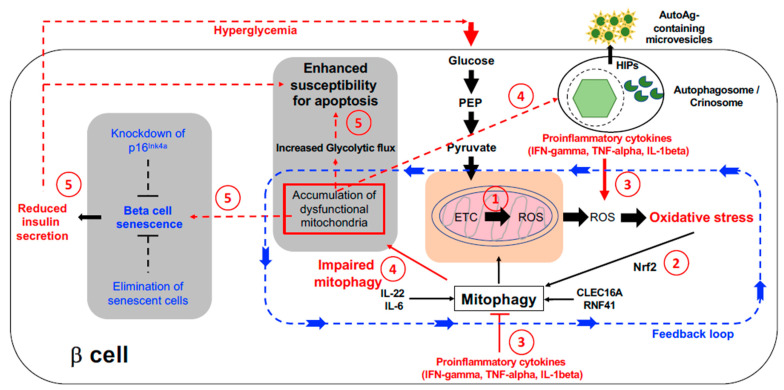
The pancreatic beta cell is a highly specialized cell type whose primary function is to secrete insulin in response to nutrients to maintain glucose homeostasis in the body. As such, the beta cell has developed unique metabolic characteristics to achieve functionality; in healthy beta cells, the majority of glucose-derived carbons are oxidized and enter the mitochondria in the form of pyruvate. The pyruvate is subsequently metabolized to induce mitochondrial ATP and trigger the downstream insulin secretion response. Thus, in beta cells, mitochondria play a pivotal role in regulating glucose stimulated insulin secretion (GSIS). In type 2 diabetes (T2D), mitochondrial impairment has been shown to play an important role in beta cell dysfunction and loss. In type 1 diabetes (T1D), autoimmunity is the primary trigger of beta cell loss; however, there is accumulating evidence that intrinsic mitochondrial defects could contribute to beta cell susceptibility during proinflammatory conditions. Furthermore, there is speculation that dysfunctional mitochondrial responses could contribute to the formation of autoantigens. In this review, we provide an overview of mitochondrial function in the beta cells, and discuss potential mechanisms by which mitochondrial dysfunction may contribute to T1D pathogenesis.
胰岛β细胞是一种高度特化的细胞类型,其主要功能是在受到营养物质刺激时分泌胰岛素,以维持体内葡萄糖的平衡。因此,β细胞已经发展出独特的代谢特征来实现其功能;在健康的β细胞中,大部分葡萄糖衍生的碳以丙酮酸的形式氧化并进入线粒体。随后,丙酮酸被代谢以诱导线粒体 ATP 的产生,并触发下游胰岛素分泌反应。因此,在线粒体中,在调节葡萄糖刺激的胰岛素分泌(GSIS)方面起着关键作用。在 2 型糖尿病(T2D)中,已经表明线粒体损伤在β细胞功能障碍和丧失中起着重要作用。在 1 型糖尿病(T1D)中,自身免疫是β细胞丧失的主要触发因素;然而,越来越多的证据表明,内在的线粒体缺陷可能导致在促炎条件下β细胞易感性增加。此外,有人推测,功能失调的线粒体反应可能导致自身抗原的形成。在这篇综述中,我们概述了β细胞中线粒体的功能,并讨论了线粒体功能障碍可能导致 T1D 发病机制的潜在机制。