Sun Yitang, Zhou Jingqi, Ye Kaixiong
Department of Genetics, Franklin College of Arts and Sciences, University of Georgia, Athens, GA 30602, USA.
School of Public Health, Shanghai Jiao Tong University School of Medicine, Shanghai 200025, China.
J Pers Med. 2021 Mar 12;11(3):195. doi: 10.3390/jpm11030195.
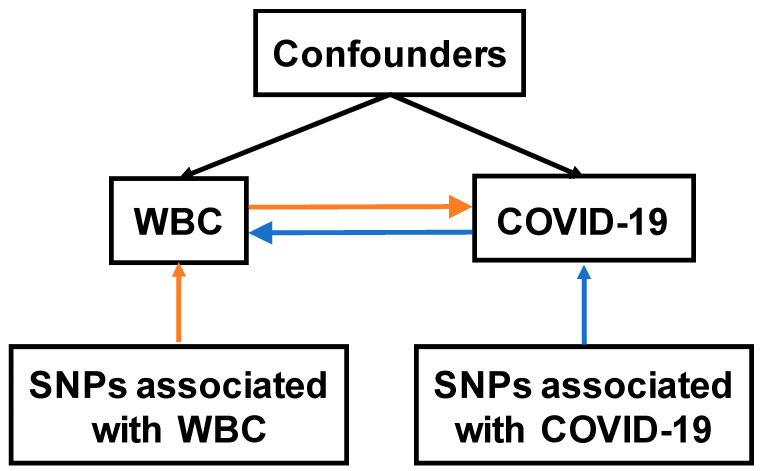
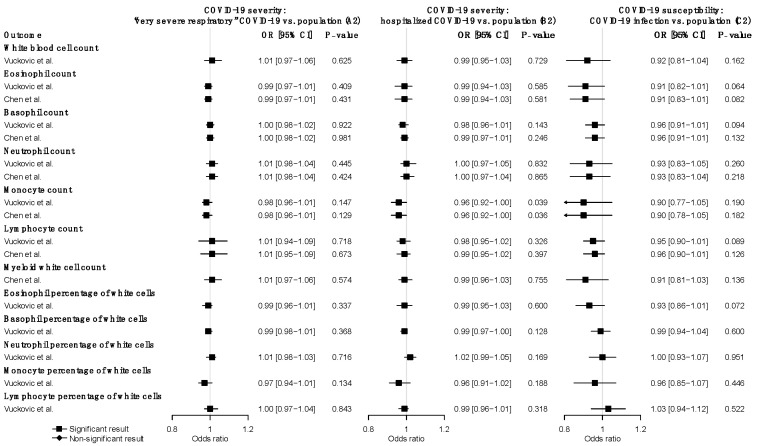
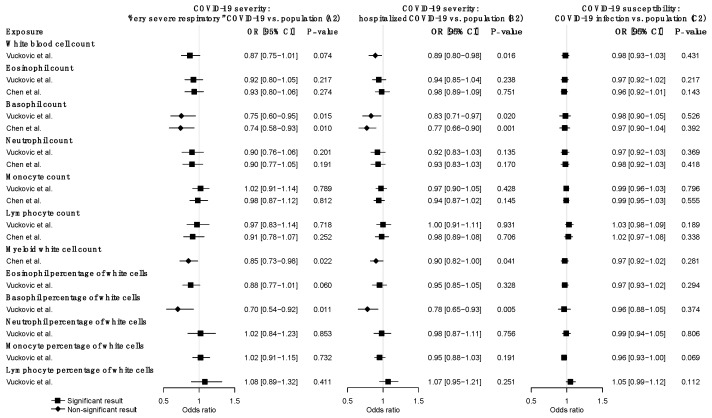
Increasing evidence shows that white blood cells are associated with the risk of coronavirus disease 2019 (COVID-19), but the direction and causality of this association are not clear. To evaluate the causal associations between various white blood cell traits and the COVID-19 susceptibility and severity, we conducted two-sample bidirectional Mendelian Randomization (MR) analyses with summary statistics from the largest and most recent genome-wide association studies. Our MR results indicated causal protective effects of higher basophil count, basophil percentage of white blood cells, and myeloid white blood cell count on severe COVID-19, with odds ratios (OR) per standard deviation increment of 0.75 (95% CI: 0.60-0.95), 0.70 (95% CI: 0.54-0.92), and 0.85 (95% CI: 0.73-0.98), respectively. Neither COVID-19 severity nor susceptibility was associated with white blood cell traits in our reverse MR results. Genetically predicted high basophil count, basophil percentage of white blood cells, and myeloid white blood cell count are associated with a lower risk of developing severe COVID-19. Individuals with a lower genetic capacity for basophils are likely at risk, while enhancing the production of basophils may be an effective therapeutic strategy.
越来越多的证据表明,白细胞与2019冠状病毒病(COVID-19)的风险相关,但这种关联的方向和因果关系尚不清楚。为了评估各种白细胞特征与COVID-19易感性和严重程度之间的因果关联,我们利用来自最大和最新的全基因组关联研究的汇总统计数据进行了两样本双向孟德尔随机化(MR)分析。我们的MR结果表明,较高的嗜碱性粒细胞计数、嗜碱性粒细胞占白细胞的百分比和髓系白细胞计数对重症COVID-19具有因果保护作用,每标准差增加的比值比(OR)分别为0.75(95%CI:0.60-0.95)、0.70(95%CI:0.54-0.92)和0.85(95%CI:0.73-0.98)。在我们的反向MR结果中,COVID-19的严重程度和易感性均与白细胞特征无关。基因预测的高嗜碱性粒细胞计数、嗜碱性粒细胞占白细胞的百分比和髓系白细胞计数与发生重症COVID-19的风险较低相关。嗜碱性粒细胞遗传能力较低的个体可能有风险,而提高嗜碱性粒细胞的生成可能是一种有效的治疗策略。