ETSI de Telecomunicación, Universidad Politécnica de Madrid, Av. Complutense 30, 28040 Madrid, Spain.
Department of Electrical Engineering, Iran University of Science and Technology, Tehran 13114-16846, Iran.
Sensors (Basel). 2021 Mar 12;21(6):2009. doi: 10.3390/s21062009.
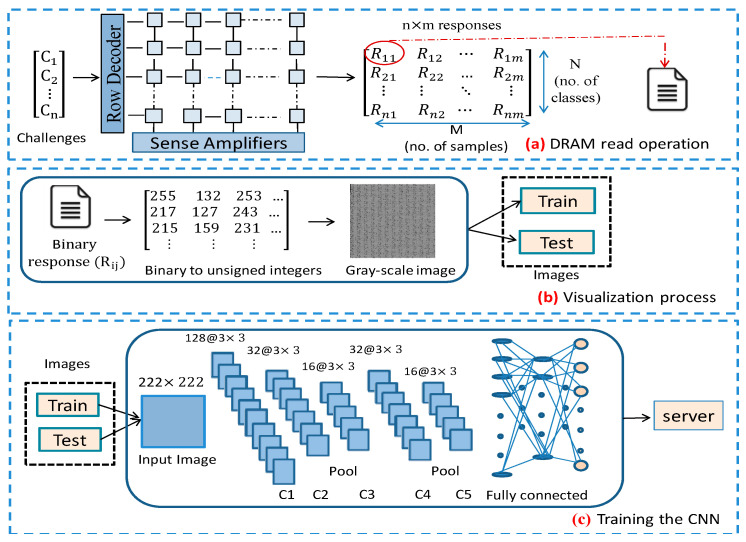
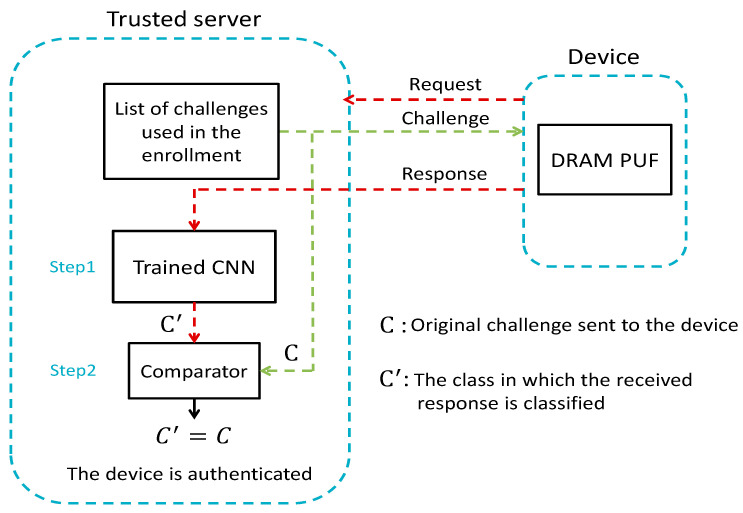
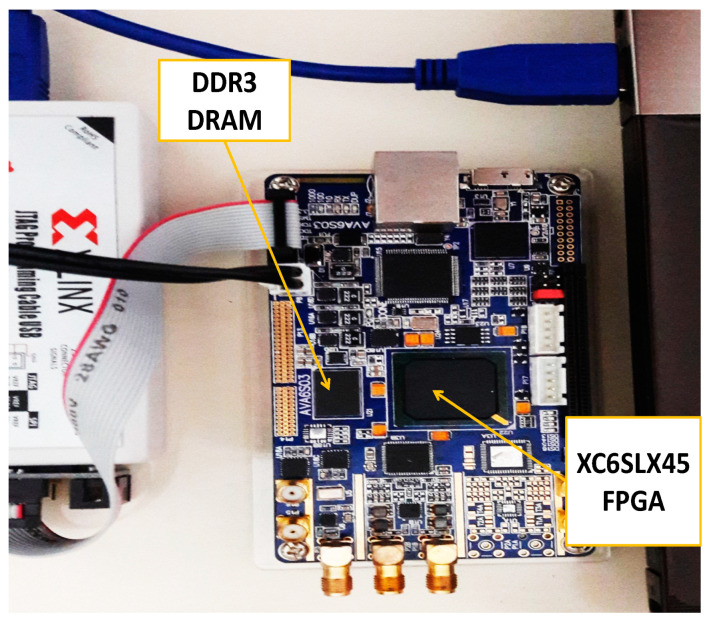
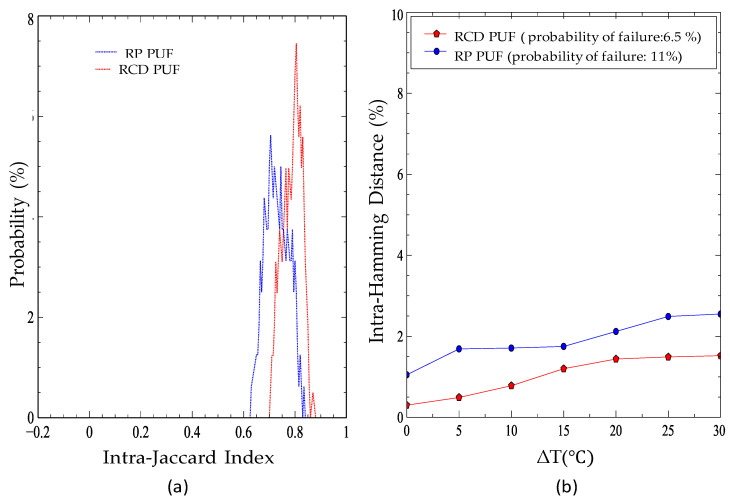
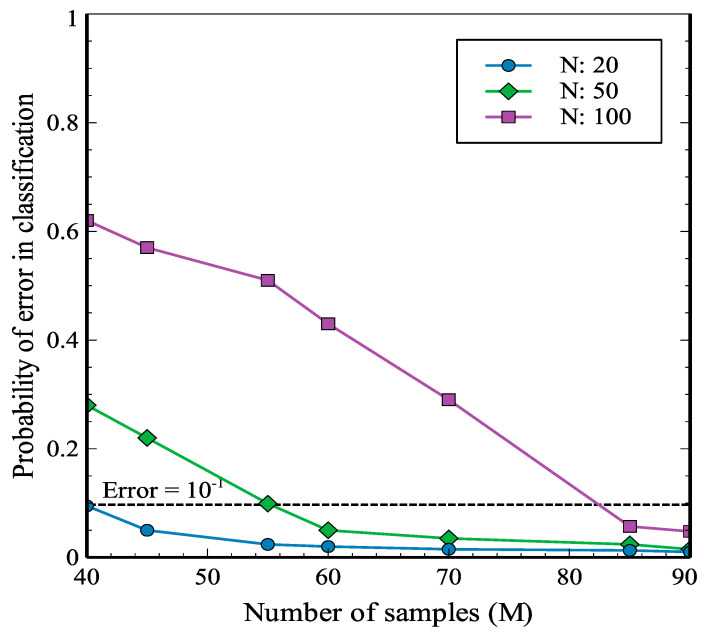
Traditional authentication techniques, such as cryptographic solutions, are vulnerable to various attacks occurring on session keys and data. Physical unclonable functions (PUFs) such as dynamic random access memory (DRAM)-based PUFs are introduced as promising security blocks to enable cryptography and authentication services. However, PUFs are often sensitive to internal and external noises, which cause reliability issues. The requirement of additional robustness and reliability leads to the involvement of error-reduction methods such as error correction codes (ECCs) and pre-selection schemes that cause considerable extra overheads. In this paper, we propose deep PUF: a deep convolutional neural network (CNN)-based scheme using the latency-based DRAM PUFs without the need for any additional error correction technique. The proposed framework provides a higher number of challenge-response pairs (CRPs) by eliminating the pre-selection and filtering mechanisms. The entire complexity of device identification is moved to the server side that enables the authentication of resource-constrained nodes. The experimental results from a 1Gb DDR3 show that the responses under varying conditions can be classified with at least a 94.9% accuracy rate by using CNN. After applying the proposed authentication steps to the classification results, we show that the probability of identification error can be drastically reduced, which leads to a highly reliable authentication.
传统的身份验证技术,如加密解决方案,容易受到会话密钥和数据上发生的各种攻击的影响。物理不可克隆函数(PUF),如基于动态随机存取存储器(DRAM)的 PUF,作为有前途的安全模块被引入,以实现密码学和身份验证服务。然而,PUF 通常对内部和外部噪声很敏感,这会导致可靠性问题。对额外的鲁棒性和可靠性的需求导致了错误减少方法的介入,例如纠错码(ECC)和预选方案,这会导致相当大的额外开销。在本文中,我们提出了深度 PUF:一种基于深度卷积神经网络(CNN)的方案,使用基于延迟的 DRAM PUF,而无需任何额外的纠错技术。所提出的框架通过消除预选和过滤机制提供了更多的质询-响应对(CRP)。设备识别的整个复杂性被转移到服务器端,从而能够对资源受限的节点进行身份验证。从 1Gb DDR3 获得的实验结果表明,通过使用 CNN,可以以至少 94.9%的准确率对各种条件下的响应进行分类。在将所提出的身份验证步骤应用于分类结果之后,我们表明可以大大降低识别错误的概率,从而实现高度可靠的身份验证。