Ohlendorf Fiona, Werner Rudolf A, Henkenberens Christoph, Ross Tobias L, Christiansen Hans, Bengel Frank M, Derlin Thorsten
Department of Nuclear Medicine, Hannover Medical School, 30625 Hannover, Germany.
Department of Radiation Oncology, Hannover Medical School, 30625 Hannover, Germany.
Diagnostics (Basel). 2021 Mar 12;11(3):504. doi: 10.3390/diagnostics11030504.
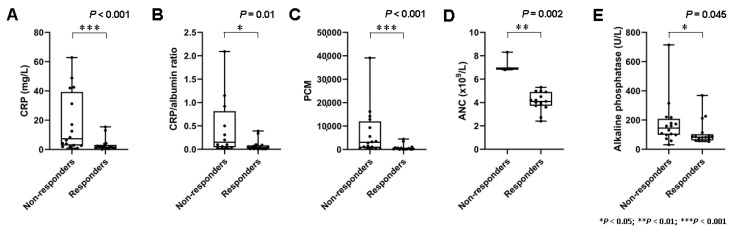
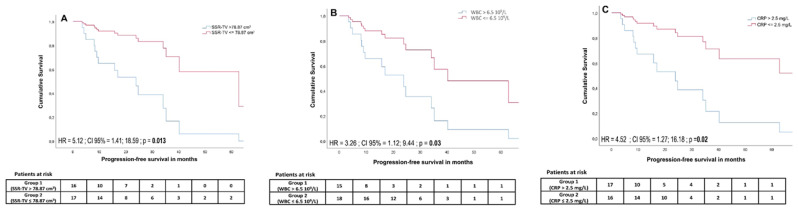
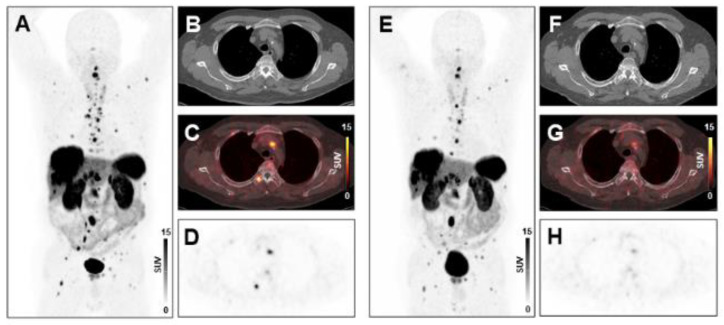
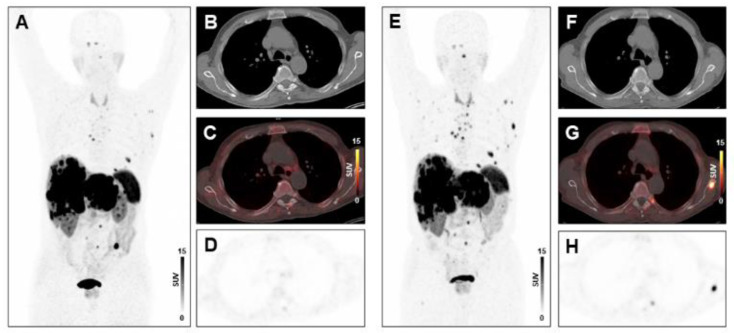
Tumor microenvironment inflammation contributes to the proliferation and survival of malignant cells, angiogenesis, metastasis, subversion of adaptive immunity, and reduced treatment response. We aimed to evaluate the early predictive and prognostic significance of markers of systemic inflammation in patients receiving somatostatin-receptor targeted peptide receptor radionuclide therapy (PRRT). This retrospective observational cohort study included 33 patients with advanced gastro-entero-pancreatic neuroendocrine tumors (GEP-NETs) treated with PRRT. Pretreatment blood-based inflammatory biomarkers, e.g., C-reactive protein levels (CRP), white blood cell count (WBC), and absolute neutrophil count (ANC), were documented and inflammation indexes, e.g., neutrophil-lymphocyte ratio (NLR) and Platelet × CRP multiplier (PCM), were calculated. Tumor burden was determined using [Ga]Ga-DOTA-TATE PET/CT before enrollment and every 2 cycles thereafter until progression. Therapy response was assessed using RECIST 1.1, including its volumetric modification. Inflammatory biomarkers and inflammatory indexes demonstrated marked heterogeneity among patients, and were significantly higher in non-responders (e.g., CRP ( < 0.001), ANC ( = 0.002), and PCM ( < 0.001)). Change in whole-body tumor burden after two cycles of PRRT was significantly associated with CRP ( = 0.0157) and NLR ( = 0.0040) in multivariate regression analysis. A cut-off of 2.5 mg/L for CRP (AUC = 0.84, = 0.001) revealed a significant outcome difference between patients with adversely high vs. low CRP (median PFS 508 days vs. not yet reached (HR = 4.52; 95% CI, 1.27 to 16.18; = 0.02)). Tumor-driven systemic inflammatory networks may be associated with treatment response, change in tumor burden, and prognosis in patients with GEP-NETs receiving PRRT.
肿瘤微环境炎症有助于恶性细胞的增殖和存活、血管生成、转移、适应性免疫的颠覆以及治疗反应降低。我们旨在评估接受生长抑素受体靶向肽受体放射性核素治疗(PRRT)的患者中全身炎症标志物的早期预测和预后意义。这项回顾性观察队列研究纳入了33例接受PRRT治疗的晚期胃肠胰神经内分泌肿瘤(GEP-NETs)患者。记录了治疗前基于血液的炎症生物标志物,如C反应蛋白水平(CRP)、白细胞计数(WBC)和绝对中性粒细胞计数(ANC),并计算了炎症指标,如中性粒细胞与淋巴细胞比值(NLR)和血小板×CRP倍数(PCM)。在入组前及此后每2个周期直至疾病进展,使用[镓]镓-多柔比星-奥曲肽PET/CT确定肿瘤负荷。使用RECIST 1.1评估治疗反应,包括其体积变化。炎症生物标志物和炎症指标在患者中表现出明显的异质性,在无反应者中显著更高(如CRP(<0.001)、ANC(=0.002)和PCM(<0.001))。在多变量回归分析中,PRRT两个周期后全身肿瘤负荷的变化与CRP(=0.0157)和NLR(=0.0040)显著相关。CRP的截断值为2.5 mg/L(AUC = 0.84,= 0.001)显示,CRP水平高与低的患者之间存在显著的预后差异(中位无进展生存期508天对未达到(HR = 4.52;95% CI,1.27至16.18;= 0.02))。肿瘤驱动的全身炎症网络可能与接受PRRT的GEP-NETs患者的治疗反应、肿瘤负荷变化和预后相关。