Steuer Andrea E, Raeber Justine, Simbuerger Fabio, Dornbierer Dario A, Bosch Oliver G, Quednow Boris B, Seifritz Erich, Kraemer Thomas
Department of Forensic Pharmacology & Toxicology, Zurich Institute of Forensic Medicine, University of Zurich, 8057 Zurich, Switzerland.
Department of Psychiatry, Psychotherapy and Psychosomatics, Psychiatric Hospital, University of Zurich, 8032 Zurich, Switzerland.
Metabolites. 2021 Mar 12;11(3):166. doi: 10.3390/metabo11030166.
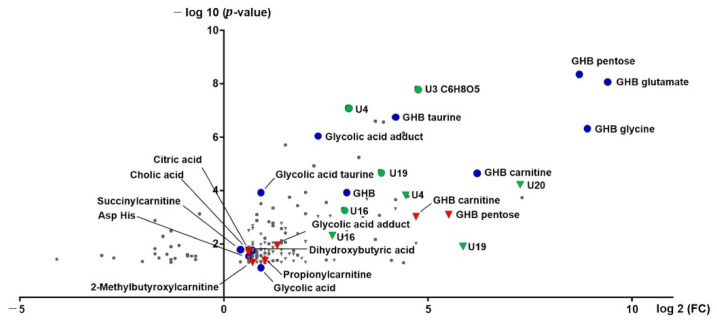
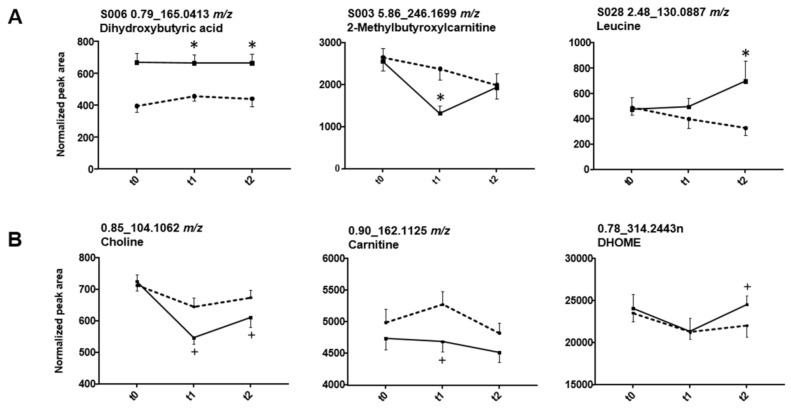
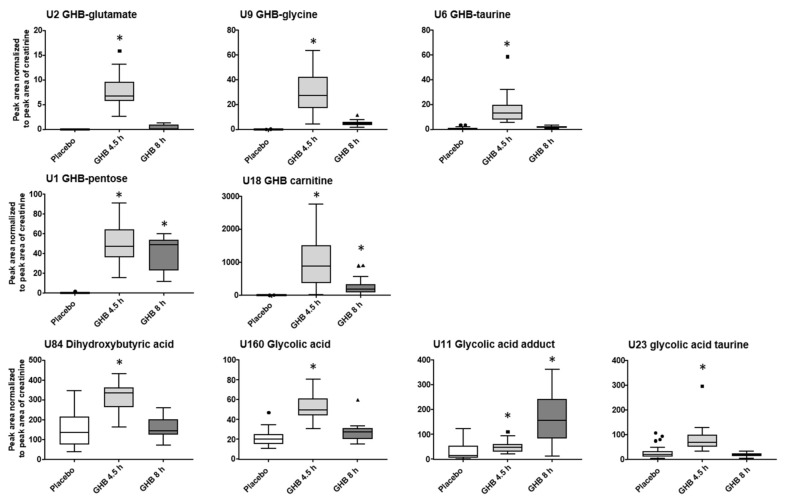
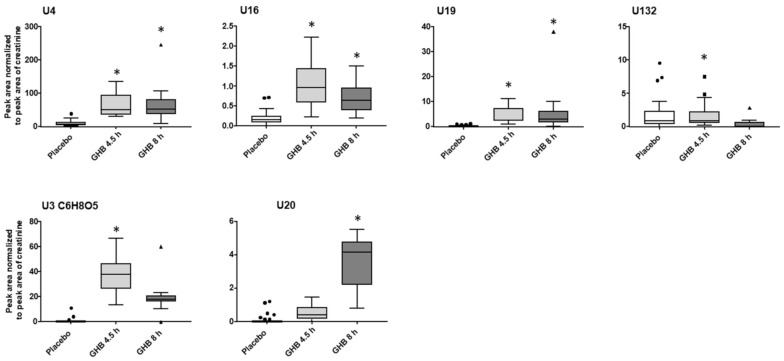
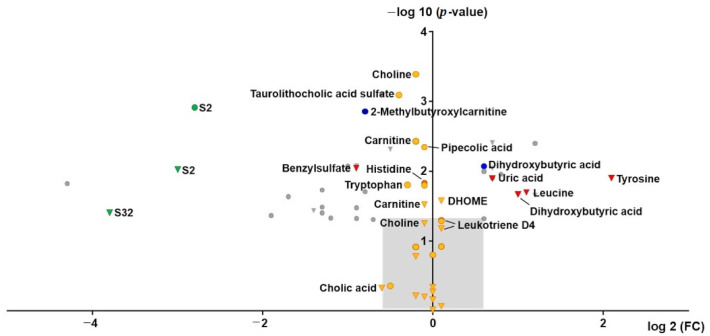
In forensic toxicology, gamma-hydroxybutyrate (GHB) still represents one of the most challenging drugs of abuse in terms of analytical detection and interpretation. Given its rapid elimination, the detection window of GHB in common matrices is short (maximum 12 h in urine). Additionally, the differentiation from naturally occurring endogenous GHB, is challenging. Thus, novel biomarkers to extend the detection window of GHB are urgently needed. The present study aimed at searching new potential biomarkers of GHB use by means of mass spectrometry (MS) metabolomic profiling in serum (up to 16.5 h) and urine samples (up to 8 h after intake) collected during a placebo-controlled crossover study in healthy men. MS data acquired by different analytical methods (reversed phase and hydrophilic interaction liquid chromatography; positive and negative electrospray ionization each) were filtered for significantly changed features applying univariate and mixed-effect model statistics. Complementary to a former study, conjugates of GHB with glycine, glutamate, taurine, carnitine and pentose (ribose) were identified in urine, with particularly GHB-pentose being promising for longer detection. None of the conjugates were detectable in serum. Therein, mainly energy metabolic substrates were identified, which may be useful for more detailed interpretation of underlying pathways but are too unspecific as biomarkers.
在法医毒理学中,就分析检测和解释而言,γ-羟基丁酸(GHB)仍然是最难检测的滥用药物之一。鉴于其快速消除,GHB在常见基质中的检测窗口期很短(尿液中最长12小时)。此外,将其与天然存在的内源性GHB区分开来也具有挑战性。因此,迫切需要新的生物标志物来延长GHB的检测窗口期。本研究旨在通过质谱(MS)代谢组学分析,在健康男性的安慰剂对照交叉研究中收集的血清样本(长达16.5小时)和尿液样本(摄入后长达8小时)中寻找新的GHB使用潜在生物标志物。通过不同分析方法(反相和亲水相互作用液相色谱;正负电喷雾电离)获得的MS数据,应用单变量和混合效应模型统计对显著变化的特征进行筛选。与之前的一项研究互补,在尿液中鉴定出了GHB与甘氨酸、谷氨酸、牛磺酸、肉碱和戊糖(核糖)的共轭物,其中特别是GHB-戊糖在延长检测方面很有前景。血清中未检测到任何共轭物。在血清中,主要鉴定出能量代谢底物,它们可能有助于更详细地解释潜在途径,但作为生物标志物过于非特异性。