Crego-Vicente Beatriz, Fernández-Soto Pedro, Febrer-Sendra Begoña, García-Bernalt Diego Juan, Boissier Jérôme, Angora Etienne K, Oleaga Ana, Muro Antonio
Infectious and Tropical Diseases Research Group (e-INTRO), Research Centre for Tropical Diseases at the University of Salamanca (IBSAL-CIETUS), Biomedical Research Institute of Salamanca, Faculty of Pharmacy, University of Salamanca, 37007 Salamanca, Spain.
IHPE, Université Montpellier, CNRS, Ifremer, Université Perpignan Via Domitia, 66100 Perpignan, France.
J Clin Med. 2021 Mar 22;10(6):1308. doi: 10.3390/jcm10061308.
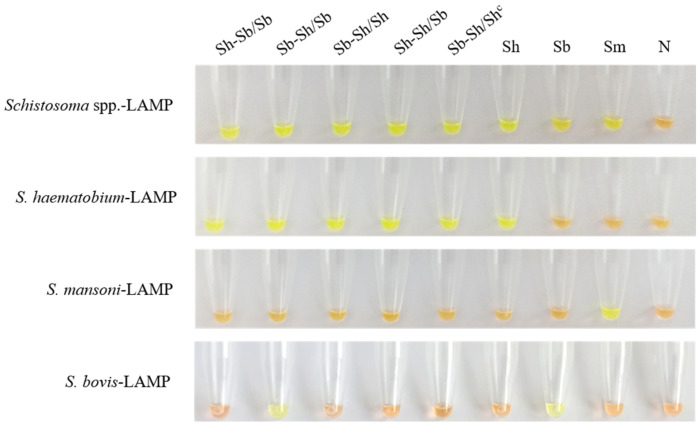
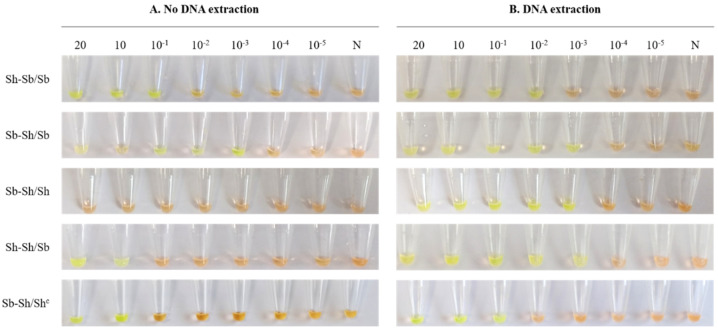
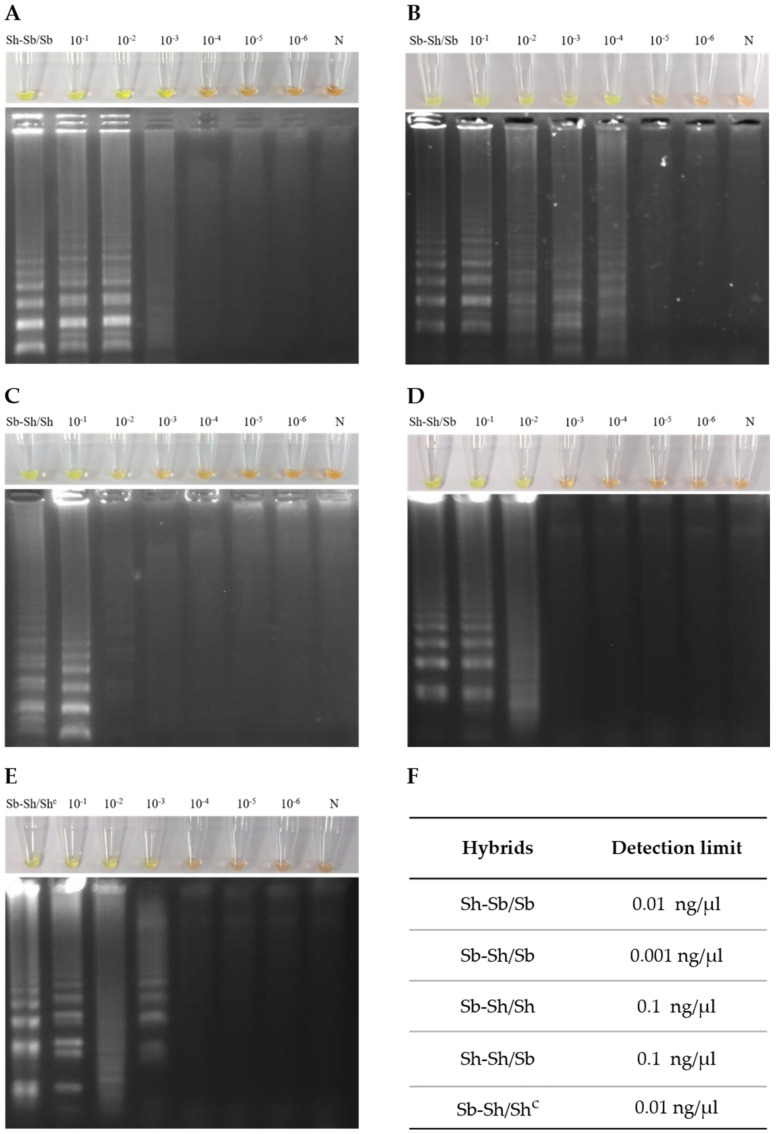
Schistosomiasis is a disease of great medical and veterinary importance in tropical and subtropical regions caused by different species of parasitic flatworms of the genus . The emergence of natural hybrids of schistosomes indicate the risk of possible infection to humans and their zoonotic potential, specifically for and . Hybrid schistosomes have the potential to replace existing species, generate new resistances, pathologies and extending host ranges. Hybrids may also confuse the serological, molecular and parasitological diagnosis. Currently, LAMP technology based on detection of nucleic acids is used for detection of many agents, including schistosomes. Here, we evaluate our previously developed species-specific LAMP assays for , , and also the genus-specific LAMP for the simultaneous detection of several species against both DNA from pure and, for the first time, x hybrids. Proper operation was evaluated with DNA from hybrid schistosomes and with human urine samples artificially contaminated with parasites' DNA. LAMP was performed with and without prior DNA extraction. The genus-specific LAMP properly amplified pure species and different hybrids with different sensitivity. The spp.-LAMP method is potentially adaptable for field diagnosis and disease surveillance in schistosomiasis endemic areas where human infections by schistosome hybrids are increasingly common.
血吸虫病是一种在热带和亚热带地区具有重大医学和兽医学意义的疾病,由血吸虫属的不同种类寄生扁虫引起。血吸虫自然杂交种的出现表明了对人类可能感染的风险及其人畜共患病潜力,特别是对于[具体物种1]和[具体物种2]。杂交血吸虫有可能取代现有物种,产生新的抗性、病理学特征并扩大宿主范围。杂交种还可能使血清学、分子学和寄生虫学诊断产生混淆。目前,基于核酸检测的环介导等温扩增(LAMP)技术用于检测包括血吸虫在内的多种病原体。在此,我们评估了我们先前开发的针对[具体物种1]、[具体物种2]、[具体物种3]的物种特异性LAMP检测方法,以及用于同时检测几种血吸虫物种的属特异性LAMP,检测对象包括纯DNA以及首次使用的[具体物种1]×[具体物种2]杂交种的DNA。使用杂交血吸虫的DNA以及人工感染寄生虫DNA的人类尿液样本评估了该方法的正确操作。LAMP检测在有无预先DNA提取的情况下进行。属特异性LAMP以不同的灵敏度正确扩增了纯血吸虫物种和不同的杂交种。[具体物种]特异性LAMP方法有可能适用于血吸虫杂交种感染人类日益常见的血吸虫病流行地区的现场诊断和疾病监测。