Centre for Emerging, Endemic and Exotic Diseases, Department of Pathobiology and Population Sciences, Royal Veterinary College, University of London, Hertfordshire, UK; London Centre for Neglected Tropical Disease Research, School of Public Health, Imperial College London, London, UK.
Centre for Emerging, Endemic and Exotic Diseases, Department of Pathobiology and Population Sciences, Royal Veterinary College, University of London, Hertfordshire, UK; London Centre for Neglected Tropical Disease Research, School of Public Health, Imperial College London, London, UK; NTD Modelling Consortium, Big Data Institute, University of Oxford, Oxford, UK.
Lancet Planet Health. 2020 Aug;4(8):e330-e342. doi: 10.1016/S2542-5196(20)30129-7.
Schistosomiasis is a neglected tropical disease of global medical and veterinary importance. As efforts to eliminate schistosomiasis as a public health problem and interrupt transmission gather momentum, the potential zoonotic risk posed by livestock Schistosoma species via viable hybridisation in sub-Saharan Africa have been largely overlooked. We aimed to investigate the prevalence, distribution, and multi-host, multiparasite transmission cycle of Haematobium group schistosomiasis in Senegal, West Africa.
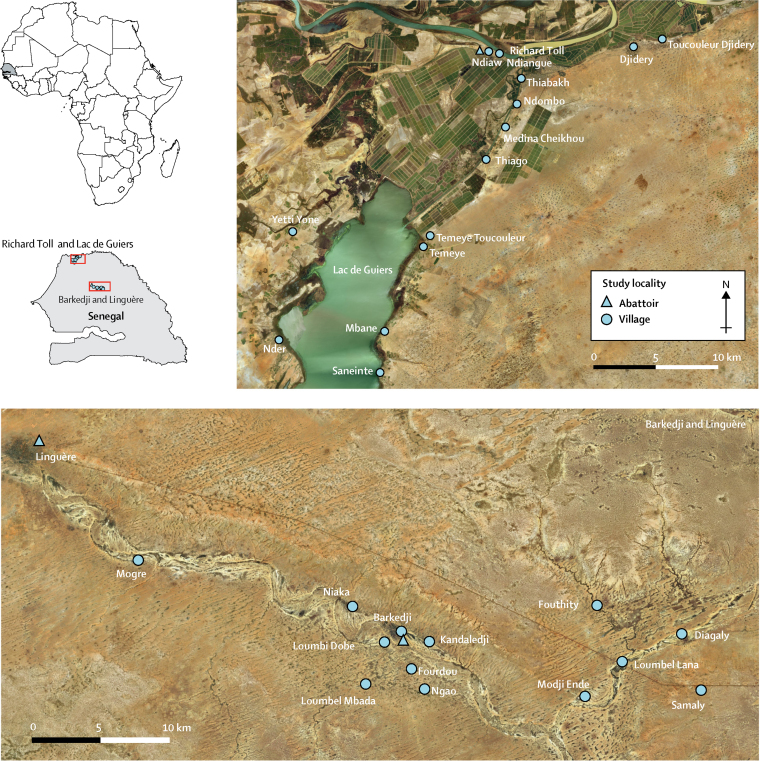
In this epidemiological study, we carried out systematic surveys in definitive hosts (humans, cattle, sheep, and goats) and snail intermediate hosts, in 2016-18, in two areas of Northern Senegal: Richard Toll and Lac de Guiers, where transmission is perennial; and Barkedji and Linguère, where transmission is seasonal. The occurrence and distribution of Schistosoma species and hybrids were assessed by molecular analyses of parasitological specimens obtained from the different hosts. Children in the study villages aged 5-17 years and enrolled in school were selected from school registers. Adults (aged 18-78 years) were self-selecting volunteers. Livestock from the study villages in both areas were also randomly sampled, as were post-mortem samples from local abattoirs. Additionally, five malacological surveys of snail intermediate hosts were carried out at each site in open water sources used by the communities and their animals.
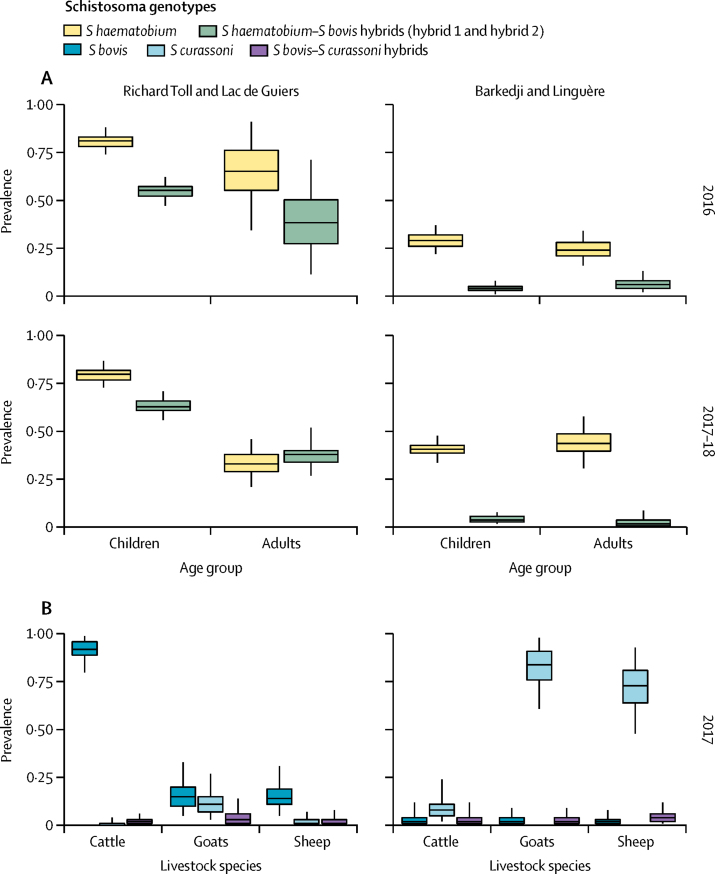
In May to August, 2016, we surveyed 375 children and 20 adults from Richard Toll and Lac de Guiers, and 201 children and 107 adults from Barkedji and Linguère; in October, 2017, to January, 2018, we surveyed 386 children and 88 adults from Richard Toll and Lac de Guiers, and 323 children and 85 adults from Barkedji and Linguère. In Richard Toll and Lac de Guiers the prevalence of urogenital schistosomiasis in children was estimated to be 87% (95% CI 80-95) in 2016 and 88% (82-95) in 2017-18. An estimated 63% (in 2016) and 72% (in 2017-18) of infected children were shedding Schistosoma haematobium-Schistosoma bovis hybrids. In adults in Richard Toll and Lac de Guiers, the prevalence of urogenital schistosomiasis was estimated to be 79% (52-97) in 2016 and 41% (30-54) in 2017-18, with 88% of infected samples containing S haematobium-S bovis hybrids. In Barkedji and Linguère the prevalence of urogenital schistosomiasis in children was estimated to be 30% (23-38) in 2016 and 42% (35-49) in 2017-18, with the proportion of infected children found to be shedding S haematobium-S bovis hybrid miracidia much lower than in Richard Toll and Lac de Guiers (11% in 2016 and 9% in 2017-18). In adults in Barkedji and Linguère, the prevalence of urogenital schistosomiasis was estimated to be 26% (17-36) in 2016 and 47% (34-60) in 2017-18, with 10% of infected samples containing S haematobium-S bovis hybrids. The prevalence of S bovis in the sympatric cattle population of Richard Toll and the Lac de Guiers was 92% (80-99), with S bovis also found in sheep (estimated prevalence 14% [5-31]) and goats (15% [5-33]). In Barkedji and Linguère the main schistosome species in livestock was Schistosoma curassoni, with an estimated prevalence of 73% (48-93) in sheep, 84% (61-98) in goats and 8% (2-24) in cattle. S haematobium-S bovis hybrids were not found in livestock. In Richard Toll and Lac de Guiers 35% of infected Bulinus spp snail intermediate hosts were found to be shedding S haematobium-S bovis hybrids (68% shedding S haematobium; 17% shedding S bovis); however, no snails were found to be shedding S haematobium hybrids in Barkedji and Linguère (29% shedding S haematobium; 71% shedding S curassoni).
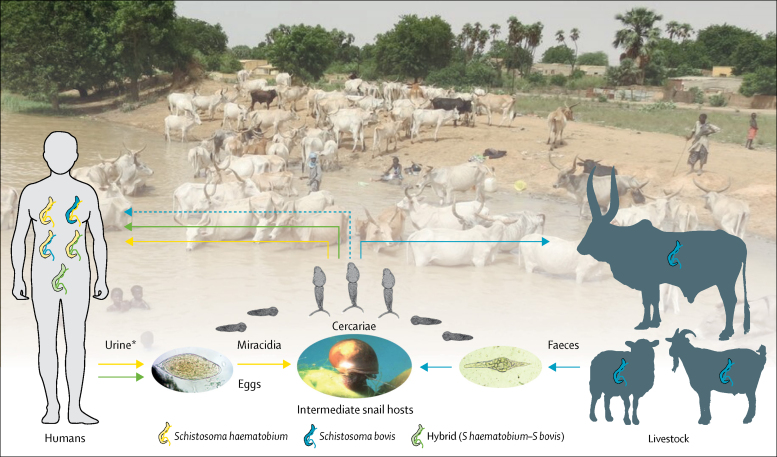
Our findings suggest that hybrids originate in humans via zoonotic spillover from livestock populations, where schistosomiasis is co-endemic. Introgressive hybridisation, evolving host ranges, and wider ecosystem contexts could affect the transmission dynamics of schistosomiasis and other pathogens, demonstrating the need to consider control measures within a One Health framework.
Zoonoses and Emerging Livestock Systems programme (UK Biotechnology and Biological Sciences Research Council, UK Department for International Development, UK Economic and Social Research Council, UK Medical Research Council, UK Natural Environment Research Council, and UK Defence Science and Technology Laboratory).
血吸虫病是一种具有全球医学和兽医重要性的被忽视的热带病。随着消除血吸虫病这一公共卫生问题和阻断传播的努力不断推进,在撒哈拉以南非洲,家畜血吸虫物种通过可行的杂交在潜在的人畜共患病风险方面,一直被大大忽视。本研究旨在调查塞内加尔西北部北理查德托尔和拉盖尔迪耶,以及巴克杰和林盖尔这两个地区的哈马托比组血吸虫病的流行率、分布情况,以及多宿主、多寄生虫传播周期。
在这项流行病学研究中,我们于 2016 年至 2018 年,在两个地区(理查德托尔和拉盖尔迪耶,常年传播;巴克杰和林盖尔,季节性传播)对人类、牛、绵羊和山羊等终末宿主,以及中间螺类宿主进行了系统调查。通过对不同宿主寄生虫标本的分子分析,评估了血吸虫物种和杂交种的发生和分布情况。从学校登记册中选择研究村庄中年龄在 5-17 岁的在校儿童和 18-78 岁的成年志愿者作为研究对象。两个地区的研究村庄的牲畜也进行了随机抽样,以及来自当地屠宰场的死后样本。此外,在每个地点的开放水源处,还进行了五次中间螺类宿主的螺类调查。
2016 年 5 月至 8 月,我们对理查德托尔和拉盖尔迪耶的 375 名儿童和 20 名成年人,以及巴克杰和林盖尔的 201 名儿童和 107 名成年人进行了调查;2017 年 10 月至 2018 年 1 月,对理查德托尔和拉盖尔迪耶的 386 名儿童和 88 名成年人,以及巴克杰和林盖尔的 323 名儿童和 85 名成年人进行了调查。在理查德托尔和拉盖尔迪耶,2016 年和 2017-18 年儿童的尿路血吸虫病流行率估计分别为 87%(80-95)和 88%(82-95)。估计有 63%(2016 年)和 72%(2017-18 年)的受感染儿童排泄混合的斯氏血吸虫-牛血吸虫。在理查德托尔和拉盖尔迪耶的成年人中,尿路血吸虫病的流行率估计在 2016 年为 79%(52-97),在 2017-18 年为 41%(30-54),其中 88%的感染样本含有斯氏血吸虫-牛血吸虫混合体。在巴克杰和林盖尔,2016 年儿童的尿路血吸虫病流行率估计为 30%(23-38),2017-18 年为 42%(35-49),在理查德托尔和拉盖尔迪耶发现的感染儿童排泄斯氏血吸虫-牛血吸虫混合体的比例要低得多(2016 年为 11%,2017-18 年为 9%)。在巴克杰和林盖尔的成年人中,2016 年尿路血吸虫病的流行率估计为 26%(17-36),2017-18 年为 47%(34-60),其中 10%的感染样本含有斯氏血吸虫-牛血吸虫混合体。理查德托尔和拉盖尔迪耶的共生牛群中的牛血吸虫流行率估计为 92%(80-99),还在绵羊(估计流行率为 14%[5-31])和山羊(15%[5-33])中发现了牛血吸虫。在巴克杰和林盖尔,主要的血吸虫物种是斯氏卷棘口吸虫,绵羊的估计流行率为 73%(48-93),山羊为 84%(61-98),牛为 8%(2-24)。在牲畜中未发现斯氏血吸虫-牛血吸虫混合体。在理查德托尔和拉盖尔迪耶,35%感染的圆口螺中间宿主排泄斯氏血吸虫-牛血吸虫混合体(68%排泄斯氏血吸虫;17%排泄牛血吸虫);然而,在巴克杰和林盖尔没有发现排泄斯氏血吸虫混合体的圆口螺(29%排泄斯氏血吸虫;71%排泄斯氏卷棘口吸虫)。
我们的研究结果表明,杂交种起源于人类,通过家畜种群的人畜共患病溢出而来,而血吸虫病在这些地区普遍存在。基因渐渗、宿主范围的进化和更广泛的生态系统背景可能会影响血吸虫病和其他病原体的传播动态,这表明需要在一个“同一健康”框架内考虑控制措施。
人畜共患病和新兴家畜系统计划(英国生物技术和生物科学研究理事会、英国国际发展部、英国经济和社会研究理事会、英国医学研究理事会、英国自然环境研究理事会和英国国防科学技术实验室)。