Dominick P. Purpura Department of Neuroscience, Albert Einstein College of Medicine, 1300 Morris Park Avenue, Bronx, NY 10461, USA.
Institute of Genetics and Biophysics "Adriano Buzzati Traverso", CNR, 80131 Naples, Italy.
Cells. 2021 Mar 26;10(4):735. doi: 10.3390/cells10040735.
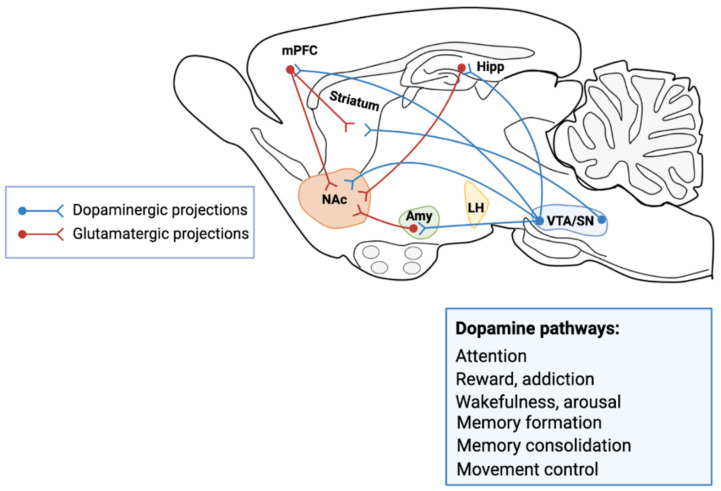
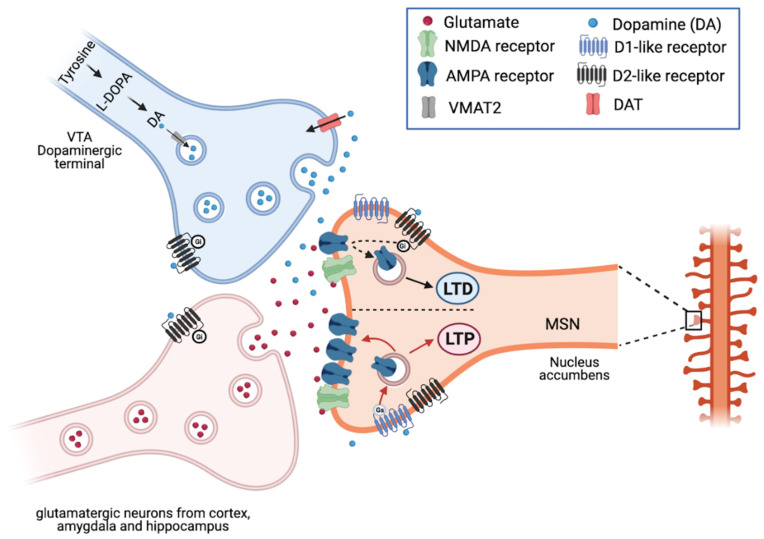
Dopamine (DA) is a key neurotransmitter involved in multiple physiological functions including motor control, modulation of affective and emotional states, reward mechanisms, reinforcement of behavior, and selected higher cognitive functions. Dysfunction in dopaminergic transmission is recognized as a core alteration in several devastating neurological and psychiatric disorders, including Parkinson's disease (PD), schizophrenia, bipolar disorder, attention deficit hyperactivity disorder (ADHD) and addiction. Here we will discuss the current insights on the role of DA in motor control and reward learning mechanisms and its involvement in the modulation of synaptic dynamics through different pathways. In particular, we will consider the role of DA as neuromodulator of two forms of synaptic plasticity, known as long-term potentiation (LTP) and long-term depression (LTD) in several cortical and subcortical areas. Finally, we will delineate how the effect of DA on dendritic spines places this molecule at the interface between the motor and the cognitive systems. Specifically, we will be focusing on PD, vascular dementia, and schizophrenia.
多巴胺(DA)是一种关键的神经递质,参与多种生理功能,包括运动控制、情感和情绪状态的调节、奖励机制、行为强化以及特定的高级认知功能。多巴胺能传递功能障碍被认为是几种毁灭性的神经和精神疾病的核心改变,包括帕金森病(PD)、精神分裂症、双相情感障碍、注意缺陷多动障碍(ADHD)和成瘾。在这里,我们将讨论 DA 在运动控制和奖励学习机制中的作用的最新见解,以及它通过不同途径参与调节突触动力学。特别是,我们将考虑 DA 作为两种形式的突触可塑性的神经调质的作用,即长时程增强(LTP)和长时程抑制(LTD)在几个皮质和皮质下区域。最后,我们将阐明 DA 对树突棘的影响如何使这种分子处于运动和认知系统之间的界面。具体来说,我们将重点讨论 PD、血管性痴呆和精神分裂症。