Majem Margarita, Cobo Manuel, Isla Dolores, Marquez-Medina Diego, Rodriguez-Abreu Delvys, Casal-Rubio Joaquín, Bueno Teresa Moran, Bernabé-Caro Reyes, Parente Diego Pérez, Ruiz-Gracia Pedro, Arroyo Marta Marina, Paz-Ares Luis
Medical Oncology, Hospital de la Santa Creu i Sant Pau, 08041 Barcelona, Spain.
Medical Oncology, Hospital Regional Universitario de Málaga, 29010 Malaga, Spain.
J Clin Med. 2021 Mar 26;10(7):1365. doi: 10.3390/jcm10071365.
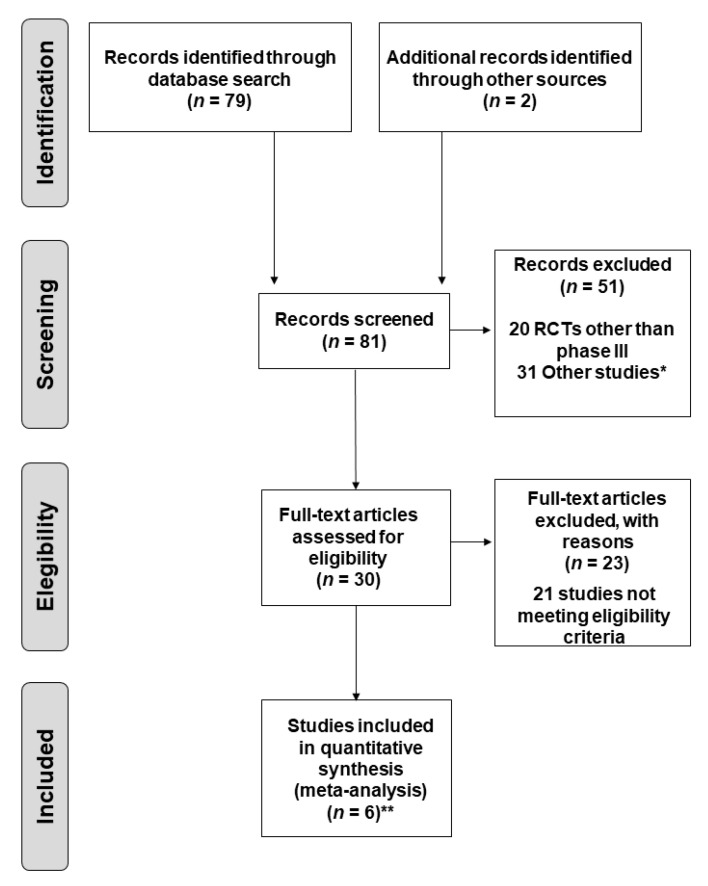
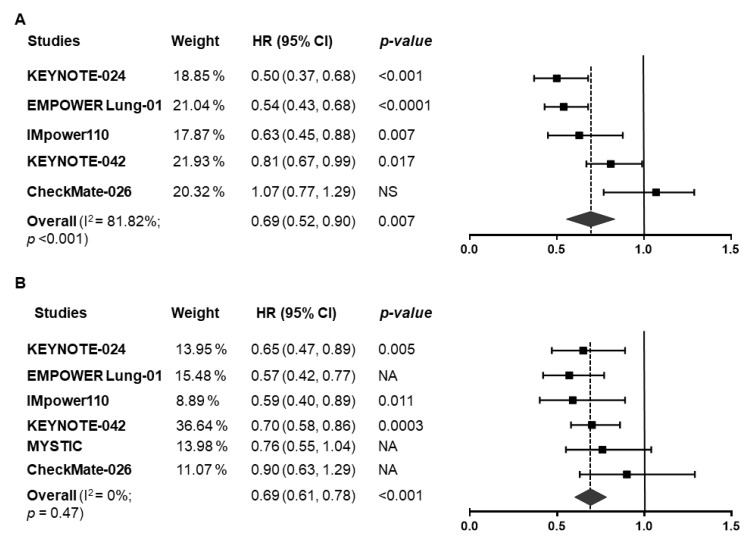
Programmed cell death-ligand 1 (PD-L1) has emerged as a potential biomarker for selection of patients more likely to respond to immunotherapy and as a prognostic factor in non-small cell lung cancer (NSCLC). In this network meta-analysis, we aimed to evaluate the efficacy of first-line anti-PD-(L)1 monotherapy in advanced NSCLC patients with high PD-L1 expression (≥50%) compared to platinum-based chemotherapy. We also evaluated efficacy outcomes according to tumor mutational burden (TMB). To that end, we conducted a systematic review. Six clinical trials with 2111 patients were included. In head-to-head comparisons, immunotherapy showed a significant improvement in progression-free survival (PFS: HR = 0.69, 95% CI: 0.52-0.90, = 0.007), overall survival (OS: HR = 0.69, 95% CI: 0.61-0.78; < 0.001) and overall response rate (ORR) (Risk ratio (RR) = 1.354, 95% CI: 1.04-1.762, = 0.024). In the assessment of relative efficacy for PFS through indirect comparisons, pembrolizumab (results from KEYNOTE-024) ranked highest followed by cemiplimab and atezolizumab, with statistical significance determined for some of the drugs. In terms of OS, cemiplimab ranked highest followed by atezolizumab and pembrolizumab, although non-significant OS was determined for these drugs. In conclusion, PD-(L)1 inhibitor monotherapy improves efficacy outcomes in the first line setting of advanced NSCLC patients with high PD-L1 expression. Evaluations with longer follow up are still needed to determine the superiority of any specific drug.
程序性细胞死亡配体1(PD-L1)已成为一种潜在的生物标志物,可用于选择更可能对免疫疗法产生反应的患者,并作为非小细胞肺癌(NSCLC)的预后因素。在这项网络荟萃分析中,我们旨在评估一线抗PD-(L)1单药疗法在高PD-L1表达(≥50%)的晚期NSCLC患者中相对于铂类化疗的疗效。我们还根据肿瘤突变负荷(TMB)评估了疗效结果。为此,我们进行了一项系统评价。纳入了6项涉及2111例患者的临床试验。在直接比较中,免疫疗法在无进展生存期(PFS:HR = 0.69,95%CI:0.52-0.90,P = 0.007)、总生存期(OS:HR = 0.69,95%CI:0.61-0.78;P < 0.001)和总缓解率(ORR)(风险比(RR) = 1.354,95%CI:1.04-1.762,P = 0.024)方面显示出显著改善。在通过间接比较评估PFS的相对疗效时,帕博利珠单抗(KEYNOTE-024的结果)排名最高,其次是西米普利单抗和阿特珠单抗,部分药物具有统计学意义。在OS方面,西米普利单抗排名最高,其次是阿特珠单抗和帕博利珠单抗,尽管这些药物的OS无统计学意义。总之,PD-(L)1抑制剂单药疗法可改善高PD-L1表达的晚期NSCLC患者一线治疗的疗效结果。仍需要更长时间随访的评估来确定任何特定药物的优越性。