Cole Peter A, Lezak Bradley A, Schroder Lisa K, Cole Peter A
Miami Herbert Business School, Coral Gables, FL, USA.
Miller School of Medicine, University of Miami, Miami, FL, USA.
J Clin Orthop Trauma. 2021 Jun;17:182-185. doi: 10.1016/j.jcot.2021.03.015. Epub 2021 Mar 26.
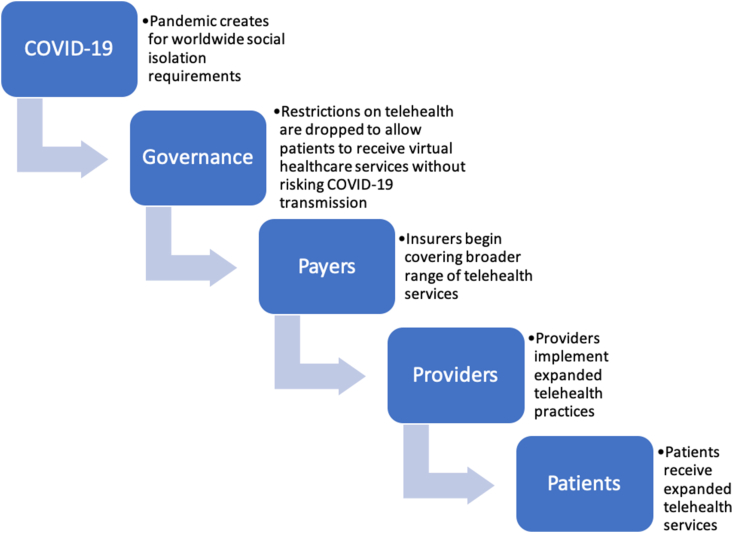
The Coronavirus (COVID-19) pandemic sparked rapid widespread adoption of telemedicine throughout specialties, including orthopaedics. A succession of factors, starting with payers, followed by provider adoption, and reciprocated by patient approval, created newly accepted telehealth practices that have moved from trial to norm in a short time span. Orthopaedic surgeons believe telehealth will endure as a permanent change to their practice beyond the COVID-19 era, however, many permanent changes must take place by payers, providers, and patients to sustain telehealth into the future. The goal of this paper is to highlight the indelibility of telemedicine adoption in orthopaedic practices globally, characterize the chain of events that led to its large-scale adoption, and catalyze discussion around actionable next steps to sustain its benefits.
冠状病毒(COVID-19)大流行促使包括骨科在内的各个专科迅速广泛采用远程医疗。一系列因素,从支付方开始,接着是医疗服务提供者的采用,再得到患者认可,创造了新的被接受的远程医疗实践,这些实践在短时间内从试验阶段转变为常态。骨科医生认为,远程医疗将作为COVID-19时代之后其医疗实践的永久性变革持续存在,然而,支付方、医疗服务提供者和患者必须做出许多永久性改变,才能使远程医疗在未来持续下去。本文的目的是强调远程医疗在全球骨科实践中采用的不可磨灭性,描述导致其大规模采用的一系列事件,并推动围绕可持续发挥其益处的可行后续步骤的讨论。